
Yunganastes ashkapara facts for kids
Quick facts for kids Yunganastes ashkapara |
|
|---|---|
| Conservation status | |
| Scientific classification | |
| Synonyms | |
|
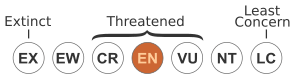
The Yunganastes ashkapara is a special kind of frog. It belongs to the family Strabomantidae. This frog lives only in Bolivia, which means it is endemic there. It has been found near the place where it was first discovered in Chapare Province (northern Cochabamba Department). It has also been seen in Abra de la Cruz in the Manuel María Caballero Province (western Santa Cruz Department). The frog's name, ashkapara, comes from the Quechuan words ashka meaning "a lot" and para meaning "rain". This name was chosen because the area where it was first found gets a lot of rain.
What Does the Yunganastes Ashkapara Look Like?
Scientists have measured two adult male Yunganastes ashkapara frogs. They were about 44 to 50 millimeters (about 1.7 to 2 inches) long from their snout (nose) to their vent (bottom). We don't know the size of the females yet.
The frog's head is a bit narrower than its body. Its snout is rounded. It has an oval-shaped eardrum, which is not very noticeable. There is a small fold of skin above the eardrum. The ridge between its eye and nostril is sharp.
This frog does not have webbing between its fingers or toes. However, its toes have small, weakly defined skin flaps on the sides. The tips of its outer fingers have expanded pads, which help it grip surfaces. The pads on its toes are almost as big as those on its fingers.
The skin on its back is rough. It also has two clear folds of skin running along its back. The frog's back is brown with some darker marks. It has a dark brown stripe from its nose to above its eardrum. Its upper lip has uneven brown spots. The belly is creamy white with some brown spots. Male frogs have a large vocal sac, which they use to make sounds.
The Frog's Special Call
Male Yunganastes ashkapara frogs make a unique sound to attract mates. Their call is a short, single note. It sounds like a "clack," almost like two hard wooden sticks hitting each other.
Where Does This Frog Live and How Is It Protected?
The Yunganastes ashkapara frog lives in tropical moist montane forests. These are forests found in mountainous areas that get a lot of rain. The forest where this frog was first found has many epiphytes. Epiphytes are plants that grow on other plants, like trees, but do not harm them.
One frog was found calling from a moss-covered branch about 2.5 meters (8 feet) above the ground. This was at an elevation of 2,100 meters (about 6,900 feet) above sea level. Other calls were heard from as high as 10 meters (33 feet) up in the tree canopy. Calls were also heard along a road at elevations between 1,800 and 2,150 meters (about 5,900 to 7,050 feet). Another frog was seen climbing a mossy rock wall next to a small stream at 2,360 meters (about 7,740 feet) high.
This frog species might be in danger because of habitat loss. This happens when forests are cut down for logging. Luckily, the main area where this frog lives, the Carrasco National Park, helps protect its home.
