
1948 Donora smog facts for kids
|
Pennsylvania Historical Marker
|
|
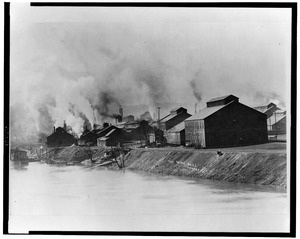
The wire mill, Donora 1910
|
|

 Location in Pennsylvania
|
|
| Coordinates | 40°10′34″N 79°51′20″W / 40.17624°N 79.85547°W |
|---|---|
| PHMC dedicated | October 28, 1995 |
The 1948 Donora smog, sometimes called the Donora death fog, was a terrible air pollution event in Donora, Pennsylvania. It started on October 27, 1948, and lasted for several days. This disaster happened because of harmful gases like hydrogen fluoride and sulfur dioxide released from two large factories: U.S. Steel's Donora Zinc Works and its American Steel & Wire plant. A special weather condition called a temperature inversion trapped these pollutants close to the ground. The smog caused serious breathing problems for about 6,000 of the 14,000 people living in Donora, a factory town near the Monongahela River. Sadly, 20 people passed away during the event. Today, the Donora Smog Museum helps us remember what happened and learn from it.
This event was later described as one of the worst air pollution disasters in the history of the United States. Even ten years after the smog, more people in Donora continued to experience health issues compared to nearby towns.
Contents
What Was the Donora Smog Disaster?
How the Smog Formed
Factories in Donora often released gases like hydrogen fluoride and sulfur dioxide into the air. But in 1948, something unusual happened. A "temperature inversion" occurred. This is when a layer of warm air gets stuck above a layer of cold air near the ground. It acts like a lid, trapping all the pollution. The harmful gases mixed with fog, creating a thick, yellowish, and smelly smog that stayed over Donora for five days. Gases like sulfuric acid, nitrogen dioxide, and fluorine usually spread out into the atmosphere. But during the inversion, they built up to dangerous levels until rain finally cleared the air.
The Smog's Impact on People
The thick fog began to form on Wednesday, October 27, 1948. By the next day, many residents in the Monongahela River valley started coughing and having trouble breathing. At first, many thought these illnesses were just asthma. The smog continued until it rained on Sunday, October 31. By then, 20 people in Donora had died, and about one-third to one-half of the town's 14,000 residents had become sick. In the month after the smog, another 50 residents passed away due to breathing problems.
Heroes Who Helped During the Smog
During the four days of intense smog, some people became true heroes. Chief John Volk of the Donora Fire Department and his assistant, Russell Davis, worked tirelessly. They responded to emergency calls from Friday night, October 29, until Sunday night, October 31. They used up all their oxygen supplies and had to borrow more from nearby towns like McKeesport, Monessen, and Charleroi. Chief Volk later shared that he didn't use any oxygen himself, but would have a small drink of whiskey when he returned to the station.
The eight doctors in Donora also made many house calls, just like the firefighters. The smog was so bad that driving was very dangerous. Russell Davis remembered, "I drove on the left side of the street with my head out the window. Steering by scraping the curb." It wasn't until Saturday, October 30, that Mrs. Cora Vernon of the American Red Cross helped set up an emergency center. All calls to doctors were then sent to this center in the town hall.
On Sunday morning, October 31, town officials finally met with the factory operators. The mayor, August Z. Chambon, asked the plants to stop working temporarily. The plant superintendent, L.J. Westhaver, said they had already started shutting down operations that morning. Once the rain cleared the smog, the factories started working normally again the next day.
Scientists later studied the event and believe that pollutants from the zinc plant were mainly to blame. The plant's emissions had harmed almost all plants within half a mile. Dr. Devra Davis, an expert in environmental health, found that victims had very high levels of fluorine in their bodies, up to 20 times more than normal. Fluorine gas, created during the zinc smelting process, was trapped by the still air and was a major cause of the deaths.
After the Smog: Changes and Lessons Learned
A study in December 1948 suggested that many more Donora residents could have died if the smog had lasted longer.
Lawsuits were filed against U.S. Steel, the company that owned the factories. The company never admitted it was responsible, calling the event "an act of God." However, in 1951, U.S. Steel paid about $235,000 to settle the lawsuits. This money was divided among 80 victims, leaving them with little after legal costs. The company argued that the smog was caused by unusual weather that trapped all kinds of pollution, not just from their plants. Both U.S. Steel plants in Donora closed by 1966.
By 1949, just one year after the disaster, the value of homes in Donora had dropped by almost 10%.
The Donora Smog helped people in America realize that breathing in a lot of pollution in a short time could be very dangerous and even deadly. This event is often seen as a key moment that started the clean-air movement in the United States. This movement led to the important Clean Air Act of 1963. This law required the United States Environmental Protection Agency to create and enforce rules to protect everyone from harmful air pollution.
For many years, people in Donora didn't talk much about the smog. But in 1998, a historical marker was placed in the town to remember the 50th anniversary. In 2008, for the 60th anniversary, there were memorials and educational programs. The Donora Smog Museum opened on October 20, 2008, with the motto "Clean Air Started Here." Today, fewer than 6,000 people live in Donora.

How the Donora Smog Influenced the World
The Donora event led to the first major scientific study in the United States about how environmental disasters affect people's health.
A famous writer named Berton Roueché wrote about the smog in The New Yorker magazine in 1950. His article, called "The Fog," won an award for medical journalism. It was later included in his book of short stories, Eleven Blue Men.
Devra Davis's 2002 book, When Smoke Ran Like Water, begins with the story of the Donora Smog.
In 2009, Joel Pierson's novel Don't Kill the Messenger featured a fictional town that became a ghost town after a smog incident, inspired by Donora.
More recently, in 2023, Andy McPhee's book, Donora Death Fog: Clean Air and the Tragedy of a Pennsylvania Mill Town, was published.
A documentary called Rumor of Blue Sky was shown on WQED TV in April 2009. It included old photos and interviews with people who lived through the smog.
The Donora smog was even mentioned in the Netflix TV series The Crown in 2016. It was used to show a similar event that happened in London in 1952, known as the Great Smog of London.
The Weather Channel also featured the Donora smog in episodes of its shows When Weather Changed History and Weather That Changed The World.
In 2024, a podcast called "Cement City" discussed the smog incident in its first episode.
In 1995, the Pennsylvania Historical and Museum Commission placed a historical marker in Donora to highlight the importance of this event in history.
See also
- 1930 Meuse Valley fog
- 1939 St. Louis smog
- 2013 Eastern China smog
- 2024 Indo-Pakistani smog
- Great Smog of London
- Pea soup fog
