
Age of the universe facts for kids
| Physical cosmology | ||||||||||||||
 |
||||||||||||||
| Universe · Big Bang Age of the universe Timeline of the Big Bang Ultimate fate of the universe
|
||||||||||||||
The age of the universe is how long the universe has existed since the Big Bang. Scientists study physical cosmology to understand how everything began. By measuring light and space, astronomers estimate that the universe is about 13.8 billion years old. This means it has taken nearly 14 billion years of cosmological time for the observable universe to grow into what we see today.
How Scientists Measure Cosmic Time

Astronomers have two main ways to figure out the universe's age. First, they can look at how fast space is stretching. In 1929, Edwin Hubble discovered that each distant galaxy is moving away from us. He noticed a red shift in the light from stars, which happens because of the Doppler effect.
When scientists know this expansion speed, called the Hubble constant, they can imagine running time backward. This calculation shows when all matter was packed together. Space missions like NASA's WMAP and the European Planck probe gathered data about this expansion. They measured ancient radiation from space called the cosmic microwave background.
Checking the Oldest Stars

The universe must be older than anything inside it. To test their calculations, astronomers search for the oldest observed stars.
- They check dim white dwarf stars, which cool down very slowly over billions of years.
- They examine old globular clusters containing ancient stars.
- They study ancient stars like the Methuselah star and BD +17°3248.
These stars are over 13 billion years old. Because these stellar ages match the space probe data, scientists feel confident about their results.
Images for kids
-
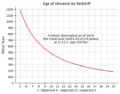
Graph showing how redshift connects to cosmic time.
-
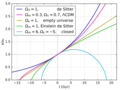
Different models comparing cosmic expansion over time.


See also
 In Spanish: Edad del universo para niños
- Age of Earth
- Cosmic Calendar
- Hubble's law
- James Webb Space Telescope
