
Arachne facts for kids
Quick facts for kids Arachne |
|
|---|---|
.jpg)
Minerva and Arachne, by René-Antoine Houasse, 1706.
|
|
| Abode | Lydia or Attica |
| Personal information | |
| Children | Closter |
| Parents |
|
| Siblings | Phalanx (brother) |
Arachne (pronounced Ah-RAK-nee) is a famous character from ancient Greek and Roman myths. Her name comes from a Greek word meaning "spider." She is known from a story told by the Roman poet Ovid, who lived a long time ago. In his poem Metamorphoses, Ovid tells how Arachne, a very talented weaver, challenged the goddess Minerva to a weaving contest. When Minerva couldn't find any mistakes in Arachne's beautiful tapestry, she became very angry. After a sad event, Arachne was transformed into a spider. This myth helps explain why spiders spin webs and also teaches a lesson about being too proud.
Contents
Biography
Arachne was a young woman from a region called Lydia in ancient Asia Minor. Her father, Idmon, was a well-known cloth dyer. People believed that Arachne was the first to create linen cloth and nets. Her son, Closter, is said to have helped develop the use of the spindle, a tool for making wool thread.
Mythology
The Story of Arachne and Minerva

The Roman poet Ovid wrote the most famous version of Arachne's story. He described Arachne as the daughter of a shepherd who started weaving at a very young age. She became incredibly skilled at weaving and often boasted that her talent was even greater than the goddess Minerva's. Arachne didn't want to admit that some of her amazing skill might have come from the goddess herself.
Minerva, who was the goddess of wisdom and crafts, felt offended by Arachne's pride. She decided to visit Arachne, disguised as an old woman. The goddess warned Arachne that it was not wise to compare herself to the gods. She suggested Arachne ask Minerva for forgiveness.
Arachne was not scared and boldly said that if Minerva wanted her to stop, the goddess should appear in person. Immediately, Minerva removed her disguise. She appeared in all her shining glory, wearing a bright white robe. The two then began their weaving contest right away.
The Weaving Contest
Minerva wove a tapestry that showed four different stories. In these stories, gods punished people who had dared to think they were as powerful or skilled as the gods. For example, she showed Hera and Zeus turning a queen and king into mountains. She also depicted Hera changing Queen Gerana into a crane for boasting about her beauty. Another scene showed Hera turning Antigone into a stork for competing with her. Finally, Minerva included a story about a king's daughter being turned to stone. These tales surrounded a central scene of Minerva and Poseidon's contest over who would be the patron of Athens. Minerva offered an olive tree, and Poseidon offered a saltwater spring. The people of Athens chose Minerva. The edges of Minerva's tapestry were decorated with olive wreaths.
Arachne, however, chose to weave different kinds of stories. Her tapestry showed how some male gods had used disguises to trick people. For instance, she depicted Zeus appearing as a bull for Europa, an eagle for Asteria, a swan for Leda, a satyr for Antiope, or even as another person like Amphitryon for Alcmene. He also appeared as a golden shower for Danaë, a flame for Aegina, a shepherd for Mnemosyne, and a snake for Persephone. Poseidon took the form of a bull for Canace, a person named Enipeus for Iphimedeia, a ram for Theophane, a horse for Demeter, a bird for Medusa, and a dolphin for Melantho. Apollo appeared as a shepherd for Issa, a countryman, a hawk, and a lion. Dionysus appeared as 'tricky grapes' for Erigone, and Cronus appeared as a horse for Philyra. The outer edge of Arachne's tapestry had beautiful flowers mixed with ivy.
The Transformation
When Minerva saw Arachne's tapestry, she was furious. Not only had Arachne insulted the gods, but her artwork was also incredibly beautiful, perhaps even more so than Minerva's own. In her rage, Minerva tore Arachne's weaving to pieces and hit her on the head three times with her weaving shuttle.
Arachne was deeply shaken and embarrassed by this. Out of deep shame and sadness, Arachne felt she couldn't go on. Seeing this, Minerva felt a moment of pity for the girl. The goddess then transformed Arachne into a spider. Minerva did this by sprinkling her with a special herb.
The myth describes the transformation:
Arachne's hair fell out. Her nose and ears disappeared, her head became tiny, and her whole body shrank. Her slender fingers became legs, and the rest of her body became a small belly. From this belly, she still spins a thread, and, as a spider, weaves her ancient web.
This story explains why spiders spin webs and how they got their eight legs.
Other Ancient Stories
Some ancient artworks might show parts of the Arachne myth. An old Greek pot from around 580-560 BC might show Athena and Arachne weaving. However, experts are not completely sure if this pot truly tells their story.
The Roman poet Virgil, who lived before Ovid, mentioned that Minerva disliked spiders, but he didn't explain why. Later, a writer named Lucian wrote that Arachne thought she was as good as Athena, lost her human form, and still spins webs today. Pliny the Elder wrote that Arachne's son, Closter, helped invent the spindle for making wool. Other ancient writers also told the story, sometimes saying Arachne was defeated in the contest.
In another version of the myth, Arachne and her brother Phalanx were both taught by Athena. However, they angered the goddess, and she transformed them into spiders.
A writer named Aelian once said that spiders don't need or want Athena's weaving skills because they don't wear clothes. But in another work, he said spiders are 'skillful weavers, just like Athena'.
Influence of the Myth

The story of Arachne's transformation has inspired many artists and writers throughout history.
The English poet Edmund Spenser included an episode about Arachne in his long poem called Muiopotmos. Spenser retold Ovid's story in a way that fit his own time. His version helps explain why a spider character, Aragnoll, disliked a butterfly hero, Clarion.
Dante Alighieri mentioned Arachne in his famous poem, The Divine Comedy. He used her weaving skill to describe a monster named Geryon, saying its patterns were as complex as Arachne's webs.
One of the most famous paintings inspired by this myth is The Spinners by the Spanish artist Diego Velázquez. This painting shows two key parts of the myth. In the foreground, you can see Arachne and Minerva (disguised as an old woman) in their weaving contest. In the background, there's a copy of a painting showing Europa. Minerva appears in front of it, punishing Arachne. This artwork makes people think about how art is made, the relationship between gods and humans, and how students learn from masters.
It's also thought that a 19th-century story called The Black Spider by Jeremias Gotthelf was influenced by the Arachne myth. In this story, a woman becomes a poisonous spider after breaking a promise.
Images for kids
-
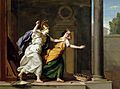
Minerva and Arachne, by René-Antoine Houasse, 1706.
-
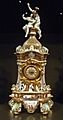
Pendule with Arachne and Athena in Meissen porcelain, attributed to Johann Gottlieb Kirchner and George Fritzsche (1727)
-
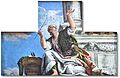
Paolo Veronese - Dialettica - Palazzo Ducale


See also
 In Spanish: Aracne para niños
- Cultural depictions of spiders
- Marsyas, a satyr who challenged Apollo to a music contest and also faced punishment
- Medusa, who was also transformed as a result of Athena's anger in some stories
- Alcinoë of Corinth, another woman punished by Athena over a textile-related matter
- 407 Arachne, an asteroid named after Arachne
