
Poseidon facts for kids
Quick facts for kids Poseidon |
|
|---|---|
| God of the sea, storms, earthquakes, horses | |

Poseidon from Milos, 2nd century BC (National Archaeological Museum of Athens)
|
|
| Abode | Mount Olympus, or the Sea |
| Symbol | Trident, fish, dolphin, horse, bull |
| Personal information | |
| Consort | Amphitrite, Aphrodite, Demeter, various others |
| Children | Theseus Triton Polyphemus Orion Belus Agenor Neleus Atlas (the first king of Atlantis) Pegasus Chrysaor |
| Parents | Cronus and Rhea |
| Siblings | Hades, Demeter, Hestia, Hera, Zeus, Chiron |
| Roman equivalent | Neptune |
In Greek mythology, Poseidon was a powerful god. He was known as the god of the sea, earthquakes, and horses. He was one of the Twelve Olympians, the most important gods who lived on Mount Olympus.
Poseidon was the brother of Zeus, the king of the gods, and Hades, the god of the underworld. He was also brother to Hestia, Demeter, and Hera. Many people believed he was the second most powerful god after Zeus.
After his father, Cronus, was overthrown, the world was split among Cronus' three sons. Zeus was given the sky, Hades got the underworld, and Poseidon became the ruler of the sea. The Earth and Mount Olympus belonged to all three of them.
Contents
Poseidon in Mythology
In some myths, Poseidon was swallowed by his father, Cronus, when he was a baby. Later, his brother Zeus tricked Cronus into spitting out all his siblings.
Other stories say that Poseidon's mother, Rhea, saved him. She tricked Cronus by giving him a small horse wrapped in a blanket to swallow instead of baby Poseidon.
The Founding of Athens

The city of Athens chose Athena as its patron goddess after a contest with Poseidon. Both gods offered a gift to the Athenians, and the people would choose which gift they liked best.
Poseidon struck the ground with his trident, and a spring of water appeared. However, the water was salty and not very useful. Athena, on the other hand, offered them an olive tree.
The Athenians, or their king Cecrops, chose the olive tree. It was a very useful gift because it provided wood, oil, and food. Because they chose Athena, she became their patron goddess. Poseidon was very angry about losing. To punish the Athenians, he sent a huge flood to the Attic Plain.
Poseidon's Symbols

Gods in ancient myths often had special items or animals that represented them. For Poseidon, these symbols were:
- The Trident: This is Poseidon's most famous symbol. It's a three-pronged spear, like a giant fork. With a strike of his trident, Poseidon could create powerful waves, cause earthquakes, or even make fresh springs burst forth from the ground! It showed his immense power over both water and land.
- Horses: Poseidon had a very special connection to horses. He was often called the "Tamer of Horses" and was believed to have created the very first horse by striking a rock with his trident. He was sometimes shown riding a chariot pulled by magnificent horses that could gallop across the waves. The famous winged horse, Pegasus, is also said to be his son.
- Dolphins: These intelligent and playful sea creatures were also associated with Poseidon. They were seen as his companions and sometimes helped him in his adventures.
- Bulls: In some ancient cities, especially in a region called Ionia, the bull was also a symbol of Poseidon. People would sometimes offer bulls as sacrifices to him during festivals.
Poseidon's Powers and Abilities
Poseidon was a god of many talents, with powers that could shape the world:
- Lord of the Sea and Storms: This was his primary role. Poseidon could command the ocean, creating calm waters for safe voyages or stirring up terrifying storms with huge waves and strong winds. Sailors would pray to him for protection and a smooth journey. He was often called "Savior" because he could rescue those in danger at sea.
- The Earth-Shaker: One of Poseidon's most ancient and powerful titles was "Earth-Shaker." The ancient Greeks believed that when Poseidon struck the ground with his trident, it caused earthquakes. He was also seen as the god who held the Earth steady, protecting its foundations. So, while he could cause quakes, he could also protect against them!
- Creator of Springs: With a mighty strike of his trident, Poseidon could make fresh water springs appear from the ground. Many famous springs in ancient Greece were believed to have been created by him. This power was closely linked to his association with horses, as horses were also thought to be able to create springs by striking the ground with their hooves.
- Tamer and Father of Horses: Poseidon was believed to have taught humans how to tame horses, making them useful for riding and pulling chariots. He was the father of many famous horses in mythology, including the swift Arion and the winged Pegasus.
- Creator of Islands: In his kinder moments, Poseidon was said to create new islands, bringing new land out of the sea.
- Connection to Vegetation: Surprisingly for a sea god, Poseidon was also sometimes associated with plants and growing things, especially in festivals related to harvests and wine.
Worship and Importance
Poseidon was a very important god in many ancient cities. In Athens, he was almost as important as the goddess Athena. In Corinth and other cities in Magna Graecia (Greek colonies in Italy), he was the main god.
People believed Poseidon could create new islands and make the seas calm for sailors. But if he was angry, he would strike the ground with his trident. This was thought to cause earthquakes, dangerous springs, drownings, and shipwrecks. Because of this, he was often called the "Earth Shaker." Sailors would pray to Poseidon for safe journeys across the water.
Today, some people still worship Poseidon and other Greek gods in modern Hellenic religion. The Greek government has recognized the worship of Greek gods since 2017.
Family and Children

Poseidon was married to Amphitrite, a sea goddess. They had a son named Triton, who was a merman.
Poseidon was also the father of many heroes. One of his most famous sons was Theseus, a great hero in Greek myths.
A mortal woman named Cleito lived on an isolated island. Poseidon fell in love with her and built a special home for her on a hill. He surrounded it with rings of water and land to protect her. Cleito gave birth to five sets of twin boys. The oldest twin, Atlas, became the first ruler of Atlantis.
Not all of Poseidon's children were human. His other children included Polyphemus, a one-eyed Cyclops, and the giants Alebion and Bergion, and Otos and Ephialtae.
Poseidon was once interested in Medusa, who was a beautiful woman. When Athena found them in her temple, she became very angry. Athena punished Medusa by turning her into a Gorgon, a terrible monster with snakes for hair. Medusa's stare could turn people into stone. Her two sisters were also punished, but they were not as powerful as Medusa.
In Literature and Art
In Greek art, Poseidon is often shown riding a chariot. This chariot was pulled by a hippocampus (a creature that was half horse and half fish) or by horses that could run on the sea. He was also linked with dolphins and his special three-pronged fish spear called a trident. Stories say he lived in a beautiful palace on the ocean floor, made of coral and sparkling gems.
Related pages
- Neptune – The Roman mythology version of Poseidon
Images for kids
-
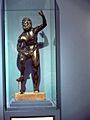
Poseidon, Paella Museum
-
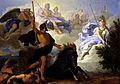
The Dispute of Minerva and Neptune by René-Antoine Houasse (circa 1689 or 1706)
-
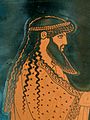
Poseidon on an Attic kalyx krater (detail), first half of the 5th century BC.
-
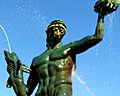
Poseidon statue in Gothenburg, Sweden.
-
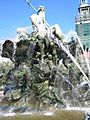
The Neptunbrunnen fountain in Berlin
-
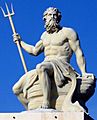
Poseidon sculpture in Copenhagen, Denmark


See also
 In Spanish: Poseidón para niños
