
Great shearwater facts for kids
Quick facts for kids Great shearwater |
|
|---|---|
 |
|
| Conservation status | |
Scientific classification  |
|
| Kingdom: | Animalia |
| Phylum: | Chordata |
| Class: | Aves |
| Order: | Procellariiformes |
| Family: | Procellariidae |
| Genus: | Ardenna |
| Species: |
A. gravis
|
| Binomial name | |
| Ardenna gravis (O'Reilly, 1818)
|
|
 |
|
| Script error: The function "autoWithCaption" does not exist. | |
| Synonyms | |
|
|

Script error: No such module "Check for conflicting parameters".
The great shearwater (Ardenna gravis) is a large seabird that belongs to the shearwater family. Its scientific name, Ardenna gravis, has an interesting history. Ardenna was first used in 1603 by an Italian naturalist to describe a seabird. The word gravis is Latin for "heavy."
Contents
About the Great Shearwater
The great shearwater is a fascinating bird. It is part of a group of large shearwaters. These birds are known for their unique flight style. They glide close to the ocean surface.
Where They Live and Breed
These birds breed on several islands in the South Atlantic Ocean. These islands include Nightingale Island, Inaccessible Island, Tristan da Cunha, and Gough Island. They nest in large groups, called colonies.
They lay one white egg in a small burrow. Sometimes, they lay their egg in open grass. The parents visit their nests only at night. This helps them avoid large gulls that might try to eat their eggs or chicks.
Amazing Migration Journey
The great shearwater is special because it migrates from the Southern Hemisphere to the Northern Hemisphere. Most birds migrate the other way around. This bird travels in a huge circle across the Atlantic Ocean.
They fly north along the eastern coast of South America. Then, they continue up the coast of North America. In August, they cross the Atlantic Ocean. You can often see them off the coasts of Great Britain and Ireland. After that, they head back south along the eastern side of the Atlantic.
How They Look and Fly
This shearwater is about 43 to 51 centimeters (17 to 20 inches) long. Its wingspan can reach 105 to 122 centimeters (3.5 to 4 feet). It has dark feathers on its back and white feathers on its belly. It also has a brown patch on its belly and dark markings on its shoulders.

The bird has a black cap on its head and a black bill. A white "horseshoe" shape can be seen at the base of its tail. Its flight is strong and direct. It glides from side to side on stiff wings. The wingtips often almost touch the water. This unique way of flying is called "shearing."
What They Eat and How They Behave
Great shearwaters eat fish and squid. They catch their food from the surface of the water. Sometimes, they dive into the water to catch prey. They often follow fishing boats to find food. When they are around boats, they can be quite noisy.
These birds like to be in groups. You can see many of them together from ships or high cliffs. They make a loud, piercing "eeyah" cry. They usually make this sound when they are resting in groups on the water.
Images for kids
-
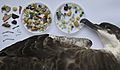
Great shearwater with plastic fragments found in its stomach

See also
 In Spanish: Pardela capirotada para niños
