
Army of the Mughal Empire facts for kids
Quick facts for kids Mughal Army |
|
|---|---|
| ارتش مغول | |

Flag of the Mughal Empire
|
|

Arrival of an imperial procession of the emperor Farrukh Siyar at Delhi's "world-revealing" mosque on a Friday, to hear the sermon (khutba) recited in his name
|
|
| Founded | c. 1556 |
| Disbanded | c. 1806 |
| Headquarters | Exalted camp / Victorious camp |
| Leadership | |
| Former Military | Timurid Army |
| Padishah (Great Emperor) |
Mughal Emperor |
| Grand-Vizier | Mughal Vazere'azam |
| Personnel | |
| Military age | 15-25 years |
| Expenditure | |
| Budget | 12,071,876,840 dams |
Script error: No such module "Check for conflicting parameters".
The Mughal Army was the powerful military force that helped the Mughal emperors build and expand their vast Mughal Empire in India. This army started with cavalry (soldiers on horseback) from Central Asia. Its main structure was set up by the third emperor, Akbar. Officers called Mansabdars were in charge of recruiting and leading most of the soldiers.
During the 1600s, the Mughal Army grew to be one of the largest in the world. It had millions of foot soldiers and hundreds of thousands of cavalry. Historians have compared its strength and ability to project power to the Roman army. The Mughals were also very good at moving their army and supplies.
The Mughal Army was known for its excellent cavalry, especially its skilled horsemen and powerful charges. They imported strong horses from places like Arabia and Central Asia. They also adopted new weapons like heavy cannons, light artillery, grenades, and rockets. This made them a "gunpowder empire."
The Mughals even had a navy called the Amla-e-Nawara. This fleet had many ships and helped control rivers and coastal areas, especially around Dhaka.
Contents
History of the Mughal Army
The Mughal Army played a key role in many important battles. These battles helped the Mughal emperors establish and maintain their control over a large part of India. You can learn more about these events in the List of battles involving the Mughal Empire.
How the Army Was Organized
The Mughal Army had a clear structure to manage its large number of soldiers. The emperor had his own personal army of about 24,000 soldiers. These special cavalry troopers were known as Ahadis. Another group of imperial bodyguards, called Walashahis, were very trusted. They had served the emperor since he was a prince.
The main Mughal Army was divided into four branches:
- Cavalry (Aswaran): Soldiers on horseback.
- Infantry (Perigean): Foot soldiers.
- Artillery (Topkhana): Handled cannons and other big weapons.
- Navy: Managed ships and water-based operations.
These branches were usually part of larger units led by Mansabdars. The artillery, however, had its own special commander.
Mansabdars: Army Leaders

Officers called Mansabdars led most of the Mughal armed forces. They were government officials responsible for finding and maintaining their own groups of horsemen. A Mansabdar's rank depended on how many horsemen they could provide. Ranks ranged from 10 (the lowest) up to 5,000. Princes could command as many as 25,000 horsemen. Their salaries were based on these ranks.
Mansabdars reported to the Mir Bakshi, who was the head of military and intelligence. They also often served as Subahdars, or provincial governors. In these roles, they maintained law and order and enforced imperial rules.
Bakhshi Officers: Managing the Military
Bakhshi officers managed the army's payments and administration in different provinces. A provincial bakhshi often also wrote news reports, keeping the central government informed about local mansabdars. This helped ensure that officials were accountable to the emperor.
The Mir Bakhshi was the chief Bakhshi in the central government. This role was very important, as it oversaw all nobles in the Mughal Empire.
Imperial Camps and Fortresses

The Mughal emperors often traveled with a huge mobile city called "The exalted camp" or "The victorious camp." This camp served as a moving capital and army headquarters. It included hundreds of thousands of people, along with 50,000 horses and oxen to carry tents and equipment.
These camps were like moving cities, with administration and governance happening inside them. Emperor Akbar's camps could hold up to 300,000 people. They moved about 6-16 kilometers each day. Scouts and workers went ahead to prepare roads, bridges, and campsites. They also bought food and fuel.
The Mughals also built strong, permanent military fortresses. Examples include Lalbagh Fort, Allahabad Fort, and Red Fort. These forts helped protect their empire.
Army Size and Manpower
Around the 1600s, the Mughal Empire was one of the wealthiest in the world. It had a military of millions of regular soldiers. Some historians estimate the army had about 4.4 million people. Others suggest the total number of military personnel, including local helpers, could have reached 26 million.
In 1647, during Shah Jahan's rule, the army included about 911,400 infantry and cavalry. It also had 47,000 mounted musketeers, foot musketeers, gunners, and archers. Emperor Akbar's army was known to include soldiers from many different backgrounds, such as Persians, Turkmens, Uzbeks, and Rajputs.
Logistics: Moving the Army
The Mughal military had a very advanced system for moving its massive army and supplies. This system was so good that historians have compared it to the Roman army or the British Army during the Victorian Era.
The army included many support staff, like animal trainers, security forces, spies, chefs, and artisans. This allowed the army to operate effectively in any season or terrain. They also had a system to provide credit and supplies from local markets to their large camps.
Logistics were also important for the navy. Army units cleared jungles and built roads and canals near coastal areas. This helped naval units move forward, especially during operations in places like Assam and Chittagong. Rivers and waterways were crucial for transporting heavy artillery.
Arms and Weapons

The main centers for making military equipment were Delhi and Lahore. Workshops called Karkhanas produced weapons, ammunition, and horse harnesses using iron, copper, and other metals.
The most common weapons were the sword, spear, and bow and arrow. The Firangi sword was a straight sword, similar to European styles. It was a symbol of power. Rajput Shamserbaz infantry used halberds and maces. Some also fought with swords and shields.
-
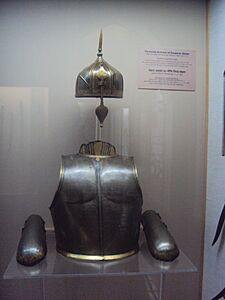
Personal body armor of Emperor Akbar
-
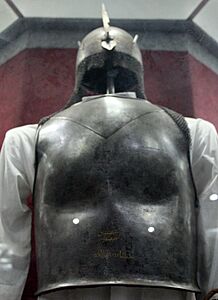
Personal body armor of Emperor Aurangzeb
-
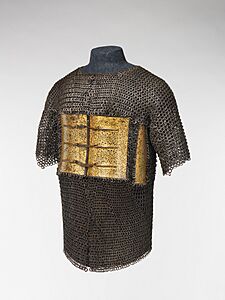
Personal body armor of Emperor Shah Jahan
-
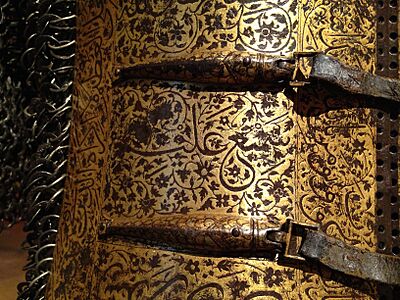
Inscription detail of a Mughal armor
-
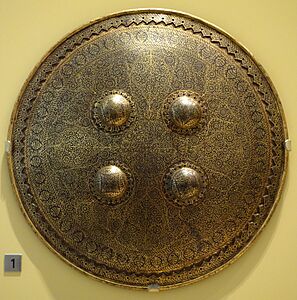
Dhal (shield) from Northern India during the Mughal era
-
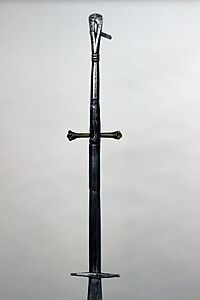
Indian Two-Handed Sword from the Metropolitan Museum of Art


,_North_India,_Mughal_period,_17th_century,_steel,_gold,_silk,_leather_-_Royal_Ontario_Museum_-_DSC04543.JPG)

The Mughals quickly adopted muskets after the Portuguese brought firearms to India in 1498. Indian armorers copied these weapons and made their own versions called Toradar matchlocks.
Cavalry troopers wore heavy armor, often made of chain mail. They were skilled mounted archers. Mughal armor was lighter than European armor due to the hot climate.
Cavalry: Horsemen and War Animals

Cavalry archery was a key part of the Mughal army from the time of Babur. The army relied heavily on animals like war elephants, warhorses, and bulls to transport artillery and other supplies.
Historians note that Mughal cavalry was very effective in battles. They were known for their discipline and powerful charges.
Warhorses

Horses often wore armor called Bargustawan mail and plate armor. This armor protected their heads, necks, and bodies.
The Mughal Empire's power greatly depended on its use of warhorses. They controlled the supply of excellent warhorses, mostly imported from Central Asia. About 75 percent of their warhorses were imported. These strong horses helped the Mughals win many battles.
Cavalrymen were usually from high social classes and were paid well. They had to own at least two of their own horses and good equipment. They were skilled in using bows and arrows, maces, lances, sabres, and swords. Their armor was made of steel, leather, or chainmail.
The Mughals had strict quality control for their horses. They used an imperial mark called Dagh to brand horses that met their standards. Well-bred horses came from Arabia, Iran, Central Asia, or were bred in regions like Sindh and Rajasthan. Emperors encouraged horse trade by reducing taxes.
The most prized warhorse breeds were:
- Iraqi Arabian breeds, considered the best.
- Arabian-Persian mixed breeds, known for endurance and speed.
- Turkish breeds, valued for strength and stamina on long marches.
Mughal cavalry also trained in special maneuvers to attack enemy war elephants. They could make their horses stand on their hind legs and jump forward. Mughal cavalry archers were very effective, able to shoot many arrows quickly while riding.
War Elephants


Mughal army commanders often led their troops from atop an elephant. This high position gave them a good view to give orders. Elephants were also used to carry heavy goods and siege cannons. Male elephants were trained to fight, while females carried baggage.
Emperor Akbar was a big supporter of using elephants in warfare. He kept thousands of elephants in his fil-khana (elephant house). The Mughals used elephants more than earlier rulers in India.
War elephants wore heavy armor called Bargustawan-i-pil, which could weigh over 100 kg. This armor mostly protected their heads and trunks. Elephants ridden by high-ranking figures often had full body armor. These war elephants served as powerful shock troops on the front lines.
Elephants were very important in South Asian culture, seen as symbols of power and respect. The Mughals adopted this tradition. One well-trained elephant was considered as valuable as 500 horses.
Camel Units

Some mansabdars used camel cavalry. Special camel units called Zamburaks carried small swivel guns on their backs. These camel-mounted guns were very mobile and could be fired from the camels. Emperor Aurangzeb reportedly took hundreds of camel-guns on his expeditions.
Akbar also had a large camel corps, with thousands of camel riders. He employed skilled camel trainers from different ethnic groups.
Infantry: Foot Soldiers

Infantry soldiers were recruited by Mansabdars or directly by the emperor. The emperor's infantry was called Ahsam. These soldiers were often not well-paid or equipped. They used swords, shields, lances, clubs, pistols, rifles, and muskets. They usually did not wear armor.
The Mughal army used wagons chained together in front of their infantry. These "wagon forts" protected the slow-loading musketeers and heavy cavalry behind them.
Musketeers
Musket infantry, called Banduqchis, were generally more effective than archer units. They made up the majority of the infantry.
Musketeers could stop enemy elephant charges and cavalry attacks, especially when working with cavalry and artillery. They were also useful for putting down local rebellions. These musketeers were mainly Hindus from various castes who were skilled marksmen.
Heavy Infantry

The main infantry included specialized units like the Shamsherbaz (sword-wielders or gladiators). These were elite heavy infantry companies of skilled swordsmen. Some served as palace guards or performed in exhibitions. Tens of thousands were assigned to army units.
Shamsherbaz were often used in siege warfare. They would deal with any resistance once walls were breached. They were divided into classes:
- Yak-hath: Carried a single-handed weapon and a shield.
- Banaits: Carried a curved longsword called Bankulis.
Many Shamsherbaz were recruited from religious groups or Rajput tribesmen.
Archers
Infantry archers were called dākhilī. They were placed under the command of manṣabdār officers. They usually earned a salary of about 100-120 dāms. A captain of 10 archers was called a Mīr-dah officer.
During Akbar's later years, there were about three archers for every musketeer. Archer units played a similar role to musketeer units in battle.
Loyal Retainers
Some commanders had special groups of loyal troops called Chela. These individuals were often brought into service when they were young. Their masters provided them with food, clothing, and housing. They were trained from a young age and became very dependable members of the army. Unlike regular soldiers, Chela were deeply loyal to their commanders. They often served as foot soldiers or in other support roles.
Female Palace Guards: Urdubegis
Urdubegis were women assigned to protect the emperor and the royal women in the zenana (harem). The women's living quarters were run entirely by women. Emperor Akbar's zenana had over 5,000 noble women and servants.
These women guards were often from Habshi, Tatar, Turk, and Kashmiri backgrounds. They were skilled in using lances and bows. Emperors spent a lot of time in the zenana, so these guards were a vital part of the emperor's protection. They accompanied the royal women during travels and guarded the palace areas where male soldiers were not allowed.
Artillery: Cannons and Rockets
-
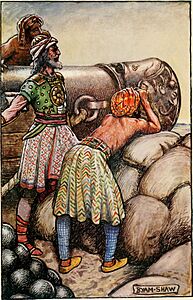
A depiction of Mughal artillery during Akbar's reign.
-
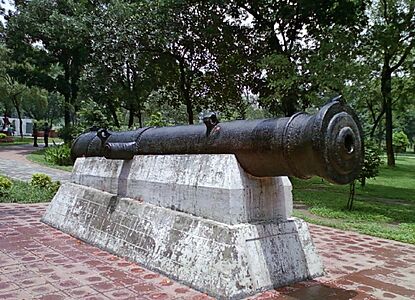
A Mughal-era Cannon.


The Mughal army had powerful artillery, including various types of cannons, light artillery, and grenadier units. The artillery was a specialized group with its own commander, the Mir-i-Atish. This commander was very influential, as he was in charge of defending the Imperial Palace Fort and had direct contact with the emperor.
Light artillery was very useful in battles. These cannons were often made of bronze and pulled by horses. This included the camel-mounted swivel guns called zamburaks.
One of the largest cannons used by the Mughals was a gigantic mortar designed by a Persian engineer. It could fire a cannonball weighing over 3,000 pounds. The Mughals also used rocket weapons. Emperor Akbar reportedly used metal cylinder rockets called bans against enemy war elephants. They also used hand grenades and rocket artillery.

The Mughals also maintained a significant navy, known as the Amla-e-Nawara. In Dhaka alone, the fleet had 768 ships. The navy's main job was to control piracy, but it was also used in wars. Bengali shipbuilders were known for their skill, which even influenced British shipbuilding later on.
Mughal Ships
The typical warships in the Bengal regions were Ghurab warships, which had 14 guns and 50 to 60 crew members. Mughal warships were known for their strength and size, thanks to Bengali shipbuilders. Some ships were as large as English frigates and carried 30 to 40 cannons.
The Mughals also operated huge imperial ships, such as the Rahīmī, which weighed 1,500 tons. Another famous large ship was the Ganj-i-Sawai, which had 800 guns and weighed 1,600 tons.
During the late 1500s, the Mughals faced challenges in Bengal due to the rainy climate and many rivers. Their opponents were local warlords with many warships. The Mughals built river forts and used rafts to fight on water.
Emperor Akbar established the salt-water naval force in the late 1500s after conquering Bengal and Gujarat. He reorganized the navy to maintain transport and combat vessels, protect trade, and enforce tolls. In the early 1600s, the Mughals employed local Bengali warriors for their navy.
The Mughal Empire's navy also worked with the Ottoman Empire to fight against Portuguese control in the Indian Ocean during the 1500s. Mughal ports like Surat provided important support to Ottoman fleets.
In 1665, Mughal commander Abul Hussain attacked Sandwip Island to remove a pirate ruler. This victory helped secure a base for future operations in Chittagong. In 1666, Emperor Aurangzeb sent Shaista Khan to capture Chittagong and stop pirate activities. This conflict involved over 500 ships and was one of the largest galley battles of the time.

The Mughal navy, especially with its allies like the Janjira mariners, often clashed with the Maratha Navy. They achieved victories in many naval battles. However, the Mughals struggled to build a strong high-seas navy due to various reasons, including technological limitations and other military priorities.
Despite these challenges, Aurangzeb did strengthen the fort of Janjira island and worked with the semi-independent Siddi community's naval force. This Siddi navy was very skilled and even blockaded the British forces during the Siege of Bombay.
Decline of the Army

The strength of the Mughal Army depended on the good relationship between the emperor and his mansabdars. As this relationship weakened in the 1700s, the army also grew weaker.
One problem was that mansabdars often did not provide as many horsemen as they were supposed to. They sometimes used the money meant for soldiers for their own personal use. The system for checking soldiers and horses became less strict over time.
The army's funding came from land assignments (jagirs). When these assignments became scarce, it hurt the army's ability to fight. The long wars in the Deccan region during Aurangzeb's later years put a great strain on this system.
By the time of Nader Shah's invasion of India in 1739, the central government was very weak. Nader Shah's attack and looting of Delhi showed how little imperial military power was left. Provincial governors and local chiefs then turned their forces into independent armies, and the unified Mughal army broke apart.
The Mughal way of war also became outdated. The empire fell behind in military technology compared to European armies, especially in field artillery. New types of infantry, trained in European styles, became more effective than the heavy cavalry the Mughals relied on.
See also
- Battles of the Mughal Empire
- List of battles involving the Mughal Empire
- Tipu Sultan
- Sir John Child
- Yahya Saleh
