
Brazilian porcupine facts for kids
Quick facts for kids Brazilian porcupine |
|
|---|---|
 |
|
| Conservation status | |
Scientific classification  |
|
| Kingdom: | Animalia |
| Phylum: | Chordata |
| Class: | Mammalia |
| Order: | Rodentia |
| Family: | Erethizontidae |
| Genus: | Coendou |
| Species: |
C. prehensilis
|
| Binomial name | |
| Coendou prehensilis (Linnaeus, 1758)
|
|
| Script error: The function "autoWithCaption" does not exist. | |
| Synonyms | |
|
Hystrix prehensilis Linnaeus, 1758 |
|

Script error: No such module "Check for conflicting parameters".
The Brazilian porcupine (Coendou prehensilis) is a fascinating porcupine that lives in the warm, wet tropical forests of South America. You can find it in many countries like Brazil, Argentina, Colombia, Venezuela, Peru, and Bolivia. It also lives on the island of Trinidad. These porcupines prefer to live in forests that are up to 1500 meters high.
Meet the Brazilian Porcupine!
This porcupine's body is covered with short, thick spines. These spines are usually whitish or yellowish. They are mixed in with darker hair, making a cool pattern. The porcupine's belly is a grayish color. Its lips and nose are soft and fleshy.
One of its most special features is its prehensile tail. This means the tail can grip things, just like a monkey's tail! The tip of its tail curls upwards to help it hold onto tree branches.
A Brazilian porcupine can grow to be about 1 meter (40 inches) long. But nearly half of that length is its amazing tail! It usually weighs around 4 kilograms (9 pounds). The long tail, which is about 330–485 mm (13–19 inches) long, does not have any spines. Its feet are also perfect for living in trees. They have four long-clawed toes on each foot, which are great for gripping branches tightly.
Life in the Trees
The Brazilian porcupine is a shy animal. It is also nocturnal, meaning it is active at night. During the day, it likes to rest. It might hide in a hollow tree or a shady spot high up in the trees. These resting spots are usually 6 to 10 meters (about 20 to 33 feet) above the ground.
This porcupine rarely comes down to the ground. If it does get caught, it usually doesn't show much fear. It's not an aggressive animal. However, it will defend itself fiercely if it feels attacked.
Its diet is mostly plants. It eats leaves, fruits, and small fresh twigs. It also enjoys shoots, seeds, roots, and flowers. Sometimes, it will eat tree bark and even crops like corn and bananas.
These porcupines can be tamed quite easily. This means they can be kept safely in captivity. When porcupines get excited, they might stamp their back feet. They communicate with growls and cries. If a porcupine is caught, it will roll into a tight ball to protect itself. Its prehensile tail is always ready to curl around branches when it climbs.
Baby Porcupines!
Usually, a female Brazilian porcupine gives birth to one baby. This often happens in the spring. When a baby porcupine is born, it is covered with soft red hairs. It also has tiny spines. These small spines become hard very soon after birth.
Images for kids
-
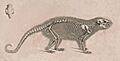
Skeleton of a Brazilian porcupine
_Coendou_prehensilis.jpg)
