
Callimedusa ecuatoriana facts for kids
Quick facts for kids Callimedusa ecuatoriana |
|
|---|---|
 |
|
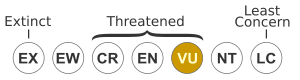
| Conservation status | |
Scientific classification  |
|
| Kingdom: | Animalia |
| Phylum: | Chordata |
| Class: | Amphibia |
| Order: | Anura |
| Family: | Hylidae |
| Genus: | Callimedusa |
| Species: |
C. ecuatoriana
|
| Binomial name | |
| Callimedusa ecuatoriana (Cannatella, 1982)
|
|
| Script error: The function "autoWithCaption" does not exist. | |
| Synonyms | |
|
|
Script error: No such module "Check for conflicting parameters".
The Callimedusa ecuatoriana is a special kind of frog that belongs to the Phyllomedusinae group. It is also known as the Agua Rica leaf frog. This frog is found only in Ecuador, a country in South America. It lives on the Amazonian slopes of the Andes mountains. You can find it in areas like the Morona-Santiago Province and the Cordillera del Condor in the Zamora-Chinchipe Province.
What Does It Look Like?
Male Agua Rica leaf frogs are usually about 46–55 mm (1.8–2.2 in) long. This measurement is taken from their nose to their bottom (called snout–vent length). We know of one female frog that was about 72 mm (2.8 in) long.
The frog's snout, or nose area, is short and looks flat from above. From the side, it slopes downwards. It has a clear eardrum, called a tympanum. Its fingers have round pads, but they are not webbed. The toes also have pads, which are a bit smaller than the finger pads. The toes are not webbed either, but they have small fringes on the sides.
The frog's back can be a bright lime green or a yellowish green color. The tops of its hands and feet are purple with orange spots that are not in a regular pattern. Its belly is a light orange color with red lines that look like a net.
Where It Lives and How We Protect It
The Agua Rica leaf frog lives in cloud forests high up in the mountains. These forests are often covered in clouds. They live at heights of about 1,300–1,900 m (4,300–6,200 ft) above sea level. These frogs probably lay their eggs in slow-moving streams and ponds.
This frog is not very common, meaning there are not many of them left. It does not live in places that have been changed by people. The biggest threat to these frogs is habitat loss, which means they are losing their homes. This happens because of things like:
- Cows eating the plants where they live (cattle grazing)
- People digging for minerals (mining activities)
- People building new homes and towns (human settlements)
To help protect these frogs, they can be found in special protected areas. These include the El Zarza Wildlife Refuge and the Cerro Plateado Biological Reserve.
