
Charles Elliott Perkins facts for kids
Quick facts for kids
Charles Elliott Perkins
|
|
|---|---|
 |
|
| Born | November 24, 1840 Cincinnati, Ohio, U.S.
|
| Died | November 8, 1907 (aged 66) Westwood, Massachusetts, U.S.
|
| Occupation | Railroad executive |
| Known for | President, Chicago, Burlington and Quincy Railroad |
Charles Elliott Perkins (November 24, 1840 – November 8, 1907) was an important American businessman. He served as the president of the Chicago, Burlington and Quincy Railroad. People respected him greatly. A historian once wrote that from the time he became vice president in 1876 until he retired as president in 1901, he was the Burlington railroad. This shows how much he shaped the company.

Charles Elliott Perkins' Life and Career
Early Years and First Jobs
Charles Elliott Perkins was born in Cincinnati, Ohio, on November 24, 1840. His father passed away when Charles was a young child. Charles went to public schools in Cincinnati. He also studied at Milton Academy in Milton, Massachusetts.
When he was 16, he moved to Burlington, Iowa. There, he found a job as a clerk in a fruit store. At 19, he started working as a clerk for the Burlington and Missouri River Railroad (B&MR). He quickly moved up in the company. A year later, he became a paymaster. Then, at age 20, he was made Assistant Treasurer of the railroad in 1860. His uncle, John Murray Forbes, was the railroad's president, which helped his fast career growth. By 1865, he was the Superintendent of the B&MR. At that time, the railroad was about 75 miles (121 km) long.
Becoming a Railroad Leader
Perkins helped create the Nebraska part of the Burlington and Missouri River Railroad. He became a director for both the Nebraska and Iowa divisions. In 1872, he was appointed vice president of the B&MR. He also became president of the B&MR's Nebraska division.
On January 1, 1873, the B&MR railroad joined with the Chicago, Burlington and Quincy (CB&Q). This was a difficult time for the economy. A period called the Panic of 1873 caused many financial problems. Despite this, Perkins continued to lead the Nebraska division.
In 1875, Perkins joined the board of directors for the CB&Q. In March 1876, he became the company's vice president. He also continued to manage the railroad's operations west of the Missouri River. During this time, the CB&Q worked with other railroads in a group called the "Iowa Pool." They shared resources to move freight more efficiently.
Perkins worked hard to strengthen the CB&Q. He faced challenges from other railroads, like the Union Pacific Railroad. He wanted his railroad to be the best at moving goods.
The Great Railroad Strike of 1877
While Perkins was a vice president, a major event called the Great Railroad Strike of 1877 happened. This was a big disagreement between railroad workers and companies across the country. Perkins decided to temporarily stop the CB&Q's operations on July 24. He wanted to make sure the railroad's property was safe. Within a few days, public opinion changed, and the strike began to end as workers returned.
The disagreements with other railroads led to changes for the CB&Q. The Burlington and Missouri River railroad became more closely connected with the CB&Q. In 1880, the Burlington railroad was fully absorbed into the CB&Q. Perkins and Forbes then worked together to take over other smaller railroads.
Leading the Chicago, Burlington and Quincy
In 1881, John Murray Forbes stepped down as president of the Chicago, Burlington and Quincy. Charles Elliott Perkins took his place. He moved to Boston, Massachusetts, because many of the railroad's main financial supporters lived there.
Perkins was known as a very smart and strong railroad executive. He worked to create the best management team. He also made sure his railroad met the highest engineering standards. During his time as president, he bought many other rail systems. This helped to expand the CB&Q's reach across the country. For example, in 1886, he extended the line to St. Paul, Minnesota. In 1889, he built tracks across Nebraska, South Dakota, and Wyoming. This connected the CB&Q with the Northern Pacific Railway in Billings, Montana.
The Burlington Railroad Strike of 1888
As president, Perkins led the CB&Q through the Burlington Railroad Strike of 1888. He did not support labor unions. In 1886, he had fired union members working for his railroads. He believed that unionized workers were loyal to the union, not just to the company.
When two worker unions asked for better work rules and fair pay, Perkins refused. On February 27, 1888, many locomotive engineers and brakemen went on strike. Perkins hired new workers to replace those who had left their jobs. He also went to federal court to ensure other railroads would continue to load freight onto CB&Q trains. The court agreed, and this helped end the strike. The strike was mostly over by the end of March 1888. For a local union leader named Eugene V. Debs, this strike changed his views on how companies and workers should interact.
Business Strategies
Perkins encouraged industries to build their factories along the CB&Q's rail lines. This strategy helped the railroad by ensuring these businesses would use his trains to ship their products. This boosted the amount of freight the railroad carried.
Retirement and Final Years
Charles Perkins retired as president of the CB&Q in 1901. This happened after investors from New York City gained control of the railroad. Two powerful railroad leaders, James Jerome Hill and J. P. Morgan, worked together to buy Perkins' railroad. Another leader, Edward Henry Harriman, also wanted to buy it. This led to a big competition over who would own the CB&Q. Eventually, Hill and Morgan succeeded in gaining control.
Perkins suffered from a kidney illness called Bright's disease. He passed away at his home in Westwood, Massachusetts, on November 8, 1907. On the day of his funeral, the entire 8,000-mile (13,000 km) CB&Q railroad system stopped running. This was a special way to honor him.
Perkins married Edith Forbes in 1864. They had seven children: Robert, Charles, Samuel, Alice, Edith, Margaret, and Mary.
Although he was buried in Boston, there is a large memorial for him in Aspen Grove Cemetery in Burlington, Iowa. It is the largest stone in the cemetery and overlooks the original CB&Q railroad line.
Other Business Activities
Perkins was also a director for other railroads, such as the Hannibal and St. Joseph Railroad. These later joined with the Burlington line. He was also on the board of directors for the American Bell Telephone Company, which was based in Boston.
Charles Elliott Perkins' Legacy
Historians who study American railroads often quote Charles Elliott Perkins. He left a lasting mark on the industry.
Perkins owned a large estate in Burlington, Iowa, called "Apple Trees." A mansion he built for his son, Charles, as a wedding gift, is now used by the Burlington Community School District. The school district bought the land in 1926. The old mansion still stands today and many of its original features remain. The Burlington Community School District also once had an elementary school named after Perkins.
In 1879, Perkins bought 240 acres (0.97 km2) of land in the beautiful Garden of the Gods near Colorado Springs, Colorado. He originally planned it for a summer home. However, Perkins decided to keep the land in its natural state. He bought more land, and all of it was informally open to the public for many years. In 1909, after his death, Perkins' children gave his 480 acres (1.9 km2) of land in the Garden of the Gods to the City of Colorado Springs. They knew he wanted it to be a public park forever, open for everyone to enjoy.
Images for kids
-
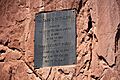
Plaque in the Garden of the Gods commemorating the donation of the land
.jpg)
