
Feast of Herod with the Beheading of St John the Baptist facts for kids
The Feast of Herod with the Beheading of St John the Baptist is a very large painting by an artist named Bartholomeus Strobel the Younger. He was from a region called Silesia, which is now part of Poland. This painting was created around 1630 to 1643. Today, you can see it in the Museo del Prado museum in Madrid, Spain. It's painted with oil on canvas and is huge, measuring about 2.80 meters tall and 9.52 meters wide!
The painting shows two important moments from the Bible story of John the Baptist's death. On the left side, which is the main part, you see a big party hosted by Herod Antipas. During this feast, his daughter Salome brings out the head of John the Baptist. On the far right, a much smaller scene shows John the Baptist being executed. Artists often combined these two scenes, but Strobel made the execution scene very small and separate.
This painting is special because it includes many portraits of important leaders from the Thirty Years' War. This was a very long and difficult war in Europe. The painting might be an allegory, which means it has a hidden message. Some think it was Strobel's way of asking Christian countries to help his home region of Silesia, which suffered a lot during the war.
Contents
A Famous Painting: The Feast of Herod

This painting features many portraits of important political and military leaders from across Europe. Strobel used prints to get the likenesses of people he didn't know in person. It's thought that the painting's hidden message is connected to Strobel's hometown, Wrocław (which he knew as Breslau). The city's coat of arms actually shows the head of John the Baptist on a platter. Strobel had to leave Breslau in 1634 because of the Thirty Years' War, and he eventually settled in Poland.
In the painting, only Herod, dressed in special clothes, seems shocked by the head on the table. Everyone else looks calm, which might be the main point of the allegory. It suggests that leaders were not reacting enough to the suffering around them.
Historians have different ideas about who some of the people in the painting are. If the painting was made in the early 1640s, some of the figures might be:
- The man holding a trumpet in the middle, looking at you, could be the Dutch Admiral Tromp. He won a big naval battle in 1639, ending Spain's power at sea.
- To his left, Henry IV of France (who died in 1610) is pulling a cloth from a table with fruit. This might mean he's showing "the fruits of victory."
- The group of men standing in the front on the left includes the general Albrecht von Wallenstein, holding a long staff. Behind him are his generals Count Vilém Kinský, Christian Freiherr von Ilow, and Count Adam Erdmann Trčka von Lípa. Also there is Walter Butler of Roscrea, an Irish colonel.
Among the people eating at the table, you might see:
- John George I, Elector of Saxony
- Charles I of England
- Maria Anna of Spain, who became Empress
- Marie de' Medici, the former Queen of France
- George Villiers, 1st Duke of Buckingham
- Marie de Rohan, duchesse de Chevreuse

The head of John the Baptist on the platter looks like Duke John Christian of Brieg, a strong Protestant leader from Silesia who died in 1639. Salome, the girl who brings the head, is probably not a portrait of a real important person.
To the right of Herod, a group of ladies includes:
- Elizabeth Stuart, Queen of Bohemia
- Queen Maria Eleonora of Brandenburg, who was the widow of Gustavus Adolphus of Sweden (he died in 1632)
- Her daughter Christina, Queen of Sweden (who was born in 1626)
- Her sister Catherine of Brandenburg, who briefly ruled Transylvania
The boy holding a torch in the front might be Charles Louis, Elector Palatine, who was exiled (born 1617). The dog that looks a bit like a lion might represent the lions in the coats of arms of the Electorate of the Palatinate and the Dutch Republic. The lady in the large turban behind them could be Amalia of Solms-Braunfels, whose husband gave the Palatine family a safe place during their exile.
Some people have suggested other identifications. For example, some think the head of John the Baptist looks like Charles I of England. However, Charles I was not beheaded until 1649, which is likely after Strobel finished this painting.
Artistic Style and Details

The way people are painted in this artwork varies a lot. Some faces look very real, like actual portraits. Others are more general or idealized, especially the women. Some even look like funny caricatures. Often, all these styles are mixed in one group of people.
The clothes worn by many figures are painted with amazing detail. However, the styles of clothing come from different places and times. You can see French styles from the 1630s mixed with Polish fashions, and even some imaginary outfits. For example, the two boys with candles at the front of the table wear Polish-style clothes. The boy on the right has a special three-plumed hat badge, and the boy on the left wears unique boots and carries a curved Polish or Hungarian sword called a szabla.
This mix of styles, both in faces and clothing, reminds us of older religious paintings from the 15th and 16th centuries, especially those showing the story of Jesus's suffering. Strobel's work, even though it was painted later, still shows the influence of a style called Northern Mannerism from Prague, where he learned art when he was young.
Where the Painting Came From
We don't know for sure when this painting was made or who asked Strobel to paint it. These questions are often linked to figuring out who the portraits are, especially the younger people, because their appearance helps narrow down the time.
One idea is that the painting was created in Elbing between 1640 and 1642. It might have been for a wealthy Protestant family called the Dönhoffs, who were becoming part of the Polish nobility. In 1637, Mr. Dönhoff married Margaretha, the daughter of Duke John Christian of Brieg. Remember, the head of John the Baptist in the painting might be a portrait of Duke John Christian.
Another idea is that King Władysław IV Vasa of Poland (who ruled from 1632 to 1649) was the patron. He made Strobel his court artist in 1639. The King's half-brother, Karol Ferdynand Vasa, who was a Prince-Bishop, has also been suggested as a patron. Strobel worked for him before leaving Breslau around 1633. If this is true, the painting would be older, from 1630–33. Only the Prince-Bishop's coat of arms is shown in the painting, and it might have been at his palace in Nysa.
By 1746, the painting was part of the Spanish Royal Collection. It belonged to Elisabeth Farnese, the Queen of Philip V of Spain. It hung in the dining room of the Royal Palace of La Granja de San Ildefonso, a summer palace near Madrid. After Philip died, the palace and its art went to his step-mother. The painting stayed at La Granja until 1766, but by 1794 and 1818, it was recorded at the newer Royal Palace of Aranjuez.
When it moved to the Museo del Prado with the rest of the Spanish royal collection, it wasn't shown to the public for a long time. In the 2000s, after the museum was remodeled, space was found for the painting. Now, it's one of the first artworks visitors see when they come out of the lifts in the old building.
For many years, no one knew for sure who painted it. People thought it might be by an unknown Flemish artist, or perhaps Joachim von Sandrart, Hendrik Goltzius, or Bartholomeus Spranger. But in 1970, an art expert named Jaromir Neumann suggested it was by Strobel. This was confirmed in 1987 by Lode Seghers, who compared it to another painting signed by Strobel. Since then, other comparisons have shown that Strobel is indeed the artist, and this is now widely accepted.
Other Versions of the Feast of Herod

Because of the discovery of the Prado painting, another Feast of Herod painting in the Alte Pinakothek museum in Munich was also identified as Strobel's work. This version is much smaller, about 95 x 73 cm, and was probably painted earlier. This "fascinating and mysterious picture" shares many features with the Prado painting. It also includes portraits of political and military leaders, a mix of styles, and a complex scene. In this one, the main feast is seen in the background through columns. Before, people thought this painting might be by another artist named Jacques Bellange.
Some suggested portraits in the Munich version include Johann Tserclaes, Count of Tilly. He was a military leader before Wallenstein and was in charge during the terrible Sack of Magdeburg in 1631. He might be the figure on the left behind the railing. The man reading next to him might also be a portrait. The "richly dressed man with a pointed beard" at the right side of the dining table could be Gabor Bethlen. He was a Protestant leader and claimed to be the King of Hungary. His widow, Catherine of Brandenburg, might be one of the ladies in the Prado version.
Strobel also painted Daniel and Cyrus before the Idol Bel (1636–1637), which is in the National Museum in Warsaw. This painting has a similar style, with figures in fancy and unusual costumes. It also shows a feast happening in the background at a lower level. This painting is even smaller, about 39.5 × 30 cm, and is painted with oil on copper.
Images for kids
-
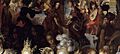
Musicians in the right background
-
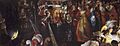
Left background


