
French ship Ville de Paris (1850) facts for kids

Ville de Paris circa 1854
|
|
Quick facts for kids History |
|
|---|---|
 .svg) France France |
|
| Builder | Rochefort shipyard |
| Laid down | 13 June 1807 |
| Launched | 5 October 1850 |
| Commissioned | 25 July 1851 |
| Reclassified | May 1858 |
| Stricken | 7 February 1882 |
| Reinstated | 1 October 1858 |
| Fate | Broken up 2 March 1898 |
| General characteristics | |
| Class and type | Océan-class ship of the line |
| Displacement | 5,302 tonnes |
| Length | 65.18 m (213.8 ft) (196.6 French feet) |
| Beam | 16.24 m (53.3 ft) (50 French feet) |
| Draught | 8.12 m (26.6 ft) (25 French feet) |
| Propulsion |
|
| Speed | 10.6 knots (19.6 km/h; 12.2 mph) |
| Complement | 1,079 |
| Armament |
|
| Armour | Timber |
The Ville de Paris was a huge French warship. It was a "ship of the line" with 118 guns. This type of ship was one of the largest and most powerful warships of its time. It belonged to the French Navy and was part of the famous Océan-class ships.
Contents
The Story of the Ville de Paris
The building of the Ville de Paris started in 1807 at Rochefort, France. It was first named Marengo. Over the years, its name changed several times due to political changes in France. It was called Ville de Vienne, then Comte d'Artois, and back to Ville de Vienne again. Finally, in 1830, after the July Revolution, it was officially named Ville de Paris.
This mighty ship was finally launched into the water on October 5, 1850. After its launch, it sailed to Toulon. There, in 1851, it became the main ship, or flagship, of a naval squadron. Captain Charles Pénaud was in charge of the ship.
Joining the Crimean War
The Ville de Paris played an important role in the Crimean War. On March 23, 1853, it left Toulon for Greece. It was the lead ship of the First Squadron. The ship then joined with the British fleet near Malta.
In June 1853, the combined French and British fleets arrived at Beşik Bay. Later, on September 22, 1853, the fleet headed towards the Dardanelles. The Ville de Paris was so large that another steamship, the Napoléon, had to tow it. This helped the Ville de Paris move through the water more easily.
Battles and Challenges
In 1854, the French squadron helped block the Black Sea. This protected the supply lines for the allied forces. The Ville de Paris reached Odessa on January 6, 1854. It took on Russian prisoners and helped shell the city on March 22, 1854.
A serious challenge came in late July 1854. A cholera sickness spread through the fleet. By the end of August, 140 people on the Ville de Paris had died. The fleet had to go into quarantine to stop the spread of the disease.
On September 2, 1854, important generals came aboard the Ville de Paris. They planned the landing of troops at Eupatoria. The ship was again towed by the Napoléon. The fleet joined the British fleet on September 13. The next day, the army began to land. By September 16, about 60,000 soldiers had landed.


On October 17, 1854, the Ville de Paris started the attack on Sevastopol. It signaled "France watches you" to begin the bombardment. During the battle, a shell hit the back of the ship, known as the poop deck. This attack killed two sailors and wounded six others. By the end of that day, the ship had been hit many times. It had 50 shots in its hull and 100 in its ropes and sails.
A big storm hit on November 14, 1854. The Ville de Paris lost its ability to steer. It had to be towed back to the Bosporus for repairs. After being fixed in Constantinople, it returned to sea on December 21, 1854. The ship finally returned to Toulon on March 28, 1855.
Later Life and End of Service

Starting in July 1857, the Ville de Paris was changed into a steamship. This meant it got an engine to help it move. The ship became longer by about 5.47 meters during this change. It was relaunched in May 1858 and put back into service in August 1858.
In 1870, the ship was changed again. This time, it became a troopship, used to carry soldiers. Its engine was removed. By 1881, it was no longer used as an active ship. Instead, it became a hulk, which is an old ship used for storage or as a base.
The Ville de Paris was eventually sold for scrapping on March 2, 1898. This means it was taken apart for its materials.
Images for kids
-
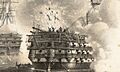
The explosion of a Russian shell on Ville de Paris at Sebastopol in 1854
-
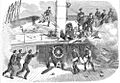
The deck of the Ville De Paris, at the moment when the poop was struck by the Russian shell at Sebastopol
-
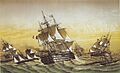
Ville de Paris among the escadre d'évolution, around 1864
