
Frost's amanita facts for kids
Quick facts for kids Frost's amanita |
|
|---|---|
_Sacc_750397.jpg) |
|
Scientific classification  |
|
| Kingdom: | Fungi |
| Division: | Basidiomycota |
| Class: | Agaricomycetes |
| Order: | Agaricales |
| Family: | Amanitaceae |
| Genus: | Amanita |
| Species: |
A. frostiana
|
| Binomial name | |
| Amanita frostiana (Peck) Saccardo
|
|
| Script error: The function "autoWithCaption" does not exist. | |
| Synonyms | |
|
|
Script error: No such module "Check for conflicting parameters".
| Amanita frostiana | |
|---|---|
 |
|
 |
gills on hymenium |
 |
cap is convex |
 |
hymenium is free |
 |
stipe has a ring |
 |
spore print is white |
 |
ecology is mycorrhizal |
  |
edibility: not recommended or poisonous |
Amanita frostiana, also known as Frost's amanita, is a small type of fungus found in the eastern United States and southeastern Canada. This mushroom often comes in bright colors like yellow, red, or reddish-pink.
Contents
Description of Frost's Amanita
The Amanita frostiana mushroom has special features that help us tell it apart from other mushrooms in its family. For example, its cap colors are darker in the center, and the outer layer (called the universal veil) is yellow to cream-colored.
Cap Characteristics
The cap of Amanita frostiana is usually rounded or shield-shaped. As it grows, it flattens out and has clear lines around its edge. The cap can be anywhere from 2 to 8 centimeters wide. Its colors can be yellow, golden orange, scarlet, or a deep reddish-pink. The surface feels smooth and can become a bit sticky when wet.
Stem or Stipe
The stem, also called the stipe, is where the mushroom stands tall. The yellow to cream-colored material from the universal veil forms yellow powder or flakes at the bottom of the stem. The stem is usually 47 to 62 millimeters long and 4 to 11 millimeters wide. It also has a ring that stays on the stem.
Gills of the Mushroom
The gills are the thin plates under the cap. They are "free," meaning they don't attach to the stem. The gills are close together and appear cream-colored when seen in a group. Many short gills are also present.
Spores and Microscopic Details
The spores are like tiny seeds that help the mushroom reproduce. They are usually 7.0 to 10.2 micrometers wide and are round or nearly round. A special feature is that these spores do not turn black when iodine is dropped on them.
Where Frost's Amanita Lives
This rare mushroom is usually found in forests that have a mix of oak trees and conifer trees (like pine or spruce). It naturally grows in the eastern United States and southeastern Canada.
Mushrooms Similar to Frost's Amanita
Amanita frostiana looks similar to several other mushroom species. These include Amanita rubrovolvata, Amanita flavoconia, Amanita albocreata, Amanita muscaria var. muscaria (or simply Amanita muscaria), and Amanita subfrostiana.
Amanita rubrovolvata
Amanita rubrovolvata looks a bit like A. frostiana. It grows small to medium-sized mushrooms with reddish-orange caps. Some reports of A. frostiana in Thailand were likely mistakes, and the mushrooms were probably A. rubrovolvata instead.
Amanita subfrostiana
Amanita subfrostiana, sometimes called 'False Frost's Amanita', grows in the same types of places as A. frostiana. However, it is mostly found in southwestern China. While it looks similar, the cap of A. subfrostiana is usually paler, which helps tell them apart.
Amanita albocreata
The distinct white base (bulb) of A. frostiana is somewhat similar to the white or yellow-white collar seen in Amanita albocreata. A. albocreata is found in hardwood-hemlock forests in the northeastern U.S. and southeastern Canada, and also in northern forests like those on the island of Newfoundland.
Amanita muscaria
The way the cells are connected at the base of the gills in A. frostiana suggests it is related to Amanita muscaria var. muscaria, or simply Amanita muscaria. Amanita muscaria is a well-known poisonous fungus from the Amanita family.
Amanita flavoconia
Many people have confused Amanita flavoconia with A. frostiana. A. flavoconia is one of the most common Amanita species in eastern North America. They are often mistaken for each other because of similar physical features, especially when looking at them under a microscope.
Is Frost's Amanita Edible?
This mushroom is considered unsafe to eat and is poisonous.
Images for kids
-
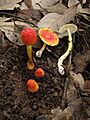
A specimen of Amanita rubrovolvata.

