
Heliotrope moth facts for kids
Quick facts for kids Heliotrope moth |
|
|---|---|
 |
|
Scientific classification  |
|
| Kingdom: | Animalia |
| Phylum: | Arthropoda |
| Class: | Insecta |
| Order: | Lepidoptera |
| Superfamily: | Noctuoidea |
| Family: | Erebidae |
| Subfamily: | Arctiinae |
| Genus: | Utetheisa |
| Species: |
U. pulchelloides
|
| Binomial name | |
| Utetheisa pulchelloides Hampson, 1907
|
|
| Script error: The function "autoWithCaption" does not exist. | |
| Synonyms | |
|
|
Script error: No such module "Check for conflicting parameters".
The Heliotrope moth, known scientifically as Utetheisa pulchelloides, is a fascinating moth from the Erebidae family. It was first described by George Hampson in 1907.
You can find these moths in many parts of the Indo-Australian region. This includes places like Borneo, Hong Kong, New Zealand, Papua, the Seychelles, and most of Australia. These moths are known for their amazing long-distance flights. They can travel to very remote islands, such as Henderson Island and Ducie Island.
Contents
What the Heliotrope Moth Looks Like
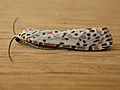
The Heliotrope moth has some unique features. Its head and the part of its body where its legs and wings are (called the thorax) are yellowish. It has two black spots on its collar and on its tegula, which are small scale-covered pads at the base of the wings. Each part of its thorax also has a black spot.
The moth's abdomen, which is the back part of its body, is whitish. Its front wings are white with five broken scarlet (bright red) bands. There are also black spots between these bands. You'll also see a line of black spots along the edge of the front wings.
The back wings are mostly see-through white. Some moths might have black markings on the central part of these wings. There's also a wiggly black band near the edge of the back wings. This band is wider near the wing tip.
Heliotrope Moth Larva
The larva, or caterpillar, of the Heliotrope moth is dark grey. It has a white stripe down its back. You can also see a line of red spots along its sides. The head of the caterpillar is yellow. When it's ready to change into a moth, the larva creates a loose cocoon. It spins this cocoon in the fallen leaves on the ground, usually under the plant it has been eating.
What the Heliotrope Moth Eats
The caterpillars of the Heliotrope moth feed on several types of plants. They enjoy eating Argusia argentea, Echium plantagineum, Heliotropium arborescens, and Myosotis arvensis. These plants provide the food they need to grow and develop.
Gallery
-
-
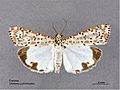
Dorsal view (from above)
-
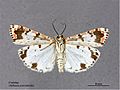
Ventral view (from below)
-
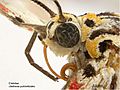
Close-up of the head


