
Helmeted hornbill facts for kids
Quick facts for kids Helmeted hornbill |
|
|---|---|
 |
|
| Immature male at Jurong Bird Park, Singapore. | |
| Conservation status | |
Scientific classification  |
|
| Kingdom: | Animalia |
| Phylum: | Chordata |
| Class: | Aves |
| Order: | Bucerotiformes |
| Family: | Bucerotidae |
| Genus: | Rhinoplax Gloger, 1841 |
| Species: |
R. vigil
|
| Binomial name | |
| Rhinoplax vigil (Pennant, 1781)
|
|
| Script error: The function "autoWithCaption" does not exist. | |
| Synonyms | |
|
Buceros vigil Forster, 1781 |
|

Script error: No such module "Check for conflicting parameters".
The helmeted hornbill (scientific name: Rhinoplax vigil) is a very large and unique bird from the hornbill family. You can find this amazing bird in parts of Southeast Asia. Its home includes the Malay Peninsula, Sumatra, Borneo, Thailand, and Myanmar.
It has a special helmet-like structure on its head called a casque. This casque is quite heavy, making up about 11% of the bird's total weight. A helmeted hornbill can weigh around 3 kilograms (about 6.6 pounds). Unlike other hornbills, this casque is almost solid. Males use it for head-to-head 'jousting' during fights. Some local cultures, like the Punan Bah people, believe that a large helmeted hornbill guards the river between life and the afterlife.
Contents
Amazing Features of the Helmeted Hornbill
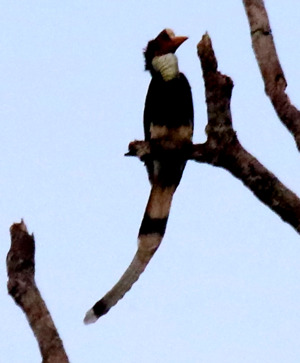
This bird has mostly black feathers. However, its belly and legs are white. Its tail is also white with a black band near the end of each feather. The tail is very long, especially the two middle feathers. These extra-long feathers make it the longest hornbill species overall!
Its body can be about 110 to 120 centimeters (43 to 47 inches) long. The long tail feathers add another 50 centimeters (20 inches) to its length. Males can weigh around 3.1 kilograms (6.8 pounds). Females are a bit lighter, averaging about 2.7 kilograms (6 pounds). Even though it's very large, its body weight is similar to the great hornbill found in Asia. It is lighter than the huge African ground hornbills.
It has a bare, wrinkled patch of skin on its throat. This patch is pale blue or greenish in females and bright red in males. The casque starts at the base of its bill. It extends about halfway to the tip, ending suddenly. Both the casque and the bill are yellow. A special red oil from a preen gland covers the top and sides of the casque. It also covers the base of the bill. This often leaves the front part of the casque and the outer half of the bill yellow. As mentioned, its casque is solid, which is unique among hornbills. The skull, including the casque and bill, can make up 10% of the bird's total weight!
The Unique Call of the Helmeted Hornbill
The helmeted hornbill has a very distinctive two-part call. First, it makes a series of loud, hooting sounds. These sounds are like an axe hitting wood ('toop' or 'took'). These hoots can be double-toned and happen many times. The hoots then get faster and faster. They end in a loud cackle that sounds like laughter! Scientists believe this call helps other hornbills know things about the caller. This includes its age, size, and how strong it is.
In some local languages, like Malay, the bird is sometimes called the "Tebang Mentua" bird. This name comes from a traditional story. The story connects the bird's axe-like call and cackling sound to a legend. This legend explains the unique sounds the bird makes. These loud calls can be heard from 2 to 3 kilometers (about 1 to 2 miles) away. They can go on for several minutes at a time!
Daily Life and Behavior

Helmeted hornbills mainly eat the fruit of strangler fig trees. They are believed to be territorial. This means they defend their living space. They are also thought to be monogamous, usually staying with one partner. However, we still have much to learn about their social lives.
These birds usually breed once a year. They have one chick at a time. The mother and her chick stay inside a sealed tree cavity for the first five months of the chick's life. The male brings food to them through a small opening. This special way of nesting makes them very vulnerable. Dangers include habitat loss (deforestation) and illegal hunting.
Males fight over territory by flying at each other. They ram their solid casques together. These airborne battles are called 'aerial jousting'. Females fly with the males during these jousts. However, they fly away in different directions just before the collision.
Why Are Helmeted Hornbills Critically Endangered?
Sadly, the helmeted hornbill is in great danger. Because of continuous hunting and the loss of their forest homes, their status was changed. It went from 'near threatened' to 'critically endangered' on the IUCN Red List of Threatened Species in 2015. This means they are very close to disappearing forever.
It is also protected under CITES. CITES is the Convention on International Trade in Endangered Species. This means international trade of this bird is strictly forbidden. Conservation groups like TRAFFIC reported that over 2,170 casques were seized. This happened in China and Indonesia in just three years. This shows how serious the illegal trade is.
In Thai forests, there are now fewer than 100 of these birds left. Over the past five years, at least 546 hornbill parts, mostly casques, were found for sale on social media platforms in Thailand. Sadly, some people illegally hunt these birds for their casques. Traders might pay villagers around 5,000-6,000 baht (about US$165–200) for a hornbill head. These prices can then double or triple in cities. They become much higher when sold internationally.
Currently, no helmeted hornbills are known to be held in captivity. However, places like the Jurong Bird Park and the Penang Bird Park used to have them.
The Valuable Casque: Hornbill Ivory

The casque is the source of something called 'hornbill ivory'. This material is highly valued for carving beautiful objects. Local indigenous people also use the long central tail feathers. They use them to decorate special dancing cloaks and head-dresses. In the past, carvers in countries like China and Japan also used the casque for their artwork.
Cultural Importance of the Helmeted Hornbill
The helmeted hornbill, along with the closely related rhinoceros hornbill, is very important. It plays a big role in the cultures of many indigenous groups in northern Borneo. These birds appear in many traditional stories and legends. They often symbolize important ideas like life, bravery, and the journey between life and the afterlife.
For example, in the Punan Bah culture, people believe helmeted hornbills guard the path between life and the afterlife. They are thought to judge the goodness of those who pass. This bird is also connected to beliefs about courage and strength in some traditions. For the Orang Ulu people of northeastern Malaysia, wearing the helmeted hornbill's feathers was a special honor. It was often associated with great bravery and achievement.
Beyond their spiritual meaning, the bird's casques and feathers play a vital role. They are used in many important rituals and ceremonies. The Orang Ulu carved detailed grave markers, beautiful centerpieces, and even ear-rings from hornbill casques. Many native peoples used the two long, central tail feathers. They used them to decorate ceremonial clothes and special items. These were for weddings, funerals, and other important events. Historically, hornbills were sometimes hunted for food using traditional tools like blowpipes.
