
History of Pieria (regional unit) facts for kids
_(English).svg)
Welcome to the fascinating history of Pieria! This area is located in Central Macedonia, Greece. It's a place rich with ancient stories, from early settlers to powerful kingdoms and empires. Let's explore the exciting past of Pieria, where many important events happened.
Where is Pieria Located?
Pieria is the southernmost part of the regional unit of Central Macedonia. Its main city is Katerini. Pieria shares its southern border with Thessaly. This location made it an important crossroads throughout history.
Pieria's Ancient History
Stone Age: Around 6500 to 3000 BC
Long, long ago, about 7,000 years before Christ, people started settling near Mount Olympus and the Pieria Mountains. This area was perfect for them. It had a mild climate, plenty of water, good land for farming, and places to hunt.
Archaeologists have found signs of these early settlers in places like Korinos and Makrygialos. They found graves with interesting items. These included stone and clay figures, pottery, tools made from bone and stone, and even jewelry.
Bronze Age: Around 3000 to 1000 BC
During the Bronze Age, people started moving from the mountains closer to the sea. This was a time of great change! People learned to work with metals, build ships, and trade with others. This brought wealth to the region.
Important finds from this time come from places like Platamonas (which was called Heraklion back then), Ancient Pydna, and Ancient Methone. Archaeologists have found old settlements and burial grounds. They discovered clay pots, metal tools, weapons, and beautiful jewelry made of gold, silver, and bronze.
The Mycenaean Influence
The very end of the Bronze Age is known as the Mycenaean period. This is because a powerful culture from Mycenae in southern Greece had a big impact. Their goods were traded far and wide. Their customs and culture also spread.
In Pieria, archaeologists have found Mycenaean graves and pottery. This pottery is very helpful for dating how old things are. Pieria is actually the northernmost place where signs of the Mycenaean culture have been found.
Iron Age: Around 1000 to 700 BC
The Iron Age brought new changes to Pieria.
- Around 800 BC, a place called Leivithra became settled.
- Later, in the 700s BC, settlers from Corfu came to Methone.
- The Greek alphabet started to be used in Methone.
More people began living along the coast. Some old settlements were even abandoned. People started building stronger defenses. For example, ancient Methone had a three-meter-high wall! Trade grew, and the Phoenician alphabet was adapted for the Greek language. Finds from this time include jewelry, pottery, weapons, and tools.
Ancient Greek Times: Around 700 BC to 323 BC
This was a very important time for Greece!
- Around 700 BC, the Macedonian Kingdom was founded.
- In the 400s BC, Alexander I of Macedon started making coins in the Macedonian Kingdom.
- The city of Pydna was attacked by the Athenians in 432 BC.
- Around 424 BC, the historian Thucydides first wrote about Dion.
- King Archelaus moved the city of Pydna away from the coast in 410 BC.
- He also moved the capital of the kingdom from Aegae to Pella. Archelaus started the Olympic Games in Dion. This was a nine-day festival to honor the nine Muses.
- Later, in the 300s BC, the Macedonian tombs of Katerini and the Macedonian tombs of Korinos were built.
- The famous Alexander the Great was born in 356 BC.
- Before his big campaign against the Persians, Alexander the Great made sacrifices to the gods in Dion.
- After a major battle, Alexander asked a famous sculptor named Lysippus to create 25 bronze statues. These statues honored the horsemen who died in the battle. They were placed in the Zeus Olympios Sanctuary in Dion.
Hellenistic Period: Around 323 BC to 146 BC
This period began after the Death of Alexander the Great.
- In 219 BC, Dion was destroyed by the Aetolian League. But Philip V of Macedon had the city rebuilt!
- The Romans arrived in 169 BC.
- In 168 BC, the Macedonian king Perseus was defeated by the Roman army in the Battle of Pydna. This was a huge event! After this, the Romans divided Macedonia into four regions.
- In 148 BC, a man named Andriscus tried to free Macedonia from Roman rule. But he was defeated. The Romans then created their first province in the east, with Thessaloniki as its capital.
Roman Period: Around 146 BC to 330 AD
The Romans now ruled Pieria.
- Around 100 BC, Leivithra was destroyed by a natural disaster. Its people left the city.
- Later, a temple for Dionysus was built in Dion around 150 to 200 AD.
- In 212 AD, all free people in the Roman Empire were given Roman citizenship.
- The Roman Empire was divided into Western and Eastern parts in 285 AD.
- In Dion, when it became a Roman province, a special festival called the Nonae Capratinae was celebrated. During this festival, female slaves had certain freedoms.
Archaeologists have found many amazing things from this long period. Dion is a very important archaeological site. Other places like Methone have also given us valuable information. Finds include coins, jewelry, pottery, glass vessels, weapons, tools, and even parts of buildings. In Dion, they even found a water organ! Many of these items are displayed in the Archaeological Museum at Dion.
Byzantine Period: Around 330 to 1453 AD
This period began when the Roman Empire shifted its focus to the east.
- In 343 AD, Dion became a place with a bishopric. A large church for the bishop was built there.
- Later, in the 400s AD, Louloudies, near ancient Pydna, also became an important church center.
- Dion is last mentioned in historical records in the 900s.
- The Kanalon monastery was founded around 1055.
- In the 1100s, the name Heraklion changed to Platamon.
- After the Fourth Crusade in 1204, knights from Western Europe created the Kingdom of Thessalonica.
- The Agia Triada monastery in Sparmos was founded. Records show it was active by 1386.
Important sites from this time include the Platamon Castle, Louloudies, and the castle of Pydna. These castles were built by the Frankish knights. There are also old monasteries like Kanalon and Agia Triada. Many churches from this period can still be seen today. Most archaeological finds from this time are from churches and monasteries. They are displayed in museums.
Ancient Sites to Explore
Pieria is full of amazing ancient sites! Here are some of them:
- Aiginio
- Alykes Kitrous
- Ancient Methone
- Ancient Pydna
- Necropolises of Pydna
- Macedonian tombs, Katerini
- Macedonian tombs, Korinos
- Leivithra
- Louloudies
- Makrygialos
- Pigi Artemidos
- Pigi Athinas
- Platamon Castle
- Ritini
- Sevasti
- Spathes
- Tria Platania
- Valtos Leptokaryas
Images for kids
-
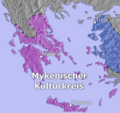
Extension of the Mycenaean culture (ca. 1400 BC.)
-
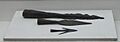
Parts of weapons, Iron Age
-
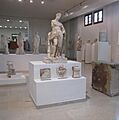
Archaeological museum, Dion
-
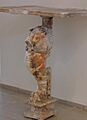
Marble table at the Archaeological museum, Dion
-
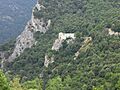
Church Agia Triada, Vrondou
-
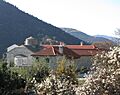
Monastery Kanalon


