
History of corsets facts for kids
A corset is a special type of undergarment. For hundreds of years, it was a common part of women's fashion in Europe. Corsets helped shape the body and encouraged good posture. Their style changed often, following new fashion trends. People called them by different names, like "stays" or "bodies," depending on the time and place.

These garments first became popular in the 1500s. They gave the wearer a cone-like shape and a flatter chest. The style we often think of as a "corset," with a very narrow waist, was most popular during the Victorian era. While usually worn under clothes, corsets sometimes appeared as outer garments. You can still see this in the traditional clothing of some European countries.
Contents
- What's in a Name? The Word "Corset"
- Early History: Before the 1500s
- Fashion in the 1500s and 1600s
- The 1700s: Cone Shapes and Comfort
- Late 1700s and Early 1800s: A Lighter Look
- The Victorian Era: New Materials and Factory Production
- Mid- to Late-Victorian Styles
- Edwardian Era: The "S-Bend" Silhouette
- After World War I
- After World War II
- Late 1900s and Today
What's in a Name? The Word "Corset"
The word "corset" comes from an old French word, corps. This word means "body." The French word itself came from the Latin word corpus, also meaning "body."
People started using the word "corset" in the late 1300s. Back then, it meant "a type of laced top." By 1795, it described a stiff undergarment. This garment supported and shaped the waist, mostly for women.
Another common name for corsets was "stays." This term was used from about 1600 until the early 1900s. During the Renaissance, "stays" and "corset" meant the same thing. "Jumps" was a different term. It described a softer type of stay, without stiff supports. Jumps were usually laced in the front.
Early History: Before the 1500s
The first possible image of a corset is very old. It's on a small statue from Minoan art, made around 1600 BCE. This clothing looks like a corset, but it was worn on the outside. It also left the chest uncovered.
In the Caucasus region, tribes like the Circassians and Abkhaz used corsets for many centuries. These corsets helped women look beautiful and showed their modesty. They were often laced very tightly with many laces. Girls would wear them from a young age. This tradition was a way to show patience and respect within their culture.
Fashion in the 1500s and 1600s


During the 1500s and 1600s, corsets were often called "bodies" or "stays." People wore them either under or over their clothes. Women at the French royal court thought these garments were essential for a beautiful shape.
In the Elizabethan era (late 1500s), stays were usually made from layers of linen and silk. They were often starched and made stiff with whalebone. A piece called a "busk" was added to the front. Busks were thin, knife-shaped pieces made of wood, ivory, metal, or whalebone. They slid into the garment and were held by laces, so they could be removed.
By the end of the 1500s, many wealthy Europeans wore stays. The front of the corset often had a "stomacher." This was a stiff, V-shaped piece worn for decoration. Some old stays made of steel or iron still exist. Experts believe these were for medical support or were unique items, not everyday fashion.
The 1700s: Cone Shapes and Comfort
The most common type of corset in the 1700s had an upside-down cone shape. This created a contrast between a stiff upper body and large, full skirts. The main goal of stays then was to make the torso look like a fashionable 'V' or cone. They gently narrowed the waist and helped people stand tall with their shoulders back.
Softer garments called "jumps" were also popular. These were made of quilted linen. People wore jumps for casual times or when they needed to move freely for work. Jumps had less stiffening, sometimes using cord instead of whalebone. They were padded with cotton to offer support without being too tight. Jumps were made from silk, cotton, or linen and often had embroidery. They fastened over the chest with ties, buttons, or hooks.
Both stays and jumps were usually worn as undergarments. They were rarely seen on their own. Stays were thought to be more proper than jumps. An old saying from 1762 noted, "Now a shape in neat stays, now a slattern in jumps." This showed how people viewed the different styles.
-
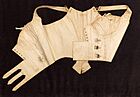
1795 short stays from Mills Jr, London
-
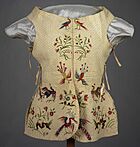
A pair of quilted linen jumps, late 1600s to early 1700s
-
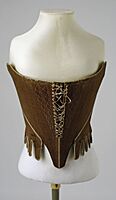
Linen stays, around 1780
-
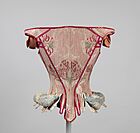
European corset from the mid-late 1700s
-
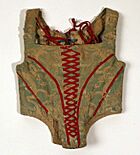
Spanish corset around 1700
-
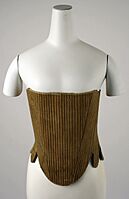
Late 1700s American stays


Late 1700s and Early 1800s: A Lighter Look
After the French Revolution, many thinkers believed natural body shapes were best. They criticized the idea that stays made a body more beautiful. Fashion began to favor loose, thin dresses. These new styles looked like the simple undergarments of earlier times.
Doctors and thinkers also spoke about the beauty of a natural waist. They worried about how stays affected women's health, especially during pregnancy. By the 1770s, "short stays" became popular. These only covered the chest and had little or no stiffening. They helped create a fashionable shape for the bust.
Short stays worked well under the empire silhouette gowns of the time. These gowns were loose below the chest. They created a long, straight look, like clothing from Ancient Greece and Rome. This style was called robe à la grecque. For very formal events, people still wore lightly stiffened stays. However, it was also acceptable to go without them, even at places like the royal court.
-
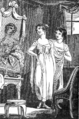
Regency short stays around 1810
-
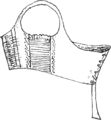
Short stays around 1803
-
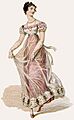
An 1823 fashion plate, showing a Regency era ball gown. A young woman dances in an empire-waist pink dress.


The Victorian Era: New Materials and Factory Production

By the 1820s, the empire silhouette went out of style. Corsets, as we know them today, became fashionable again. They were worn with the fancy, structured gowns of the Victorian era. The Industrial Revolution changed how clothes were made. By the 1830s, steel began to replace whalebone for stiffening corsets.
Steel boning, along with metal clasps and eyelets, meant corsets could be tightened more. This could be done without damaging the garment, unlike older stays. A new front-opening busk made it easier for women to put on and take off their corsets. This was helpful for those who didn't have servants to assist them.
Corset making also moved to factories. Before this, one person made each corset by hand. In the 1800s, factories used an assembly line process. Different groups of people, often children, did each step. Heavy tasks like cutting fabric were done in the factory. Lighter work, like sewing in the bones, was often done at home by women and their children. The invention of the sewing machine and steam-molding helped factories create many different corset styles. In 1839, Jean Werly patented a way to make corsets on a loom. A common corset cost about one dollar in 1839, which is about $34.85 in 2026.
Mid- to Late-Victorian Styles

Corset styles changed a lot during the mid- to late-Victorian era. They followed the latest fashions. Corsets from this time often had no straps and fastened in both the front and back. They were sometimes decorated with colorful stiffeners or lace.
New inventions, like the crinoline in 1856, changed skirt sizes. Women could wear very large skirts without heavy petticoats. This led to corsets with wider hips and less dramatic shaping. Later, in the 1870s, skirts became smaller. Corsets then returned to creating smaller waists. The "spoon busk" was invented in the 1870s. It helped shape the stomach and spread pressure evenly.
Edwardian Era: The "S-Bend" Silhouette

People started to worry about how corsets affected health. This led to "hygienic" corsets, which claimed to be healthier. Some doctors even became corset makers. They helped patients find corsets or started making them. Inès Gâches-Sarraute, a female doctor, created the straight-fronted busk corset. She designed it to reduce pressure on the abdomen. This new shape became very popular by the late 1890s.
The "S-bend" shape also required a new way of standing. Wearers had to adopt a swayback posture to fit the corset's shape. This helped prevent the flexible stiffeners inside from bending incorrectly. The straight-front corset could be worn with pads for the hips and bust. This created a fashionable, exaggerated silhouette.
From 1908 to 1914, narrow skirts were in style. This meant corsets became longer at the bottom. At the same time, bras started to become popular in the 1910s. Fewer corsets included bust support. A new type of corset covered the thighs and changed the hip position. It made the waist look higher and wider, and the hips narrower. This style hinted at the "flapper" look of the 1920s. This new fashion was sometimes uncomfortable. The invention of rubberized elastic materials in 1911 helped girdles replace corsets. Girdles were designed mainly to slim the hips.
-
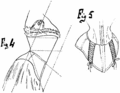
A diagram of a straight-front corset, 1902
-
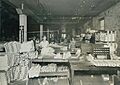
Corset production in a factory, 1912.
-
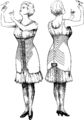
A longline corset from 1917, designed to slim the hips and thighs.

_(cropped).jpg)

After World War I
After World War I, fashion moved towards looser styles. In 1939, corsets that narrowed the waist briefly returned. However, World War II soon ended this trend. Many women entered the workforce, and materials became scarce. This led to simpler, more practical clothing designs.
After World War II
In 1952, a corset called 'The Merry Widow' was released by Warner's. It was first designed for actress Lana Turner for a movie. Both corsets and girdles remained popular through the 1950s and 1960s. This was especially true with Christian Dior's "New Look" in 1947. The "New Look" featured full skirts and narrow waists. It brought back a sense of glamour after the war. This style was very different from the practical clothes worn during wartime. Dior's designs symbolized a return to elegance and femininity.
-
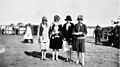
Four women showing the short skirts and straight shapes of the late 1920s.
-
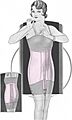
A diagram of a girdle from the 1930s.
-
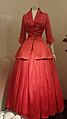
A 1954 evening gown by Dior, showing the "New Look" style.
_-_by_unknown_photographer_(2968453258).jpg)


Late 1900s and Today
By the 1960s, hippie culture and youth movements changed fashion. The narrow-waisted look became less popular. Feminist activists protested against the restrictive nature of some designs. In 1968, at the feminist Miss America protest, protestors threw items like girdles and corsets into a "Freedom Trash Can." They called these items "symbols of restriction."
Since the 1920s, corsets have mostly gone out of mainstream fashion in Europe and North America. However, corsets are still used as part of costumes and in certain fashion styles. People in the Goth and Punk subcultures started wearing corsets as outerwear. They used them to make a bold fashion statement. In the 1970s, designer Vivienne Westwood began adding corsets with printed designs to her high-fashion punk collections. In the 1980s, other designers like Jean Paul Gaultier and Thierry Mugler also experimented with corsets.
In the early 2020s, corset-inspired tops and dresses became trendy. These modern designs often look like corsets but usually do not have stiff boning.
-

A goth woman wearing a black and white corset over a black blouse.
-

A corset-inspired tank top from 2021, with metal hooks and a sweetheart neckline.
.jpg)

