
Eucharist facts for kids

The Eucharist is a special Christian ceremony. People also call it Holy Communion, the Blessed Sacrament, or the Lord's Supper. Most churches consider it a holy sacrament, while other groups call it an ordinance. It remembers the Last Supper, an important meal described in the New Testament. At this gathering, Jesus Christ shared bread and a cup of wine with his disciples. He told them to keep doing this in memory of him. Today, millions of people take part in this tradition around the world.
Contents
What Names Do People Use for the Ceremony?
Different Christian traditions use different words for this meal. Each word highlights a slightly different meaning of the tradition.
The Word Eucharist
The word Eucharist comes from an ancient Greek word that means "thanksgiving". Many churches use this name today, including the Catholic Church, Eastern Orthodoxy, Oriental Orthodoxy, Anglicans, and Lutherans. In the Bible, Jesus gave thanks before breaking the bread. The ancient early church document called the Didache also used this term.
The Lord's Supper and Communion

Many Christians, like Baptists and other Evangelicals, prefer the name Lord's Supper. This title comes directly from the writings of Paul the Apostle in the First Epistle to the Corinthians. Another common name is Holy Communion. The word "communion" comes from a Latin word that means "sharing together in common". Catholic families celebrate a child's First Communion when they take part for the very first time.
Other Common Terms
Other names include the "Breaking of Bread", which is often used by the Plymouth Brethren. In the Catholic and Lutheran churches, the entire service is often called the Mass. In Byzantine traditions, the service is called the Divine Liturgy. Some Lutheran churches also call it the Divine Service. Members of the Church of Jesus Christ of Latter-day Saints usually call it "the Sacrament".
How Did the Holy Meal Begin in History?

The story of the holy meal begins in the ancient lands of the Bible.
The Biblical Stories
The stories of the Last Supper are written in three synoptic Gospels: Matthew, Mark, and Luke. Jesus and his friends gathered during the Jewish holiday of Passover. In the Gospel of John, Jesus speaks about himself as the living bread. He also set an example by washing the feet of his followers. Early believers would often eat a full meal together called an Agape feast before breaking the bread.
Early Church Writers
Early Christian leaders wrote instructions about how to share this meal. Ignatius of Antioch and Justin Martyr both wrote about the sacred bread in the second century. Later, an abbot named Paschasius Radbertus at Corbie Abbey wrote a famous book about the bread and wine. He taught that Jesus was truly present during the meal.
What Do Different Churches Believe?

Christians share this meal across many denominations, but they understand the bread and cup in different ways.
Catholics and Orthodox Christians
The Catholic Church teaches that the bread and wine truly become the actual body and blood of Jesus. This idea is called transubstantiation. While the outward shape, smell, and taste remain the same, their inner reality completely changes. In Eastern Christianity, this miracle is viewed as a holy mystery through the work of the Holy Spirit.
Lutherans and Reformed Churches
Lutherans teach a concept known as the sacramental union. They believe that Jesus is truly present "in, with, and under" the bread and wine. In contrast, Reformed Christians believe in a spiritual presence. They think the bread and cup connect the believer's heart to Jesus through faith.
Memorial and Symbolic Views
Other groups, such as many Baptists and Anabaptists, follow a view called Memorialism. They believe the bread and the cup are symbols. For them, the service is an act of obedience and a way to remember what Jesus did.
How Is the Service Practiced Today?

Churches around the world carry out the service with special prayers, actions, and foods.
Bread and Drink Choices
Different churches choose different items for the meal:
- Some churches use unleavened bread, which is flat bread made without yeast.
- Eastern churches use regular leavened bread to represent life.
- Many churches use wine, while groups like Methodists and Baptists use pasteurized grape juice.
- Latter-day Saints use plain water and bread.
- People with celiac disease can often receive low-gluten wafers or fruit juice instead.
Preparation and Worship Customs

Churches often ask people to get ready before taking the sacrament. In some traditions, believers fast by skipping breakfast. Many believers say prayers, go to confession, or sit in quiet reflection. Some churches practice closed communion, meaning only prepared members may take part. Others practice open communion, welcoming any visiting Christian. In Catholic and some Anglican churches, people also take part in Eucharistic adoration. During this practice, consecrated bread is placed inside a beautiful gold holder called a monstrance so people can pray nearby.
Interesting Facts About the Eucharist
- The word "Eucharist" comes from the ancient Greek word eucharistia, which means "thanksgiving."
- The two main parts of the Eucharist are the bread and the wine. However, in some Protestant churches, you might find grape juice being used instead of wine.
- The practice of "breaking bread" is one of the oldest traditions in Christianity, dating back to the very first days of the early church in the first century AD.
- In many Catholic churches, the bread is a thin, round wafer made of unleavened flour and water, called a "host." In many Orthodox churches, they use leavened bread, which is bread made with yeast so that it rises.
- The cup used to hold the wine is called a "chalice." In many churches, these are made of precious metals like gold or silver and are often decorated with beautiful jewels.
- The table where the bread and wine are prepared is called the "altar." In many churches, the altar is considered the most sacred part of the building.
Images for kids
-

Early Christian painting of an Agape feast
-
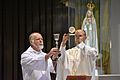
Eucharistic celebration at the Sanctuary of Our Lady of Fátima
-
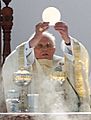
Pope Benedict XVI celebrates a Mass
-

Eucharistic elements prepared for the Divine Liturgy
-
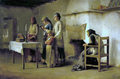
Painting by Théodore Jacques Ralli showing preparation for communion
-

Illuminated title of The Holy Communion from an 1845 prayer book
-

Small individual cups used for serving grape juice
-
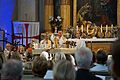
The elevation of the chalice during a Lutheran Mass
-
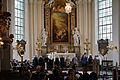
Receiving the elements at a communion rail in Sweden
-

A historic Scottish communion token
-
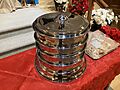
A communion tray used to serve juice
-

A United Methodist minister consecrating the elements
-

Communion elements featuring flat unleavened bread
-

A young girl receiving communion
-
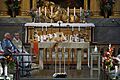
An altar table prepared for a large service
-

People kneeling during an outdoor procession in London
-
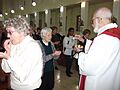
Communicants receiving the bread in their hands


,_20_e_21_set._2012)_25_Igreja_S%C3%A3o_Francisco_de_Assis_em_Porto_Alegre.JPG)
See also
 In Spanish: Eucaristía para niños
Related Pages
- Last Supper
- Baptism
- Divine Liturgy
- Mass (liturgy)
