
Hyatt Reservoir facts for kids
Quick facts for kids Hyatt Reservoir |
|
|---|---|

Hyatt Reservoir
|
|

 Hyatt Reservoir
Location in Oregon

Hyatt Reservoir
Location in the United States
|
|
| Location | Jackson County, Oregon |
| Coordinates | 42°11′10″N 122°27′14″W / 42.18611°N 122.45389°W |
| Type | Reservoir, eutrophic |
| Primary inflows | Cottonwood Creek |
| Primary outflows | Keene Creek |
| Catchment area | 8 square miles (21 km2) |
| Basin countries | United States |
| Surface area | 957 acres (387 ha) |
| Average depth | 18 feet (5.5 m) |
| Water volume | 16,900 acre-feet (20,800,000 m3) |
| Shore length1 | 7.5 miles (12.1 km) |
| Surface elevation | 5,016 ft (1,529 m) |
| 1 Shore length is not a well-defined measure. | |
Hyatt Reservoir is a high-mountain reservoir in Jackson County, Oregon. It sits in the southern region of Oregon, about 14 miles east of Ashland. A massive earth and rock barrier named Hyatt Dam holds back the water. People use this mountain lake to supply fresh farm water and for outdoor adventures. Farmers rely on it for seasonal irrigation, while campers enjoy exploring its cool shores.
A local irrigation group first constructed the dam back in 1923. Sitting at an impressive elevation of 5,016 feet (1,529 m), the lake stays cool. Because of its cool water, it supports bass, trout, and many other swimming animals. The Bureau of Land Management manages a large park along the scenic shoreline for visitors.
Contents
History and Construction of Hyatt Reservoir
Long before visitors came to camp, local fruit growers needed reliable water for their crops. Keene Creek flows through this forested mountain basin, providing a steady natural stream. In 1923, engineers designed an earth-fill dam across the stream channel to trap melted winter snow. This trapped water formed what people now call Hyatt Reservoir, also called Hyatt Lake.
Downstream along the same waterway, planners built a smaller sister pool called Little Hyatt reservoir. Both lakes worked together to store snowmelt each spring for hot summer months. Later on, the United States Bureau of Reclamation took over ownership of the dam structures. In 1960, workers completely rebuilt and improved Hyatt Dam so it stayed strong and secure. Today, the Talent Irrigation District manages water flow through the gates to keep farms watered.
The Regional Water Network
Hyatt Reservoir does not work alone in the mountains of southern Oregon. It connects to a network of human-made water channels, pipes, and nearby lakes. Water journeys from Hyatt Lake into nearby Keene Creek before entering the Ashland Lateral Canal. This long water canal carries water directly toward Emigrant Lake, near Ashland.
Another nearby lake called Howard Prairie Lake sits just 3 miles to the east. It is a much larger reservoir that adds even more water into the canal network. When mountain snow melts, gates open to share water safely between all these reservoirs. Farmers in the valleys below depend on these connected water routes to grow sweet pears. Without these canals, the dry summer months would make farming in the region very difficult.
Weather Patterns and Severe Dry Spells
Because Hyatt Reservoir relies directly on mountain snowfall, local weather patterns shape water levels every season. Deep winter snowpacks keep the lake full, clean, and cool through the warm summer months. When winter brings little precipitation, the water level inside the reservoir drops down quite low. During the severe 2020–21 North American drought, the lake shrank to just 1% of its normal capacity.
A severe drought means plants and animals must work hard to survive with less water. Boating ramps sat far away from the water edge during those extremely dry years. When normal mountain storms returned, the lake slowly filled back up with crisp, blue water. Park rangers and water managers check mountain snow levels every year to predict reservoir levels.
Outdoor Recreation at Hyatt Lake
Today, Hyatt Reservoir is a favorite destination for families who love exploring the outdoors. The Bureau of Land Management operates a large campground complex right beside the blue water. Visitors can sleep outside in tents, stay in trailers, or visit for day picnics. The public park officially welcomes overnight campers from late April through the end of October.
Visitors travel to the lake by driving cars, riding horses, or walking on forest paths. Hiking paths like the famous Pacific Crest Trail pass right along the edge of the lake. Hikers walking from Mexico toward Canada often stop near the cool water to rest. The developed campground offers flush toilets, hot showers, cozy campfire rings, and covered group shelters.
Popular Water and Field Activities
Families find plenty of fun outdoor games and adventures to enjoy at Hyatt Reservoir. Visitors can bring speedboats, canoes, kayaks, or sailboats to launch from two paved boat ramps. Swimming in the clear water provides great relief during sunny, warm summer afternoons in the forest. On dry land, visitors can play friendly team matches at the community softball field.
- Boating with family canoes, kayaks, or motorized fishing boats
- Swimming near marked beach areas along the forested lake shore
- Playing fun team sports on the volleyball court and basketball area
- Tossing metal shoes with friends in a classic game of horseshoes
- Watching wild animals explore the mountain forest near the campgrounds
Winter Adventures in the Snow
Hyatt Reservoir stays open even when chilly winter weather freezes the surrounding mountain trails. The cold elevation brings heavy blankets of white snow to the surrounding evergreen forest slopes. In the winter months, visitors do not have to pay fees to enter the park. Campers must bring their own drinking water because park water systems turn off during freezing weather.
People who love cold-weather adventures travel to Hyatt Lake for exciting winter activities:
- Cross-country skiing across miles of quiet, snow-covered forest tracks
- Riding machines along marked recreational vehicle and snowmobile trails
- Snowshoeing through tall evergreen trees around the frozen reservoir shoreline
- Sledding down gentle snowy hillsides right beside cozy local winter cabins
Lake Wildlife and Aquatic Life
Hyatt Reservoir provides a rich natural habitat for freshwater fish, birds, and forest mammals. Because the lake is eutrophic, it contains abundant nutrients that help green water plants grow quickly. Tiny aquatic insects feed on these plants, providing a banquet of food for growing fish. This rich underwater ecosystem makes the lake a popular spot for people who love sport fishing.
State wildlife managers stock the lake every year with about 250,000 young rainbow trout. Because food is so plentiful, these stocked trout can grow up to 20 inches (51 cm) long. Anglers also enjoy catching fast largemouth bass hiding near logs along the lake edges. Other panfish swimming in the reservoir include schools of crappie and colorful little bluegill.
Birds and Forest Mammals
Many wild birds and land animals live in the tall pine forests surrounding Hyatt Reservoir. Fish-eating birds, such as ospreys and bald eagles, soar high over the water on sunny mornings. They swoop down fast with sharp talons to pluck swimming trout straight from the surface. Great blue herons stand completely still in the shallow water, waiting patiently to catch small fish.
Black-tailed deer and elk often walk quietly down to the water edge to take cool drinks. Curious chipmunks, squirrels, and beavers build homes near the streams that feed into Hyatt Reservoir. Visitors should always watch wildlife from safe distances so these mountain animals stay wild and safe. Hyatt Reservoir remains a special mountain retreat where nature, history, and outdoor fun come together.
Images for kids
-
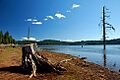
A scenic view across Hyatt Reservoir in southern Oregon
See also
