
International Thylacine Specimen Database facts for kids
The International Thylacine Specimen Database (ITSD) is a huge collection of information and pictures about the amazing thylacine, also known as the Tasmanian tiger. This special project spent four years gathering details and photos of every known thylacine part. These parts, called specimens, are found in museums, university collections, and even private homes around the world.

The ITSD was first released in April 2005 on three CD-ROMs. It was updated in July 2006 and then completely revised in May 2009. The final version came out on a single DVD, holding about 3.68 gigabytes of data and images.
Contents
What is the Thylacine Database?
The ITSD was created to be a free tool for students and researchers. It helps them study the thylacine. You can usually access it through the main offices of universities and museums that have thylacine specimens. You can also find it in the libraries of some major animal societies.
What Information Does the Database Hold?
The ITSD lists all the available details for each thylacine specimen. This includes:
- The place where it is kept (like a museum)
- Its special identification number
- If it was male or female
- When it was added to the collection
- What type of specimen it is (like a skin or a bone)
- Where it came from
- Who collected it
- Any old or extra numbers it might have
- How it was obtained (bought or traded)
- Any other important notes about the specimen
Why Are There So Many Pictures?
To make the database even more useful, it includes many high-quality digital photographs of the specimens. The ITSD has the largest collection of thylacine photos in the world. The main reasons for including these digital images were:
- To let researchers see the thylacine specimens and their information from far away. This helps more people study the species.
- To protect the real specimens from being handled too much. This helps them last longer.
- To help keep the specimens safe. If a photo record exists, it's easier to track them.
- To save digital pictures of the specimens exactly as they look right now. This creates a permanent record for the future.
The data sets within the ITSD are supported by an image bank of around 2000 high-resolution digital photographs of the specimens themselves. All biological material deteriorates over time and these unique digital images will act as a permanent record of the specimens for future generations in their present state of preservation.
—Nicholas Ayliffe, principal photographer to the ITSD Project
Types of Thylacine Specimens
The specimens in the ITSD include different parts of thylacines. You can find:
- Skins
- Skeletons
- Skulls
- Taxidermy mounts (stuffed animals)
- Wet specimens
Wet specimens are whole animals, organs, or body parts that have been kept in liquids like alcohol or formalin. Thylacine specimens are spread all over the world. So, the search to find them was a big international effort. It involved 106 museum, university, and private collections in 23 different countries!
The International Thylacine Specimen Database is a unique and precise database of the largest modern day marsupial carnivore. I am confident that all researchers will appreciate both its complexity and accuracy as a research tool. It is a wonderful resource and an extremely valuable part of Australia’s natural heritage.
—Heinz F. Moeller, former director of the Zoological Museum and Department of Comparative Morphology of Vertebrates, Heidelberg University, author of Der Beutelwolf
Where is the Main Database Kept?
The main copy of the ITSD is kept at the Zoological Society in London. Other copies, called mirror copies, are held in different places. These include the University of Tasmania in Hobart, the Australian National Wildlife Collection in Canberra, and the Queen Victoria Museum and Art Gallery in Launceston. The main and mirror copies are always updated when new information is found.
The Zoological Society was chosen to keep the main copy because of its long history with the thylacine. Many early scientific papers about the species were published by the society. Also, their zoo in Regent's Park showed more thylacines than any other zoo outside Australia.
Awards and Recognition
Each year, the Royal Zoological Society of New South Wales hosts the Whitley Awards. These awards honor Gilbert Whitley, a famous Australian expert on fish (ichthyologist). They are given for excellent publications that share a lot of new information about animals in the Australasian region.
In September 2005, the International Thylacine Specimen Database won the Whitley Award for the best zoological database. This was a special moment because it was the first time in the history of the awards that a database had received this honor!
Images for kids
-
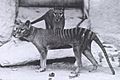
Thylacines in Washington D.C., c. 1906
References
- Australian Zoologist 33: 419. Whitley Awards 2005 - The International Thylacine Specimen Database.
- Moeller, H. F. (1997). Der Beutelwolf, Thylacinus cynocephalus. Die Neue Brehm – Bucherei Vol. 642, Westarp Wissenschaften, Magdeberg.ISBN: 3-89432-869-X
- Sleightholme, S. & Ayliffe, N. (2005). International Thylacine Specimen Database. CD-ROM. Master Copy: Zoological Society, London
- Sleightholme, S. & Ayliffe, N. (2006). International Thylacine Specimen Database. CD-ROM. Master Copy: Zoological Society, London
- Sleightholme, S. & Ayliffe, N. (2009). International Thylacine Specimen Database. CD-ROM. Master Copy: Zoological Society, London
