
Jörmungandr facts for kids
_-_cropped_(cropped).png)
In Norse mythology, Jörmungandr is a giant and powerful sea serpent. People also call him the Midgard Serpent or World Serpent. He is so huge that he wraps around the entire Earth (Midgard). He even bites his own tail, forming a complete circle. This makes him a symbol of the world's cycle.
Jörmungandr is one of three special children of the god Loki and the giantess Angrboða. The other children are the wolf Fenrir and Hel, who rules the underworld. According to old stories, the god Odin took these three children from Asgard. He threw Jörmungandr into the vast ocean that surrounds Midgard. There, the serpent grew incredibly large. He became big enough to encircle the whole Earth and hold his own tail. The mighty thunder god, Thor, is Jörmungandr's greatest enemy. They have many fierce battles. During Ragnarök, the end of the world, Thor and Jörmungandr fight their final, deadly battle. Both of them die in this epic clash.
Contents
Who is Jörmungandr?
Jörmungandr is a central figure in the ancient stories of the Norse people. He is often described as a monstrous worm or dragon. His immense size is a key part of his legend. He represents the wild, untamed power of the ocean.
The Serpent's Family
Jörmungandr's parents are the trickster god Loki and the giantess Angrboða. His siblings are Fenrir, a giant wolf, and Hel, who oversees the realm of the dead. These three children were seen as dangerous. This is why Odin sent them away from Asgard, the home of the gods. Jörmungandr's destiny was to live in the world sea.
What Does the Name Mean?
The name Jǫrmungandr comes from Old Norse words. Jǫrmun- means something huge or vast. Gandr can mean many things, often referring to long, supernatural beings. So, Jörmungandr can mean "the world serpent" or "the vast serpent." His other name, Miðgarðsormr, means "worm of Midgard." This name clearly shows his connection to the Earth. It highlights how he encircles the human world.
Where Do We Learn About Jörmungandr?
We learn about Jörmungandr from several ancient texts. The most important is the Prose Edda, written around 1220 by Snorri Sturluson. Other sources include old poems like Húsdrápa, Hymiskviða, and Völuspá. These poems were passed down orally for centuries. They tell us about the gods and their adventures. There are also old stone carvings that show scenes from Jörmungandr's myths.
Thor's Epic Encounters
The stories of Thor and Jörmungandr are some of the most exciting in Norse mythology. They met three times in famous tales. Each meeting showed Thor's incredible strength and courage.
The Giant Cat Challenge
In one story, Thor visited the giant king Útgarða-Loki. The king challenged Thor to many feats of strength. One challenge was to lift a giant cat. Útgarða-Loki had used magic to disguise Jörmungandr as this huge cat. Thor grabbed the cat around its middle. He pulled with all his might. He could only lift it enough for one paw to leave the floor. Later, Útgarða-Loki revealed his trick. He explained that Thor had actually lifted the World Serpent. This was an amazing feat, as Thor had almost pulled Jörmungandr up to the sky. Many giants watching were terrified. If Thor had fully lifted the cat, he would have changed the entire universe.
The Great Fishing Trip
Jörmungandr and Thor met again during a fishing trip. Thor went fishing with the giant Hymir. Hymir refused to give Thor bait. So, Thor bravely tore the head off Hymir's largest ox. He used it as bait. They rowed far out to sea. Thor prepared a strong line and a huge hook. He baited it with the ox head. Soon, Jörmungandr bit the hook! Thor pulled the serpent from the water. The two faced each other, with Jörmungandr spitting venom. Hymir turned pale with fear. As Thor reached for his hammer, Mjölnir, to strike the serpent, Hymir cut the fishing line. Jörmungandr sank back into the ocean. He returned to his place around the Earth.
Some older versions of this story have a different ending. In these tales, Thor successfully killed the serpent by hitting it on the head. This fishing trip was a very popular scene in Viking Age art. It is shown on several ancient stones. These include the Altuna Runestone and the Ardre VIII image stone.
The Final Battle at Ragnarök
The last meeting between Jörmungandr and Thor was predicted to happen during Ragnarök. This is the Norse prophecy of the end of the world. One sign of Ragnarök's beginning was Jörmungandr releasing his tail. The sea would then become violent and flood the land. The serpent would thrash onto the land, spraying poison everywhere. He would join other monstrous beings, like Fenrir, to fight the gods.
Thor and Jörmungandr finally met on the plain of Vigrid. They fought a ferocious battle. Thor eventually killed Jörmungandr with his hammer. However, Thor himself was poisoned by the serpent's deadly venom. He managed to walk nine paces before falling dead. This final battle is also shown on ancient artifacts, like the Gosforth Cross.
Jörmungandr in Our World
The legend of Jörmungandr continues to inspire people today. His story is a powerful reminder of nature's might. It also shows the eternal struggle between order and chaos.
An Asteroid's Name
In modern times, Jörmungandr's name has been given to an asteroid. Asteroid 471926 Jörmungandr was named after this famous mythological sea serpent. The official naming was announced on September 25, 2018. This shows how ancient myths can still connect with new discoveries.
Gallery
-
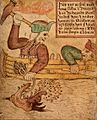
Thor fishing for the Midgard Serpent in an illustration from an 18th-century Icelandic manuscript
-
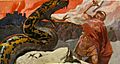
Thor and the Midgard Serpent (1905) by Emil Doepler
-

The children of Loki (1920) by Willy Pogany
-
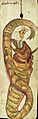
Jörmungandr rising to the ox head bait, from the 17th-century Icelandic manuscript AM 738 4to


See also
 In Spanish: Jörmundgander para niños
- Apep
- Bakunawa
- European dragon
- Germanic dragon
- Horned Serpent
- Lernaean Hydra
- Leviathan
- Níðhöggr
- Oceanus
- Ophiotaurus
- Ouroboros
- Python (mythology)
- Sea monster
- Shesha
- Typhon
- Vritra
