
Kemp's ridley sea turtle facts for kids
Quick facts for kids Kemp's ridley sea turtle |
|
|---|---|
 |
|
| Lepidochelys kempii | |
| Conservation status | |
Scientific classification  |
|
| Kingdom: | Animalia |
| Phylum: | Chordata |
| Class: | Reptilia |
| Order: | Testudines |
| Suborder: | Cryptodira |
| Family: | Cheloniidae |
| Genus: | Lepidochelys |
| Species: |
L. kempii
|
| Binomial name | |
| Lepidochelys kempii (Garman, 1880)
|
|
| Script error: The function "autoWithCaption" does not exist. | |
| Synonyms | |
|
|

Script error: No such module "Check for conflicting parameters".
The Kemp's ridley sea turtle (Lepidochelys kempii) is a special type of sea turtle. People also call it the Atlantic ridley sea turtle. It is the smallest and most endangered sea turtle in the world. This turtle lives mostly in the Gulf of Mexico. Sometimes, it travels into the Atlantic Ocean. Rising ocean temperatures are changing where these turtles go. This can make them vulnerable to sudden cold weather. The Kemp's ridley sea turtle is a critically endangered species. Many people are working hard to protect it. Things like losing their homes, pollution, and oil spills threaten these amazing creatures.
Contents
What's in a Name?
This turtle got its name from Richard Moore Kemp. He was the first person to send a specimen to a scientist at Harvard. The word "ridley" itself has a mysterious origin.
Some people also called them "heartbreak turtles." Fishermen saw turtles dying after being flipped onto their backs. They said the turtles "died of a broken heart."
How to Spot a Kemp's Ridley
The Kemp's ridley is the smallest sea turtle. Its shell, called a carapace, is about 58 to 70 cm (23 to 28 in) long. It weighs only 36 to 45 kg (79 to 99 lb) when fully grown. Like other sea turtles, it has a flat body. Its front limbs are like flippers, perfect for swimming. It also has a strong beak. Adult turtles can grow up to 75 cm (30 in) long. They can weigh up to 50 kg (110 lb). Their oval-shaped shell is usually olive-gray.
These turtles change color as they grow. When they are babies, they are dark purple. Adult turtles have a yellow-green or white belly, called a plastron. Their top shell is grey-green. They have a triangular head with a slightly hooked beak. Kemp's ridleys are unique because they are the only sea turtles that nest during the day.
Where Do They Live?

Kemp's ridley turtles live in different places depending on their age and gender. Adult turtles mostly stay in the Gulf of Mexico. They look for food in shallow waters. Females travel from Florida to the Yucatán Peninsula. Males tend to stay closer to nesting beaches in Texas and Mexico. Very few adult Kemp's ridleys are found outside the Gulf of Mexico.
Younger turtles often swim into the Atlantic Ocean. They live along the coast of North America. This area stretches from Florida to Massachusetts. Sometimes, they are found even further north. Rising sea temperatures might be making these trips longer. The Gulf Stream ocean current helps them travel far. They have been seen from Newfoundland to Venezuela. They have also been spotted in places like Ireland and the Netherlands. Most of these sightings are of young turtles.
In November 2021, a male turtle was found alive in North Wales. It was taken to a sea zoo for care. The plan was to return it to the Gulf of Mexico.
What They Eat and How They Grow
What Do Kemp's Ridleys Eat?
Kemp's ridley turtles eat many things. They enjoy mollusks, crustaceans like crabs and shrimp, and jellyfish. They also eat fish, algae, and sea urchins. Young turtles mostly eat near the surface of the ocean. Adult turtles are bottom-feeders. They mostly eat crabs. Studies show that their dives for food might be longer at night. Their diet can change based on where they live and what food is available.
The Kemp's Ridley Life Cycle
Most female turtles return to the same beach each year to lay eggs. This main beach is Rancho Nuevo in Tamaulipas, Mexico. They gather in huge groups of hundreds or thousands. These mass nesting events are called arribadas, which means "arrivals" in Spanish. Males usually stay closer to these breeding areas.
Young turtles spend their first years in floating sargassum seaweed beds. Then, they travel between the northwest Atlantic and the Gulf of Mexico. They do this until they are old enough to reproduce. They become adults and can have babies when they are about 10 to 12 years old.
These turtles are special because they are the only sea turtles that nest mainly during the day. Their nesting season runs from April to August. About 95% of their nesting happens on a 16-mile beach in Tamaulipas, Mexico. They also nest on Padre Island in Texas, USA. They mate in the ocean. Females prefer nesting in areas with sand dunes or swamps.
In 1947, there were an estimated 89,000 nesting females. By 1985, this number dropped to about 7,702. This was a huge decline. Since then, the numbers grew until around 2011–2016. Then, another drop in nests happened. As of 2016, the number of nests was only about 9.9% of what it was in 1947.
Females lay eggs one to four times in a season. They wait 10 to 20 days between each nesting. Each nest, called a clutch, holds about 100 eggs. The temperature of the sand decides if the baby turtles will be male or female. If the temperature is below 29.5°C (85.1°F), most hatchlings will be male.
Protecting These Special Turtles
Kemp's ridley sea turtles are currently listed as critically endangered. In the past, people collected their eggs and hunted them. Today, the biggest threats are losing their homes, pollution, and getting caught in fishing nets. Many efforts are underway to protect them. These include keeping their habitats safe, reducing accidental catches in fishing gear, and rescuing injured turtles.
Protection efforts started in 1966 in Mexico. In the United States, the Kemp's ridley turtle was listed as endangered in 1970. In 1977, groups from both countries started working together. They created a plan to help the turtles recover. This plan was updated in 1992 and again in 2010.
From 1947 to 1985, the number of nests dropped sharply. It went from about 121,517 nests to just 702. This was a huge decline. Since then, the numbers grew until around 2011–2016. Then, another drop in nests happened. As of 2016, the number of nests was only about 9.9% of what it was in 1947.
One important tool to protect turtles from fishing nets is the turtle excluder device (TED). This device is a special grid placed in shrimp trawls. It lets small animals pass through. But sea turtles hit the bars and escape through a hole. Federal rules control how these devices are designed and used.


In September 2007, wildlife officials in Texas found a record 128 Kemp's ridley nests. This included 81 on North Padre Island. This record was broken in the following years. In 2007, officials released 10,594 Kemp's ridley hatchlings along the Texas coast.
In July 2020, five rescued turtles were released in Cape Cod. They had satellite trackers to monitor them. A rescue mission in 2020 saved 30 turtles from freezing seas in Cape Cod. These "cold-stunning" events might happen more often. This is because rising sea temperatures make young turtles stay longer in northern waters. Then, they face late-season storms.
As of June 13, 2025, 383 Kemp's ridley nests were recorded on the Texas coast. This broke the previous record of 353 nests from 2017 at Padre Island National Seashore.

How Oil Spills Affect Turtles
Oil spills are a big danger to Kemp's ridley turtles. After the 1979 Ixtoc 1 oil rig blowout, some turtles were flown out of Mexico to safety. This spill released millions of gallons of oil into the Gulf of Mexico.
After the 2010 Deepwater Horizon accident, many sea turtles died. Most of them were Kemp's ridleys. Biologists and agents rescued many turtles in Grand Isle. The US Fish and Wildlife Service cleaned and released 456 oiled turtles. Most of these were Kemp's ridleys.
The Gulf of Mexico is the only place where Kemp's ridley turtles breed. This makes them very vulnerable to oil spills there. To save them from the Deepwater Horizon spill, scientists collected eggs. They incubated them in safe places. For example, 67 eggs from a Florida nest were taken to NASA's Kennedy Space Center. 56 of these hatched, and 22 were released.
The plan was to collect eggs from about 700 nests. These eggs would be incubated and the young released in Alabama and Florida. In the end, 278 nests were collected. Only a few of these were Kemp's ridley nests. Scientists have found that oil exposure can affect the turtles' ability to reproduce.
Images for kids
-
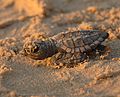
Hatchling
-
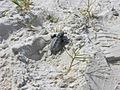
Hatchling
-
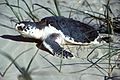
Juvenile turtle
-
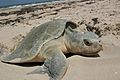
Adult turtle nesting
-
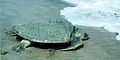
Nesting female returning to sea
-
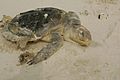
Deceased adult
.jpg)

.jpg)


See also
 In Spanish: Tortuga lora para niños
