
Luzon montane forest mouse facts for kids
The Luzon montane forest mouse (Apomys datae) is a type of rodent, like a mouse or rat. It belongs to a group of mice called Apomys.
This mouse lives only in the Philippines. It has been found on the large northern island of Luzon. You can find it in the Cordillera Central mountains and along the coast of Ilocos Norte. It is closely related to the large Mindoro forest mouse, which lives on Mindoro island. The Luzon montane forest mouse is a fairly large mouse that lives on the ground. Its tail is quite short compared to other mice in its group.
Quick facts for kids Luzon montane forest mouse |
|
|---|---|
 |
|
| Conservation status | |
Scientific classification  |
|
| Kingdom: | Animalia |
| Phylum: | Chordata |
| Class: | Mammalia |
| Order: | Rodentia |
| Family: | Muridae |
| Genus: | Apomys |
| Species: |
A. datae
|
| Binomial name | |
| Apomys datae (Meyer, 1899)
|
|
 |
|
| Range of the Luzon montane forest mouse on global scale | |
 |
|
| Range of the Luzon montane forest mouse within the Philippines (blue) | |
| Script error: The function "autoWithCaption" does not exist. | |

Script error: No such module "Check for conflicting parameters".
Contents
Discovering the Luzon Montane Forest Mouse
The Luzon montane forest mouse was the very first Apomys species ever found. In 1895, an expedition went to the Philippines. They brought back many new animals to Europe.
In February 1895, an English explorer named John Whitehead caught some unknown rats. He found them at a place called Lepanto on Mount Data. This was high up in the mountains, about 2,500 meters (8,200 feet) above sea level.
Early Descriptions and Confusions
In 1898, a British biologist named Oldfield Thomas looked at these animals. He thought they were an "interesting species." But he mistakenly identified them as Mus chrysocomus. This was a species from Sulawesi that is now known as the yellow-haired hill rat.
Thomas sent one of these mice to a museum in Germany. There, Adolf Bernard Meyer realized it was not the same as Mus chrysocomus. In 1899, Meyer described the animal as Mus datae. He named it after Mount Data, where it was found. At that time, the name Mus was used for many different mice.
For a long time, not much was known about Mus datae. In 1913, an American biologist named Ned Hollister described eight rats from Luzon. He called them Epimys datae. However, these were actually Himalayan field rats (Rattus nitidus). Another American biologist, Guy Musser, corrected this mistake in 1977.
Correcting the Mouse's Family Tree
Meanwhile, in Britain, John Ellerman finally placed Mus datae with its true relatives in the Apomys group in 1941.
Eleven years later, in 1952, an American zoologist named Colin Campbell Sanborn announced he had caught 54 A. datae mice on Mount Data. But later, scientists found that many of these were actually another species. They were Luzon Cordillera forest mousees (A. abrae). Sanborn himself had described this other species in the same article.
In 1982, Guy Musser wrote an important article. He clearly defined the Apomys group and gave the first modern description of A. datae. He also corrected Sanborn's identification errors. It turned out that Sanser had not been the only one to mix up the Apomys species from Luzon. The original specimen of Apomys Major, described in 1910, was actually an A. datae. Other animals thought to be A. major were found to be A. abrae. Because of this, Apomys major is now considered the same as A. datae.
Musser identified A. datae as the only member of the "Apomys datae group." This group was different from all other Apomys species. In the 1990s, scientists saw mice that looked like A. datae in the Sierra Madre mountains. But these were probably a different, unknown species.
In 1995, a second species was added to the A. datae group. It was the Apomys gracilirostris. In the 21st century, scientists learned even more about A. datae using genetic research. In 2002, they found its karyotype (the number and shape of its chromosomes). In 2003, DNA studies confirmed its close relationship with A. gracilirostris. Recently, this mouse has been found in several new places in northern Luzon.
Evolution and Family Relationships
The Luzon montane forest mouse belongs to a larger group called the Chrotomys division. This group of rodents lives only in the Philippines. Besides Apomys, it includes Rhynchomys, Chrotomys, and Archboldomys. All animals in this group share similar body features and genetic traits.
Within this group, Apomys is the largest and most widespread. It includes small, shy wood mice found all over the Philippines. The other groups are more specialized and are mostly found only on Luzon.
The Apomys Family Tree
In 1982, Musser divided the Apomys group into two main parts:
- The datae group, which originally contained only A. datae.
- The abrae-hylocetes group, which includes all other species.
These two groups differ in how blood flows to their heads. After Musser's article, another species, A. gracilirostris, was added to the datae group. Both A. datae and A. gracilirostris are relatively large for their group and have longer snouts.
In 2003, a study looked at the DNA of thirteen Apomys species. This study confirmed that the large Mindoro forest mouse (A. gracilirostris) and the Luzon montane forest mouse (A. datae) are closely related. It also showed that the datae group is a "sister group" to all other Apomys species. This means they share a common ancestor.
Here is a simple way to see their family tree:
| Chrotomys division |
|
||||||||||||||||||||||||||||||
When Did They Evolve?
Scientists used a "molecular clock" to estimate when these mice evolved. They believe the Luzon montane forest mouse and the large Mindoro forest mouse split apart about three million years ago. This was during a time called the Pliocene epoch.
It is also thought that the Apomys group itself started more than four million years ago. The entire Chromotys division is even older, perhaps more than ten million years old. The split between the Chromotys division and its closest relatives (a group mostly from Africa) happened about sixteen million years ago.
Since Apomys likely first appeared on Luzon, the Luzon montane forest mouse probably developed directly from its ancestors. The large Mindoro forest mouse likely came from a group that migrated to Mindoro during the Pliocene.
How to Identify the Luzon Montane Forest Mouse
The Apomys group, which includes the Luzon montane forest mouse, has some special features. They are usually small with long tails and narrow hind feet. They have four mammary glands on their belly. Their skulls also have many unique characteristics.
Physical Appearance
The Luzon montane forest mouse is a large, sturdy mouse. Its tail is about the same length as its body. Its soft, thick fur on its back is dark brown. Its belly is a creamy white color. The top of its hind feet are partly brown, but the rest is white. Its tail is brown on top and creamy white underneath.
This mouse has a large skull with a square-shaped braincase. Some features of its skull are so unique that they help tell it apart from almost all other Apomys species.
One mouse measured 143 millimeters (about 5.6 inches) from head to body. Its tail was 144 millimeters (about 5.7 inches) long. Its hind feet were 34 millimeters (about 1.3 inches) long. The mice caught by Sanborn on Mount Data had an average skull length of 39.2 millimeters (about 1.5 inches).
Chromosomes
The Luzon montane forest mouse has a karyotype of 2n=44 and FN=54. This means it has 44 chromosomes in total. Five pairs of these chromosomes have four arms, and sixteen pairs have two arms. The X-chromosome is large, and the Y-chromosome is small. This karyotype is similar to that of the least forest mouse (Apomys musculus). However, it is very different from the karyotypes of Apomys species from other parts of the Philippines. The karyotype of the large Mindoro forest mouse is not yet known.
Images for kids
-
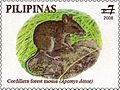
A stamp from the Philippines featuring the Luzon montane forest mouse.
-

Map showing the range of the Luzon montane forest mouse on a global scale.
-
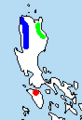
Map showing the range of the Luzon montane forest mouse within the Philippines (blue area).
