
Narrow-headed vole facts for kids
Quick facts for kids Narrow-headed vole |
|
|---|---|
_(8610008124).jpg) |
|
| Conservation status | |
Scientific classification  |
|
| Kingdom: | Animalia |
| Phylum: | Chordata |
| Class: | Mammalia |
| Order: | Rodentia |
| Family: | Cricetidae |
| Subfamily: | Arvicolinae |
| Genus: | Stenocranius |
| Species: |
S. gregalis
|
| Binomial name | |
| Stenocranius gregalis (Pallas, 1779)
|
|
| Script error: The function "autoWithCaption" does not exist. | |
| Synonyms | |
|
|
Script error: No such module "Check for conflicting parameters".
The narrow-headed vole (scientific name: Stenocranius gregalis) is a small rodent. It belongs to the Cricetidae family, which includes hamsters and other voles. This animal lives across large parts of northern and central Asia.
Scientists used to place this vole in a different group called Microtus. Now, some experts put it with Lasiopodomys voles. Others believe it should be in its own special group, Stenocranius.
Contents
About the Narrow-Headed Vole
The narrow-headed vole is a small creature. Its body, from head to tail base, is about 89 to 122 millimeters (3.5 to 4.8 inches) long. Its tail is quite short, measuring only 21 to 32 millimeters (0.8 to 1.3 inches).
You can tell this vole apart from other similar voles by looking at its skull. Its unique skull shape helps scientists identify it.
The color of its fur changes with the seasons. In summer, its back is a light yellowish-brown. The fur on its sides is lighter, blending into a yellowish-grey on its belly. In winter, its back fur becomes a brighter reddish-orange. Its tail can be all yellowish-brown or have two colors: dark brown on top and yellowish-brown underneath. Its paws are brownish-white.
Where Narrow-Headed Voles Live
The narrow-headed vole lives in the cold tundra regions of northern Asia. Its home stretches from the White Sea to the Kolyma River. You can also find separate groups of these voles in other areas.
These areas include the grassy plains of Kazakhstan and Kyrgyzstan. They also live in southwestern Siberia, the Sakha Republic, Mongolia, and northern China.
Voles prefer places with lots of grass. This includes open grasslands, semi-deserts, and grassy spots within forests. They also live in high mountain meadows and wet meadows near water. They can be found at heights of up to 4,000 meters (about 13,000 feet).
During the Ice Ages, long ago, the narrow-headed vole lived across much of Europe. As the Earth got warmer between ice ages, they moved to the Carpathians, Urals, and Asia. Some groups in Europe eventually disappeared. For example, the group in the Carpathians became extinct during the Copper Age.
Narrow-Headed Vole Behaviour
The narrow-headed vole builds a complex system of tunnels. These tunnels can go up to 25 centimeters (10 inches) deep underground. Their homes have many entrances and several special rooms for nesting.
Scientists think the vole's narrow head helps it squeeze through small cracks. This is especially useful in frozen ground. These voles are mostly active at dusk and during the night. However, they also come out during the day to find food.
They eat different kinds of plants. Their diet includes grasses, legumes (like peas and beans), and other plant parts found both above and below ground.
Reproduction and Life Cycle
Narrow-headed voles usually have their babies during the warmer months. A female vole can have about five litters (groups of babies) each year. On average, each litter has about eight young voles.
These voles are an important food source for other animals. For example, on the Yamal Peninsula, the narrow-headed vole is a main prey for the Arctic fox. Another vole, Alexandromys middendorffi, is also a key part of the Arctic fox's diet there.
Conservation Status
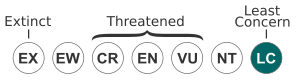
The narrow-headed vole lives in a very large area. Even though the number of voles can go up and down, there are no major threats to this species. Overall, their population seems to be stable.
Because of this, the International Union for Conservation of Nature (IUCN) has listed the narrow-headed vole as "least concern". This means they are not currently at risk of disappearing.
