
Old Persian cuneiform facts for kids
Imagine a secret code from ancient times! Old Persian cuneiform was a special writing system used by the ancient Persian Empire. It's called "cuneiform" because its letters look like tiny wedges. This script was mainly used for the Old Persian language. We've found these ancient writings in places like Iran (especially in cities like Persepolis and Susa), Armenia, Romania, and Turkey. Most of these important messages were carved during the reigns of powerful kings like Darius the Great and his son, Xerxes I, around 525 BC to 330 BC.
Discovering Old Persian Cuneiform
A Look Back: How Old Persian Cuneiform Began
The Old Persian cuneiform writing system was inspired by older scripts from the Sumerians and Akkadians. Around 521 BC, when Darius the Great became king, the Persian people didn't have their own unique way of writing. They mostly used the Elamite language for official documents.
King Darius wanted his empire to have its own special script. So, he ordered the creation of Old Persian cuneiform. This new script was much simpler than others used at the time. It had only about 34 characters, while Elamite cuneiform had around 200, and Babylonian cuneiform had about 600! This made it easier to learn and use. It also had special marks to separate words, which helped with reading.
Around 400 BC, the Aramaic script started to replace Old Persian cuneiform. The very last known text written in cuneiform, which was about stars, dates back to AD 75. Some people thought a few Old Persian texts were from earlier kings like Cyrus the Great, but experts now believe these were carved later.
Unlocking Ancient Secrets: The Decipherment Story
Imagine finding a message written in a language nobody understands! That's what happened with Old Persian cuneiform. Unlike the Rosetta Stone for Egyptian hieroglyphs, there wasn't a "cheat sheet" with translations. Scientists had to figure it out using clever guesses and detective work. They looked at how often certain signs appeared and how long groups of signs were. This helped them guess what some words might mean, especially the names of kings.
Early Explorers and Mysterious Writings
The first time anyone mentioned these ancient writings was in 1611. An ambassador from Spain and Portugal, Antonio de Gouvea, wrote about inscriptions in the ruins of Persepolis. Later, travelers tried to draw these writings. In 1700, Thomas Hyde called them "cuneiform" because of their wedge shape. But many thought they were just decorations!
Real efforts to crack the code began when good copies of the inscriptions became available. Jean Chardin published some in 1711. Then, around 1764, Carsten Niebuhr visited Persepolis and made excellent copies. He noticed there were "three different alphabets" in the writings. His careful copies were super important for starting the study of cuneiform, which we now call Assyriology.
Niebuhr realized that one of these scripts, which we now call Old Persian cuneiform, was the simplest. It had only 42 characters. He thought this meant it must be an alphabet, where each sign represents a sound.
Guessing the Word for "King"
In 1802, a smart person named Friedrich Münter agreed that the Old Persian cuneiform was likely an alphabet. He noticed a group of characters that appeared very often: 𐎧𐏁𐎠𐎹𐎰𐎡𐎹. Because it was so common and a bit long, he guessed it must be the word for "king." He was right! Today, we know it was pronounced xšāyaθiya. Münter also figured out that a special backslash sign (𐏐) was used to separate words.

Grotefend's Clever Deductions
Another brilliant mind, Georg Friedrich Grotefend, took Münter's ideas even further. He knew that in later inscriptions, a king's name was often followed by phrases like "great king, king of kings" and then the name of his father.
Grotefend looked at two inscriptions from Persepolis, called the "Niebuhr inscriptions." They seemed to use the word "King" that Münter had guessed. He noticed that the father's name in one inscription appeared as the first name in the other.
-
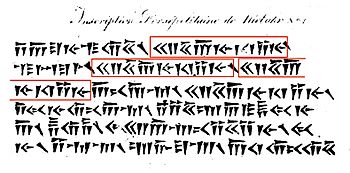
Niebuhr inscription 1, showing the word for "King" highlighted. This inscription is about King Darius.
-
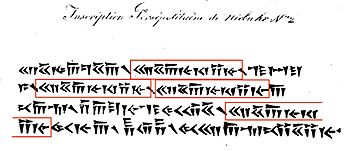
Niebuhr inscription 2, showing the word for "King" highlighted. This inscription is about King Xerxes.


By comparing the lengths of the names and using what was known about the Achaemenid kings from Greek history, Grotefend made an amazing guess. He figured out that the kings in these inscriptions must be Darius the Great, his father Hystaspes (who was not a king), and his son Xerxes. This was a huge breakthrough!
He matched the cuneiform signs 𐎭𐎠𐎼𐎹𐎺𐎢𐏁 to "Darius," 𐎧𐏁𐎹𐎠𐎼𐏁𐎠 to "Xerxes," and 𐎻𐎡𐏁𐎫𐎠𐎿𐎱 to "Hystaspes." Even though his exact pronunciations weren't perfect yet, he had correctly identified the kings!
Guessing Whole Sentences
Grotefend didn't stop there. He tried to guess the meaning of entire sentences. For the Xerxes inscription, he came up with: "Xerxes the strong King, King of Kings, son of Darius the King, ruler of the world." This was incredibly close to the modern translation: "Xerxes the Great King, King of Kings, son of Darius the King, an Achaemenian."
His method was unique because he didn't have a known language to compare Old Persian to. He used history and logic. However, many scholars didn't believe his findings at first.
Proving the Guesses Right
Grotefend's work was finally confirmed in 1823. The famous French archaeologist Champollion, who had just figured out Egyptian hieroglyphs, read an Egyptian inscription on a special vase called the "Caylus vase." This vase also had cuneiform writing.
.jpg)
The Egyptian part of the vase mentioned King Xerxes I. Champollion and another expert, Antoine-Jean Saint-Martin, could then see that the cuneiform words Grotefend had guessed for "king" and "Xerxes" were indeed correct! This proved Grotefend's amazing detective work.
Later, other scholars like Eugène Burnouf, Christian Lassen, and Sir Henry Rawlinson built on Grotefend's ideas. They helped correctly identify most of the symbols by 1847. The decipherment of Old Persian cuneiform was a huge step. It opened the door to understanding many other ancient cuneiform scripts, like Elamite, Babylonian, and Sumerian, especially with the help of the multi-language Behistun Inscription.
Understanding the Old Persian Script
How the Script Works
Many experts believe Old Persian cuneiform was a brand new invention. It didn't seem to be directly copied from other writing systems of its time. Even though it looks like other cuneiforms, its signs were often carved into hard stone. This meant the carvers had to make cuts that looked like the shapes easily made on soft clay tablets.
The letters are made from simple shapes: horizontal, vertical, and angled wedges. You can think of them as building blocks. There are a few basic wedge shapes, and new signs are created by adding more wedges to these basics. This script is read from left to right.

The script uses three vowels: a, i, u. It also has twenty-two consonants, such as k, g, d, p, m, s, and h. Some consonant symbols change their shape depending on the vowel that follows them. Other consonant symbols always look the same, and the vowel sign is written separately after them.
Here's a look at the different signs:
| Ø | ||||||||||||||||||||||||
| k- | x- | g- | c- | ç- | j- | t- | θ- | d- | p- | f- | b- | n- | m- | y- | v- | r- | l- | s- | z- | š- | h- | |||
| Ø | -(a) | 𐎠 | 𐎣 | 𐎧 | 𐎥 | 𐎨 | 𐏂 | 𐎩 | 𐎫 | 𐎰 | 𐎭 | 𐎱 | 𐎳 | 𐎲 | 𐎴 | 𐎶 | 𐎹 | 𐎺 | 𐎼 | 𐎾 | 𐎿 | 𐏀 | 𐏁 | 𐏃 |
| -i | 𐎡 | — | — | 𐎪 | 𐎮 | 𐎷 | 𐎻 | |||||||||||||||||
|---|---|---|---|---|---|---|---|---|---|---|---|---|---|---|---|---|---|---|---|---|---|---|---|---|
| -u | 𐎢 | 𐎤 | 𐎦 | — | 𐎬 | 𐎯 | 𐎵 | 𐎸 | — | 𐎽 |
- Some special symbols (logograms) represent whole words:
- Ahuramazdā (a god): 𐏈, 𐏉, 𐏊
- xšāyaθiya ("king"): 𐏋
- dahyāuš- ("country"): 𐏌, 𐏍
- baga- ("god"): 𐏎
- būmiš- ("earth"): 𐏏
- A word divider (to separate words): 𐏐
Numbers in Cuneiform
Old Persian cuneiform also had a system for writing numbers, mostly based on groups of ten. 1 𐏑, 2 𐏒, 5 𐏒𐏒𐏑, 7 𐏒𐏒𐏒𐏑, 8 𐏒𐏒𐏒𐏒, 9 𐏒𐏒𐏒𐏒𐏑,10 𐏓, 12 𐏓𐏒, 13 𐏓𐏒𐏑, 14 𐏓𐏒𐏒, 15 𐏓𐏒𐏒𐏑, 18 𐏓𐏒𐏒𐏒𐏒, 19 𐏓𐏒𐏒𐏒𐏒𐏑, 20 𐏔, 22 𐏔𐏒, 23 𐏔𐏒𐏑, 25 𐏔𐏒𐏒𐏑, 26 𐏔𐏒𐏒𐏒, 27 𐏔𐏒𐏒𐏒𐏑, 40 𐏔𐏔, 60 𐏔𐏔𐏔,120 𐏕𐏔
Old Persian Cuneiform in the Digital Age
Today, you can even find Old Persian cuneiform on computers! It was added to the Unicode Standard in March 2005. This means that these ancient symbols can now be used and displayed digitally around the world.
Template:Unicode chart Old Persian
