
Pearl facts for kids
Quick facts for kids Pearl |
|
|---|---|

Various pearls
|
|
| General | |
| Category | Carbonate mineral, protein |
| Formula (repeating unit) |
|
| Strunz classification | 05.8 |
| Identification | |
| Color | White, pink, silver, cream, brown, green, blue, black, yellow, orange, red, gold, purple, iridescent |
| Crystal system | Orthorhombic |
| Cleavage | None |
| Fracture | Uneven, various |
| Mohs scale hardness | 2.5–4.5 |
| Streak | White |
| Specific gravity | 2.60–2.85 |
| Refractive index |
|
| Birefringence | 0.156 |
| Pleochroism | Absent |
| Dispersion | None |
| Ultraviolet fluorescence |
|

A pearl is a hard, gleaming object made inside the soft body of a living shelled mollusk. Just like the animal's shell, a pearl is built from calcium carbonate, usually as the mineral aragonite or calcite. These minerals are glued together by a tough organic substance called conchiolin. Most famous pearls are shiny and round, but unusually shaped baroque pearls also exist. People have prized natural pearls as dazzling gemstones for thousands of years. In stories and books, a pearl is often used as a metaphor for something rare and precious.
Today, most genuine pearls in jewelry are cultured pearls grown on farms. Wild natural pearls are extremely rare and hard to find. People also create imitation pearls out of glass, plastic, or coated beads. In the past, pearls were sewn onto royal clothing, and some cultures ground them up for traditional medicines and cosmetics.
Contents
What Is a Pearl and How Does It Form?

Pearls form inside the soft skin-like fold of an animal called the mantle. The word pearl comes from the French word perle, which traces back to the Latin word perna. The scientific family name Margaritiferidae comes from an Old Persian word that also gave us the name Margaret.
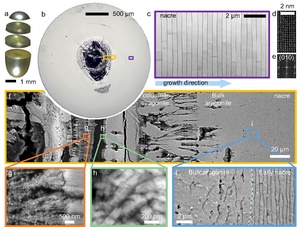
Many people believe a grain of sand starts a pearl, but that is rarely true. Usually, a tiny parasite or an injury traps stray mantle cells inside the tissue. The animal protects itself by creating a small pocket called a pearl sac. The mollusk then covers the irritant with layer upon layer of nacre, also known as mother of pearl.
Over several years, the creature builds concentric rings of crystals. If you cut a natural pearl open, you can see growth rings like those inside a tree trunk. Because pearls are made of calcium carbonate, household acids can harm them. For instance, the acetic acid in vinegar slowly dissolves a pearl into calcium acetate and carbon dioxide.
Types of Pearls and Where They Come From
Pearls come from different types of shelled animals living in fresh water or in the ocean.
Freshwater and Saltwater Pearls
Freshwater pearls grow inside river mussels from the animal family Unionidae. These animals live in rivers, lakes, and streams. A well-known type is the freshwater pearl mussel, which can be found in places like Scotland. Today, most freshwater pearls are farmed in China. In India, a town named Mehsi became famous for using river shells to carve traditional pearl buttons.
Saltwater pearls grow in ocean oysters from the family Pteriidae. Famous saltwater types include white and golden South Sea pearls, shiny Akoya pearls, and dark Tahitian pearls. Saltwater pearls are farmed in ocean bays, lagoons, and coral atolls.
Pearls from Other Sea Creatures

Almost any creature with a shell can make a pearl, though most lack shiny nacre. A malacologist, who studies mollusks, considers all of them genuine pearls. Some rare and colorful non-nacreous pearls come from the queen conch snail in the Caribbean Sea. These pink conch pearls show an optical shimmer called chatoyance. Large orange pearls come from the marine snail Melo melo, while purple pearls can form inside edible quahog clams. The largest known pearls in the world come from the giant clam in the Philippines, including the massive Pearl of Puerto.
Science and Physical Properties

The glowing luster of a fine pearl is created by the way light bounces through its translucent layers. Light waves undergo reflection, refraction, and diffraction inside the microscopic crystal plates. This bending of light produces shimmering colors called iridescence.
Scientists and jewelers test pearls using special X-ray machines. An X-ray reveals the inside of the pearl without breaking it. Natural wild pearls show solid circles of growth rings all the way to the center. Cultured pearls that were started with an implanted bead reveal a solid center core. Under a microscope, genuine pearls show tiny ridges of crystals, while smooth glass imitation pearls look completely flat.
History of Pearls

Before pearl farming began, brave divers plunged into deep waters to hunt for wild shells. Ancient records like the Mahavamsa chronicle describe rich pearl fisheries off Sri Lanka in the Gulf of Mannar. The Roman writer Pliny the Elder wrote about the incredible pearl beds of the ancient world. People also dived for pearls in the Persian Gulf and the Red Sea. During the ancient Han dynasty, pearl divers explored the South China Sea.
In the 1500s, Spanish explorers found vast oyster beds near the island of Cubagua and Margarita in South America. A famous discovery called the La Peregrina pearl was owned by King Philip II of Spain and worn by European royalty for centuries. In 1917, jeweler Pierre Cartier bought a famous mansion on Fifth Avenue in New York City by trading a magnificent double strand of natural pearls.
In the early 20th century, scientists and inventors like Kokichi Mikimoto and William Saville-Kent helped develop modern pearl farming methods. Instead of hunting through thousands of wild oysters, farmers learned to place a small bead inside an oyster to start the process safely.
Pearls in Jewelry

Jewelers sort pearls by their size, shine, shape, and color. Perfectly round pearls are the most traditional, but tear-shaped pearls make beautiful pendants. Designers describe pearl necklace lengths with classic names:
- A collar fits snugly against the throat at 10 to 13 inches.
- A choker sits at the base of the neck at 14 to 16 inches.
- A princess length reaches the collarbone at 17 to 19 inches.
- A matinee length falls just above the chest at 20 to 24 inches.
- An opera length measures 28 to 35 inches.
- A pearl rope is any long strand over 45 inches.
Related pages
See also
 In Spanish: Perla para niños
Images for kids
-
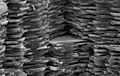
Electron microscope view of a broken nacre surface
-
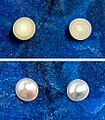
Cross-section of river pearls showing internal growth rings
-

Round shell beads used to seed cultured pearls
-

Pearl tiara made for French Empress Eugénie
-
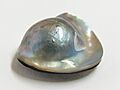
A blister pearl attached to the inside of a shell
-
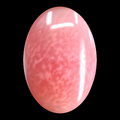
A rare natural conch pearl with flame patterns
-

Large marine snail shell beside smooth orange pearls
-

A pendant featuring an orange conch pearl
-

Old diving suit used by pearl divers in the Persian Gulf
-

Medieval drawing of pearl fishing
-

A worker opening a farmed oyster to collect a pearl
-
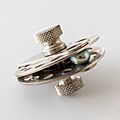
Jeweler clamp holding a pearl for careful drilling
-
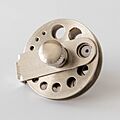
Front view of a pearl held securely in a drilling clamp
-

Antique watch and chain covered in small pearls
-

Portrait of an English duke wearing pearl jewelry
-
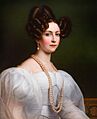
Empress of Brazil wearing a double necklace of pearls
-

Queen Margherita of Italy wearing many strands of pearls
-
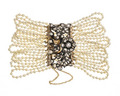
Gold bracelet set with pearls from the 1840s
-

A pair of dangling pearl earrings
-

Historic painting showing a merchant trading pearls
-
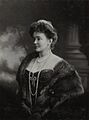
Princess Louise wearing multiple long ropes of pearls
-
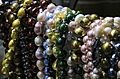
Strands of colorful dyed pearls


