
Penny (British decimal coin) facts for kids
| United Kingdom | |
| Value | £0.01 pound sterling |
|---|---|
| Mass | 3.56 g |
| Diameter | 20.3 mm |
| Thickness | |
| Edge | Plain |
| Composition | |
| Years of minting | 1971–2023 |
| Obverse | |
 |
|
| Design | King Charles III |
| Designer | Martin Jennings |
| Design date | 2023 |
| Reverse | |
 |
|
| Design | Hazel dormouse |
| Designer | The Royal Mint |
| Design date | 2023 |
The British decimal penny (1p) is a small, copper-coloured coin used across the United Kingdom. It is a part of sterling coinage and is worth 1⁄100 of a single British pound. People use it every day as standard pocket change. The front side, known as the obverse, showed Queen Elizabeth II for over fifty years. Her portrait appeared on the coin from 15 February 1971, when the country celebrated Decimal Day, until her passing in 2022. Coins made after 2022 feature a portrait of King Charles III, designed by an artist named Martin Jennings. The back side, or reverse, has displayed different images over time, including an ancient castle gate, a royal shield, and a sleepy woodland animal.
Contents
Understanding the British Penny Coin
The penny is the smallest value coin in British money. Even though it is tiny, billions of these coins exist. In fact, experts counted more than ten billion pennies circulating across towns and cities in 2016. That equals around £105,000,000 in total value.
What Does the Word Penny Mean?
The name penny comes from an ancient Old English word called penig. That word grew out of an even older language known as proto-Germanic. People use two different plural words depending on what they mean. If you are counting separate metal discs, you say pennies. For instance, you might have ten shiny pennies inside your piggy bank. When you talk about the price or total value of an object, you say pence. A tasty apple might cost fifty pence.
How Does Legal Tender Work for Pennies?
You might hear people say that coins are legal tender. In Britain, this rule is a technical legal term about settling debts. By law, someone only has to accept pennies for payments up to 20p. You cannot legally pay for a new bicycle using huge buckets filled with thousands of pennies. However, normal shops can choose how you pay for sweets or toys during everyday visits.
History of the Decimal Penny
Before 1971, the British money system was very different and quite tricky to calculate. It used a system of pounds, shillings, and pence. In that old system, one single pound contained 240 old pennies.
Moving to the Decimal System
In March 1966, a British politician named James Callaghan announced a big plan. The government planned to simplify the money system completely. Instead of 240 pence, each pound would contain exactly 100 new pence. This shift made everyday maths much simpler for shoppers, shopkeepers, and school pupils.
Changing money meant that the government needed totally new coins. Parliament passed the Decimal Currency Act 1969 and later the Currency Act 1971. These laws set the exact weight and size of the new one penny coin. Each penny had to weigh 3.564 grams and measure about two centimetres across. Later, the Currency Act 1983 let officials update coin rules by royal proclamation.
To prepare for the big launch, a huge new coin factory opened in Llantrisant, a town in South Wales. The workers at this Royal Mint factory began pressing millions of shiny pennies in late 1968. By the end of 1971, they had minted over 1.5 billion pennies. The new coins officially entered everyday use on 15 February 1971.
What Are Pennies Made Of?
Pennies look like they are made of solid copper, but their true recipe has changed over time. From 1971 until 1992, each coin was made from solid bronze. This metal mixture contained 97% copper, 2.5% zinc, and 0.5% tin.
Over the years, metal became much more expensive around the world. By 1992, the raw copper inside an old penny was worth more than one pence itself. To save money, the mint changed the recipe. They began making the coins from strong steel. Then, they used copper plating to cover each steel disc in a thin copper shell. Because of the steel core, any British penny made after 1992 will stick right to a magnet. Old bronze pennies from before 1992 will not stick to magnets at all.
Exploring the Coin Designs
Every coin has two distinct sides that tell a story through art. The front side shows the ruler of the nation, while the back side features national symbols or wildlife.
The Monarch on the Front
During her long reign, Queen Elizabeth II appeared in four different portraits on the decimal penny. Around the edge, coins include Latin abbreviations such as D.G.REG.F.D., which stand for ancient royal titles. Early versions also had tiny raised dots around the rim, known as beading.
- The first portrait was created by Arnold Machin in the 1960s. It showed the Queen wearing the famous 'Girls of Great Britain and Ireland' Tiara.
- In 1985, a new sculpted portrait by Raphael Maklouf arrived. It showed the monarch wearing the George IV State Diadem alongside shiny earrings and a necklace.
- In 1998, an artist named Ian Rank-Broadley designed a third portrait. His picture showed the Queen as an older woman, creating a very realistic image.
- The fourth portrait arrived in 2015, created by coin designer Jody Clark.
In 2023, the Royal Mint released a new portrait of King Charles III designed by Martin Jennings. Unlike the Queen's portraits, King Charles faces towards the left and does not wear a crown. The Latin words DEI.GRA.REX.FID.DEF. appear around the border, alongside the year of manufacture.
Famous Back Side Designs

The reverse side of the penny has changed several times since decimalisation began.
The original design was drawn by an artist named Christopher Ironside. It showed an iron gate called a portcullis with heavy chains hanging down. This gate was an old royal badge linked to King Henry VII of England. Today, that same badge represents the Palace of Westminster, where the British Parliament meets. The word "NEW PENNY" was stamped above the gate until 1982, when it changed to read "ONE PENNY".
In 2008, a talented designer named Matthew Dent won a national competition to rethink British coins. He designed coins that fit together like a giant jigsaw puzzle. The 1p, 2p, 5p, 10p, 20p, and 50p coins each show a small piece of the Royal Shield. When you push all the coins together, they reveal the complete shield design. The 1p piece shows the left part of the shield, representing both England and Northern Ireland.
In late 2023, the Royal Mint revealed a fresh look celebrating nature. The latest reverse design features a cute hazel dormouse curled up safely among leaves. This tiny creature reminds everyone about protecting British woodland habitats.
The Value of the Penny Today
The purchasing power of the penny has changed dramatically because of inflation. Economists talk about purchasing power as real terms value. Today, a penny buys much less than it did decades ago.
Comparing Historic Small Coins
Britain has used many tiny coins throughout its long history. Over the years, earlier coins lost value and were taken out of circulation.
- The tiny Half farthing was withdrawn in 1870.
- The famous Farthing, worth a quarter of an old penny, vanished in 1960.
- The pre-decimal halfpenny was taken out of use in 1969.
- The old pre-decimal penny retired on Decimal Day in 1971.
- A tiny decimal halfpenny existed briefly until 1984.
Since around 2002, the modern 1p coin has held lower buying power than any other coin in British history. That includes every coin minted since the famous Acts of Union joined England and Scotland together.
Will the Penny Disappear?
Because people use digital bank cards and phones to buy things, some politicians have wondered about retiring copper coins. Former government leaders, such as George Osborne and David Cameron, discussed this topic. Experts from the Bank of England found that removing 1p coins would not harm the economy.
However, many people still love using pennies. Charities rely on loose pennies dropped into collection tins to fund important work. Family amusement arcades at the seaside also rely on 1p coins for fun coin-pusher games. In 2019, Chancellor Philip Hammond promised that copper coins would remain in use so everyone can choose how they spend money. Even though fewer are made each year, the humble penny continues to be an iconic piece of British daily life.
Images for kids
-
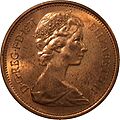
The original 1971 obverse design of Queen Elizabeth II
-
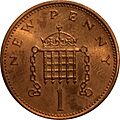
The portcullis reverse from the 1971 decimal release
-
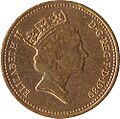
The second portrait of Queen Elizabeth II introduced in 1985
-
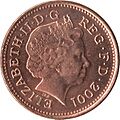
The third portrait of Queen Elizabeth II designed by Ian Rank-Broadley
-

The Royal Shield reverse design introduced in 2008
-

The fourth portrait of Queen Elizabeth II designed by Jody Clark


See also
 In Spanish: Un penique para niños
