
Porpita porpita facts for kids
Quick facts for kids Porpita porpita |
|
|---|---|
 |
|
| Blue button | |
Scientific classification  |
|
| Kingdom: | Animalia |
| Phylum: | Cnidaria |
| Class: | Hydrozoa |
| Order: | Anthoathecata |
| Family: | Porpitidae |
| Genus: | Porpita |
| Species: |
P. porpita
|
| Binomial name | |
| Porpita porpita (Linnaeus, 1758)
|
|
| Script error: The function "autoWithCaption" does not exist. | |
Script error: No such module "Check for conflicting parameters".
The Porpita porpita, often called the blue button, is a fascinating marine creature. It's not a single animal, but a group of tiny animals called hydroids living together as a colony. You can find these blue buttons floating in the warm, tropical and sub-tropical waters of the Pacific, Atlantic, and Indian oceans. They also live in the Mediterranean Sea and the eastern Arabian Sea.
Even though a blue button looks a lot like a small jellyfish, it's actually quite different! Each blue button is a colony of many tiny hydrozoan polyps. This means it's related to other sea creatures like anemones, corals, and jellyfish, all belonging to the phylum Cnidaria.
Contents
Discovering the Blue Button
The blue button was first described by a famous scientist named Carl Linnaeus in 1758. He initially named it Medusa porpita. This organism is part of a special group of cnidarians called Chondrophora, which also includes another interesting floater called Velella. Chondrophores are similar to siphonophores, a group that includes the well-known Portuguese man o' war.
What Does a Blue Button Look Like?

A blue button can grow up to about 30 millimeters (which is about 1.2 inches) across. It spends its life floating on the ocean's surface. It has two main parts: a float and a colony of hydroids.
The float is round, almost flat, and has a golden-brown color. It's about an inch wide. This float helps the blue button move up and down in the water. It also has tiny pores that might help it communicate with other blue buttons or sense its surroundings.
The hydroid colony is made up of many small polyps. These polyps can be bright blue, turquoise, or even yellow. They look a bit like the tentacles you might see on a jellyfish. Each polyp has many small branches, and at the end of these branches are stinging cells called nematocysts.
The blue button has a single mouth located underneath its float. This mouth is used for both eating food and getting rid of waste. Around the mouth, there are special polyps called gonozooids and dactylozooids. The dactylozooids are found further away from the mouth, towards the outer edge of the colony, and these are the ones that have the tentacles.
Is Its Sting Dangerous?
The blue button's sting is generally not powerful for humans. If you accidentally touch one, it might cause a slight irritation to your skin, perhaps a mild itch or a little redness, similar to brushing against a stinging nettle plant. It's usually nothing to worry about.
However, with more blue buttons potentially appearing closer to shorelines, there's a slightly higher chance of people coming into contact with them. In fact, the first recorded case of contact dermatitis (which is a type of skin rash or irritation) specifically from this species was recorded in Japan. This doesn't mean they are dangerous, but it's a good reminder to always observe marine life without touching it, just to be safe and respectful of their home.
Where Do Blue Buttons Live and What Do They Eat?
The blue button is part of the neustonic food web. This means it lives right at or near the very surface of the ocean. It's a "passive drifter," which means it doesn't swim on its own. Instead, it relies on ocean currents and wind to carry it across the seas.
Unlike some other drifters that just wait for food to come to them, the blue button actively hunts. It mainly eats small crustaceans like copepods and tiny crab larvae. It competes with other floating organisms for these food sources.
-
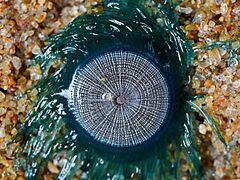
The central disk of a blue button, about 1.5 cm wide.
-
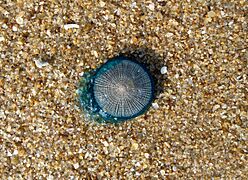
A blue button found in the Bay of Bengal.
-
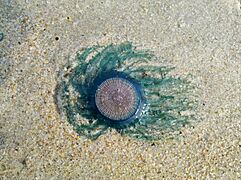
A blue button from the Arabian Sea.
-
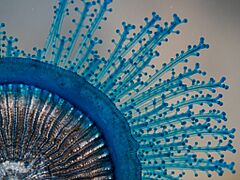
A close-up view of the polyps.

_Blue_button_at_Thotlakonda_Beach_06.JPG)
_Blue_button,_found_on_Uttorda_Beach,_Goa,_India.jpg)

Predators
Even though it has those mild stinging cells, the blue button isn't safe from everyone! It has its own predators in the ocean. One of its most famous eaters is the incredible sea slug Glaucus atlanticus, often called the "sea swallow" or "blue dragon." This beautiful blue and silver sea slug actually eats other stinging creatures and can even store their stinging cells to use for its own defense! Another predator is the violet sea-snails of the genus Janthina, which are also beautiful purple snails that float on the surface. There's even another type of "blue dragon" sea slug, Glaucus marginatus, that preys on the blue button.
Friends in the Ocean: The Blue Button and Fish
Sometimes, young Carangoides malabaricus fish, also known as 'Malabar trevally', find shelter underneath the floats of blue buttons. It's like a safe hiding spot for them! If these young fish are taken away from their blue button host, they can become stressed. Interestingly, these juvenile fish seem to prefer a specific blue button. If you separate pairs of fish and blue buttons and then put them back together in the same tank, each fish will often return to its original blue button partner.
Blue Buttons and Our Changing Oceans
In recent years, scientists have observed some changes in blue button populations. For example, colonies of Porpita porpita (sometimes called Porpita pacifica) have been appearing in larger numbers along coastlines in Japan. The first recorded case of skin irritation from this species was noted there. A similar increase in blue button populations has also been seen in the Ionian and Adriatic seas. Scientists believe these changes, including the increased numbers, might be linked to rising ocean temperatures due to global warming.
