
Ruth Anna Fisher facts for kids
Quick facts for kids
Ruth Anna Fisher
|
|
|---|---|

1920
|
|
| Born | March 15, 1886 |
| Died | January 28, 1975 |
| Education | Oberlin College (A.B. 1906) |
| Occupation | Archivist and historian |
Ruth Anna Fisher (born March 15, 1886 – died January 28, 1975) was an American historian, archivist, and teacher. She was very important in finding and collecting old documents from British archives. These documents helped the Carnegie Institution and the Library of Congress learn more about American history.
Contents
Ruth Anna Fisher's Early Life
Fisher was born in Lorain, Ohio. Her father, David C. Fisher, worked with real estate and ice. Her mother was Elizabeth Dorsey. Ruth graduated from Oberlin College in 1906. She was offered a job at the Tuskegee Institute. However, she soon left because she disagreed with Booker T. Washington about teaching methods. She also did not want to be involved in the school's Sunday School.
After leaving Tuskegee, Fisher taught in schools in Lorain and Indianapolis. She also taught at the Manassas Industrial School for Colored Youth in Manassas, Virginia. She studied music at the Canadian Academy of Music in Toronto. Later, she managed a fun center at a YWCA in New York City. Her work at the YWCA connected her with Eva del Vakia Bowles, an important organizer. Meeting soldiers returning from World War I in France made her see how different life was for Black people in the U.S. compared to Europe. In 1920, someone offered to pay for her to study abroad for a year. Fisher chose to go to the London School of Economics.
Becoming an Archivist and Historian
While in London, Fisher met J. Franklin Jameson, a historian. Jameson was looking for documents about American history for the Carnegie Institution. He thought highly of Fisher and supported her throughout her career. He even helped her pursue her dream of becoming an opera singer. She received a scholarship to study music in London in 1931. However, a surgery stopped her musical career. After Jameson passed away, Fisher helped edit a book of tributes from other historians.
In 1927, Fisher started working for the Library of Congress. Her job was to oversee the copying of American history materials found in British archives. This project copied about 100,000 pages each year once photo copying became common. Fisher believed she was the only foreign woman to have her own key at the British Museum. She returned to the United States in 1940. This was because her apartment was bombed during an air raid on London. She went back to England to continue her research in 1949.
Her last years with the Library of Congress were from 1952 until she retired in 1956. She worked in Washington, DC. By then, she felt that their work in London had found most of the important historical documents about American history in England. She still thought new discoveries might pop up from private collections.
Many historians thanked Fisher in their books. They found her skill in finding rare documents very helpful. One important discovery was the original copy of a secret agreement. This agreement was signed by Toussaint Louverture and British general Thomas Maitland (British Army officer) on August 31, 1798. It ended the British blockade on Saint-Domingue. In return, Louverture promised not to spread the Haitian Revolution to the British colony of Jamaica.
Ruth Anna Fisher During World War II
Fisher had lived in London for about 20 years when World War II began. The bombing in London that destroyed her home also ruined almost all her belongings. Only a small book of wise sayings was left.
Back in the U.S., she found Washington, D.C., very different from London. She wrote to her friend W. E. B. Du Bois about her feelings. She felt that some groups in the U.S. were similar to military groups in other countries. She thought they believed in their own race being better than others. She also felt these groups controlled the army and navy. She compared the Ku Klux Klan to other powerful groups. She worried that a leader like Hitler could rise in the U.S. under these conditions.
She stayed in touch with her friends in the U.K. She shared some of their thoughts from letters with Du Bois's new magazine, Phylon.
Ruth Anna Fisher's Social Views
Ruth Anna Fisher was mainly a researcher. But she cared deeply about racial issues from a young age. She knew many people who worked for civil rights and better chances for Black Americans. She wrote friendly letters to W. E. B. Du Bois for 50 years.
She went to the 2nd Pan-African Congress in London in 1921. Fisher was also active in the Association for the Study of African American Life and History. She spoke at their meeting in Columbus, Ohio, in 1941.
In 1941, she thought about why World War II started. She said that unhappiness that led to Hitler was not just in Germany. She believed that ordinary people worldwide were tired of being poor. They did not want to work to make their country rich unless they got their fair share. She said their demand was simple: they wanted the ideas of democracy to be real for them.
When she was 77, Fisher took part in the March on Washington for Jobs and Freedom. This big event happened on August 28, 1963.
Ruth Anna Fisher's Writings
- Extracts from the Records of the African Companies (Washington, DC: Association for the Study of Negro Life and History, 1930)
- 'Legend of the Blue Jay' in Musser, Judith, ed., "Girl, colored" and Other Stories : A Complete Short Fiction Anthology of African American Women Writers in The Crisis Magazine, 1910-2010 (Jefferson, NC: McFarland & Co., 2011)
Edited Works by Ruth Anna Fisher
- J. Franklin Jameson: A Tribute (Washington, DC: Catholic University of America Press, 1965)
Ruth Fisher's personal papers are kept at the Library of Congress.
Images for kids
-
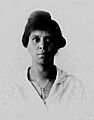
Ruth Anna Fisher in 1920
