
Scat singing facts for kids
_(cropped).jpg)
Scat singing is a fun and creative way to sing in vocal jazz. It's like using your voice as a musical instrument! Instead of singing words, scat singers make up melodies and rhythms using sounds like "doo-wop" or "shoo-bee-doo." It's all about making music up on the spot with your voice. This style is different from vocalese, where singers put words to existing instrumental solos.
Contents
What is Scat Singing?
Scat singing is a unique way to use your voice as an instrument. Instead of words, singers create melodies and rhythms with sounds like "doo-wop" or "shoo-bee-doo." It's all about making music up on the spot with your voice.
How Scat Singing Works
Even though scat singing is improvised, it often follows musical rules. Singers use parts of scales and arpeggios (broken chords). They also use common musical phrases called riffs, just like instrumental musicians do.
Scat performances usually have a clear structure. For example, when Ella Fitzgerald sang "How High the Moon" using scat, she always started with the song's original words. Then, she would move into her amazing improvised scat section. It was like following a plan, but making it sound fresh every time.
Choosing Scat Sounds
The sounds a scat singer chooses are very important. These sounds, called syllables, affect how the music sounds. They change the pitch (how high or low), articulation (how clear each sound is), and overall feel of the song.
Different jazz singers had their own favorite scat sounds. Betty Carter liked soft, flowing sounds like "louie-ooie-la-la-la." Sarah Vaughan often used sharper sounds like "shoo-doo-shoo-bee-ooo-bee." These choices helped create their unique singing styles.
Singers can also pick syllables to sound like musical instruments. Ella Fitzgerald's scat often sounded like the big bands she performed with. Sarah Vaughan's scat, however, sounded more like the smaller, faster bop groups she sang with.
Adding Humor to Scat
Scat singing can also be very funny! Famous bandleader Cab Calloway was known for his humorous scat. Other singers like Slim Gaillard and Leo Watson also used humor in their performances.
For example, in a 1945 song called "Avocado Seed Soup Symphony," singers scatted many different sounds using the word "avocado." This made the song playful and entertaining.
Singers also add humor by quoting other songs. This means they briefly sing a melody from a well-known tune within their scat. Leo Watson sometimes used parts of nursery rhymes. Ella Fitzgerald often included melodies from popular songs in her scat, like "A-Tisket, A-Tasket" in her famous "How High the Moon" performance.
The History of Scat Singing
Singing with made-up sounds isn't new! Many cultures around the world have similar traditions. For example, there's lilting in Ireland, German yodeling, and joik singing by the Sámi people.
Early Scat Singers
While many people think Louis Armstrong started modern scat singing in 1926, it actually existed before him. Singers like Gene Greene recorded scat parts in his songs as early as 1911.
Other early examples include Al Jolson in 1911 and Cliff "Ukulele Ike" Edwards in 1923. One of the first female singers to use scat was Aileen Stanley in her 1924 song "It Had To Be You."
The famous jazz pianist Jelly Roll Morton believed that scat singing started even earlier. He said that a comedian named Joe Sims from Vicksburg, Mississippi, was the first to scat around the year 1900. Morton and other musicians in New Orleans then picked up the style.
Morton explained that scat doesn't have a specific meaning. It's just a way to add a special "flavor" to a song. He even claimed he and Tony Jackson were using scat for fun in 1906, long before Louis Armstrong became famous for it.
Louis Armstrong and "Heebie Jeebies"
Even with earlier examples, Louis Armstrong's 1926 recording of "Heebie Jeebies" was a huge moment for scat singing. It helped shape how modern scat would sound.
There's a famous story about how it happened. While recording with his band, The Hot Five, Armstrong's sheet music supposedly fell. To keep the song going, he started making up sounds instead of words.
He thought the recording would be thrown away, but everyone loved it! This version of "Heebie Jeebies" became a huge hit. After that, scat singing became strongly linked to Louis Armstrong.
His style inspired many others, including Cab Calloway. Calloway's scat solos even influenced George Gershwin when he wrote his famous 1935 opera Porgy and Bess.
Scat Spreads Wide
After Armstrong's success, many popular songs started featuring scat singing. In 1927, Bing Crosby and Harry Barris of "The Rhythm Boys" used scat in songs like "Mississippi Mud."
That same year, Duke Ellington's Orchestra recorded "Creole Love Call" with Adelaide Hall singing wordlessly. Her unique vocal sounds were praised for acting like another instrument in the band.
During the Great Depression, groups like The Boswell Sisters regularly used scat in their music. They even scatted together in harmony, which was very complex. Their creative use of scat inspired a young Ella Fitzgerald.
Ella Fitzgerald became an incredibly talented scat singer. She was widely considered one of the best vocal improvisers in jazz history. Other famous scat singers from this time included Scatman Crothers and Nat Gonella. Gonella's scat recordings were even banned in Nazi Germany during the 1930s.
Scat in Modern Music
As jazz music grew and changed, so did scat singing. In the 1940s, during the bop era, vocal improvisation became even more popular. Singers like Annie Ross, Eddie Jefferson, Betty Carter, Sarah Vaughan, and Dizzy Gillespie all became known for their scat skills.
In the 1960s, Ward Swingle took scat singing and applied it to classical music, creating The Swingle Singers. Scat was also famously used in the Disney movie The Jungle Book (1967) in the song "I Wan'na Be Like You."
The 1970s saw a renewed interest in bop scat singing. The style continues to evolve today, with vocal improvisation often developing new sounds and techniques.
In the mid-1990s, Scatman John brought scat singing to pop music and eurodance. His 1994 hit song "Scatman (Ski Ba Bop Ba Dop Bop)" made the genre popular worldwide again. Today, artists like Bobby McFerrin continue to push the boundaries of wordless singing.
Different Kinds of Scat
Scat singing has developed into several interesting forms.
Vocal Bass: Singing Basslines
Vocal bass is a type of scat singing where a person uses their voice to sound like a bassline played by a bass guitar. It's often used by bass singers in a cappella groups. They work with a vocal percussionist or beatboxer to create a full rhythm section with just their voices.
Some well-known vocal bass artists include Tim Foust, Bobby McFerrin, and Al Jarreau.
Scat in Hip Hop Music
Many hip hop artists and rappers use scat singing to help them create the rhythms for their raps. They might scat out a rhythm first, and then fill in the words later.
Tajai from the group Souls of Mischief explained this process, saying he often makes a "scat kind of skeleton" for the flow before adding lyrics. Rapper Tech N9ne has also shown how he uses this method.
Where Did Scat Singing Come From?
People have different ideas about how scat singing began.
African Music Connections
Some believe scat singing has roots in African musical traditions. In many African cultures, the human voice and instruments are very similar. They blend together so well that it's hard to tell them apart.
In West African music, drum rhythms are often turned into vocal melodies using specific syllables. However, scat singing also involves free improvisation, which might mean it developed uniquely in the United States.
Scat and Instrumental Music
Another idea is that scat singing came from jazz musicians practicing their instrumental solos vocally. They would sing a melody or "riff" before playing it on their instrument. A common saying in early New Orleans jazz was, "If you can't sing it, you can't play it."
This practice allowed musicians like Louis Armstrong to easily switch between playing an instrument and scatting with their voice.
Irish Lilting Similarities
Scat singing also shares similarities with lilting or diddling, a vocal music style from Ireland and Scotland. In lilting, people use nonsense syllables to sing dance tunes that usually don't have words.
Images for kids
-
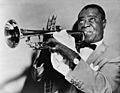
Paul Berliner suggested that scat singing might have come from instrumental soloists like Louis Armstrong (pictured) singing jazz melodies.

See also
 In Spanish: Scat (música) para niños
