
Secret Treaty of Vienna facts for kids

French Foreign Minister Talleyrand; the treaty provided him an opportunity to end French diplomatic isolation
|
|
| Signed | 3 January 1815 |
|---|---|
| Location | Vienna |
| Condition | Defensive alliance in case of attack by another party |
| Expiration | 8 February 1815 |
| Signatories |  Talleyrand Talleyrand Metternich Metternich Castlereagh Castlereagh |
| Parties | France Austria Great Britain |
The Secret Treaty of Vienna was a special agreement signed on January 3, 1815. It was a defensive alliance between France, the Austrian Empire, and Great Britain. This treaty happened during the Congress of Vienna, a big meeting where European leaders discussed what to do after Napoleon was defeated.
The main goal of the treaty was to warn Prussia and Russia. These two countries wanted to take over large parts of Saxony and Poland. Other countries, especially Britain and Austria, worried this would make Prussia and Russia too powerful.
Charles Maurice de Talleyrand-Périgord, France's representative, saw a chance to help his country. France had been isolated after Napoleon's wars. By supporting Britain and Austria, Talleyrand could show that France was a reliable partner again. The treaty helped prevent a new war and led to compromises between the major powers.
Contents
Europe After Napoleon

After Napoleon was defeated in 1814, European leaders met at the Congress of Vienna. This big meeting in Austria was held to decide the future of Europe. The main winners of the war – Britain, Austria, Prussia, and Russia – were there. France, now under a new king, also had a seat.
The leaders had many important tasks. They needed to redraw national borders that Napoleon had changed. They also set up rules for things like shipping on international rivers. One of the biggest challenges was deciding what to do with the Kingdom of Saxony and the Duchy of Poland.
The Polish-Saxon Problem
Prussia and Russia had a plan that caused a lot of trouble. Russia wanted to control a new Polish state. In return, Prussia wanted to take most of Saxony. This idea worried Austria and Britain. They thought it would give Prussia and Russia too much power. This disagreement became known as the Polish-Saxon crisis.
Charles Maurice de Talleyrand-Périgord, the French diplomat, saw an opportunity. He was worried about a stronger Prussia. But he also wanted to end France's isolation. By supporting the rights of Saxony's king, Talleyrand made France look like a defender of fairness. This helped France regain its place among the major powers.
Tensions grew high in late 1814. Russia's Grand Duke Konstantin went to Warsaw. Prussian generals returned to Berlin. Austria moved its troops into Galicia. A Russian commander even tried to give Saxony to Prussia, claiming Austria and Britain had agreed.
The Secret Agreement
Prussia threatened to take Saxon land by force if they didn't get it through talks. To stop this, Talleyrand suggested a defensive alliance. He spoke with Lord Castlereagh from Britain and Klemens von Metternich from Austria. They agreed that a secret treaty would warn Prussia and Russia. It would also strengthen their position in talks about Poland.
The three powers signed the treaty on January 3, 1815. They agreed to help each other if attacked. Each country promised to provide a large army of 120,000 foot soldiers and 30,000 cavalry. Britain, with a smaller army, could pay other countries to supply troops instead. The leaders did not expect to go to war, but they wanted to show they were serious.
News of the treaty was deliberately leaked to Tsar Alexander I. This was meant to intimidate him. Russia had been weakened by years of war. The Tsar backed down and accepted a smaller, semi-independent Polish state. In February, Prussia also agreed to take only 40% of Saxony. The treaty achieved its goals and was cancelled on February 8, 1815.
Napoleon's Return and Aftermath

While the Congress was still meeting, Napoleon escaped from exile on March 1. He returned to France, gathered an army, and took back power from King Louis XVIII. The major European powers quickly formed armies against him. These included British and Dutch forces under the Duke of Wellington and a Prussian army under Gebhard Leberecht von Blücher.
Napoleon tried to use the secret treaty to cause trouble between Wellington and Blücher. He sent a copy of the treaty to Blücher, hoping to make him suspicious of Wellington. However, the treaty's details were already known. Wellington reassured the Prussians that he would work with them. He even sent an officer, Henry Hardinge, to help coordinate their plans.
Some Prussian soldiers, especially those from Saxony, were not fully loyal. Many Saxons had fought for Napoleon before. When ordered to join the Prussian army, some refused. They cheered for their old king and Napoleon. Blücher even had to order some of them shot to restore order.
Napoleon's return made the European powers work together again. After Napoleon's final defeat at Waterloo, Prussia's role in the victory was rewarded. They received about 60% of Saxony, along with other territories like the Rhineland.
The Secret Treaty was a big success for Talleyrand. He ended France's isolation and helped divide the other major powers. He also made sure that Prussia's new lands were not easy to control. Talleyrand's actions helped France become an important player in keeping Europe balanced and secure.
Later, Prussia, Russia, and Austria signed the Holy Alliance. Britain's Castlereagh refused to rejoin the Secret Treaty. Instead, he worked to make the Quadruple Alliance a group that would guarantee peace in Europe. The borders set by the Congress of Vienna helped create a stable "Concert of Europe" that lasted for about 40 years.
Images for kids
-
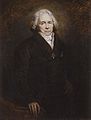
French Foreign Minister Talleyrand
-
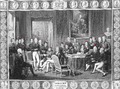
Representatives at the Congress of Vienna
-
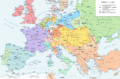
Boundaries agreed at the Congress of Vienna
