
Souimanga sunbird facts for kids
Quick facts for kids Souimanga sunbird |
|
|---|---|
_male.jpg) |
|
| male | |
_female.jpg) |
|
| female both C. s. apolis at Toliara |
|
| Conservation status | |
Scientific classification  |
|
| Kingdom: | Animalia |
| Phylum: | Chordata |
| Class: | Aves |
| Order: | Passeriformes |
| Family: | Nectariniidae |
| Genus: | Cinnyris |
| Species: |
C. sovimanga
|
| Binomial name | |
| Cinnyris sovimanga (Gmelin, JF, 1788)
|
|
| Script error: The function "autoWithCaption" does not exist. | |
| Synonyms | |
|
Nectarinia sovimanga |
|

Script error: No such module "Check for conflicting parameters".
The Souimanga Sunbird (Cinnyris sovimanga) is a small, colorful passerine bird. It is part of the sunbird family, called Nectariniidae. These birds live on islands in the western Indian Ocean. You can find them in places like Madagascar, the Aldabra Group, and the Glorioso Islands.
Contents
About Their Names
Scientists give every animal a special two-part name. This helps everyone know exactly which animal they are talking about. The Souimanga Sunbird was first officially described in 1788. A German scientist named Johann Friedrich Gmelin gave it the scientific name Certhia sovimanga.
The name sovimanga comes from a French name for the bird, Souï-manga. Today, this bird is placed in a larger group of sunbirds called Cinnyris.
Different Types of Souimanga Sunbirds
There are five slightly different types, or subspecies, of the Souimanga Sunbird. They live in different areas:
- C. s. sovimanga: Found in the Glorioso Islands and most of Madagascar.
- C. s. apolis: Lives in southern Madagascar.
- C. s. aldabrensis: Found on Aldabra Island.
- C. s. abbotti: Lives on Assumption Island.
- C. s. buchenorum: Found on Cosmoledo and Astove Atoll.
One of these types, C. s. abbotti, was sometimes thought to be its own separate species. It was called Abbott's Sunbird.
What They Look Like
The Souimanga Sunbird is about 10 centimeters (4 inches) long. Its wings can spread about 13 centimeters (5 inches) wide. It has a long, thin, and curved black beak.
Males and Females
Male birds of the main type have a shiny metallic green head, back, and throat. Their chest is blackish with a red band across it. Their belly is yellow. Their wings and tail are brown. They also have yellow tufts of feathers on their sides. These tufts show when the males lift their wings to attract a mate.
After March or April, males might lose some of their bright metallic and red feathers. They get a duller set of feathers for a few months.
Female Souimanga Sunbirds look different. They have grey-brown feathers on their upper body. Their belly is a dull yellow, and their throat and chest are grey with darker marks. Young birds look similar to adult females.
Size and Calls
Some types of Souimanga Sunbirds are a bit bigger. For example, C. s. abbotti is about 11 centimeters (4.3 inches) long. Its wingspan is about 14 centimeters (5.5 inches). Males of this type have a wider red band on their chest. They do not have yellow on their underparts. Instead, their underparts are dark brown or blackish.
These birds make a "chirruping" sound when they fly. They also have a loud, rough alarm call. Only the male bird sings. His song is fast and scratchy, with phrases repeated often.
Where They Live and What They Do
Souimanga Sunbirds are very common small birds in many areas. They live alongside other birds like the Malagasy white-eye. Scientists say this bird is of "least concern" for its survival. This means there are plenty of them in the wild.
You can find the Souimanga Sunbird in many different places. They live in mountain forests, mangrove swamps, and scrublands. They also live in parks, gardens, and other areas changed by people.
They use their curved beak to reach inside flowers and drink nectar. They also eat insects and spiders. These birds do not have many natural enemies. Their nests are often built in places that most predators cannot reach.
Life Cycle and Reproduction
The Souimanga Sunbird has a long breeding season. On Aldabra, it lasts from August to March.
The nest is shaped like a dome. It has an entrance hole on the side. The birds build it from plant materials like grass stems, coconut fibers, and leaves. Nests are usually hung from a branch about 1 to 2 meters (3 to 6.5 feet) above the ground. Sometimes, they build nests on buildings or in holes in eroded coral.
The female bird lays two eggs. The eggs are whitish with reddish spots. She sits on the eggs for 13 to 14 days to keep them warm. This is called incubation. The young birds leave the nest after 16 to 18 days.
The female bird builds the nest and incubates the eggs. She also does most of the feeding for the baby birds.
Gallery
-
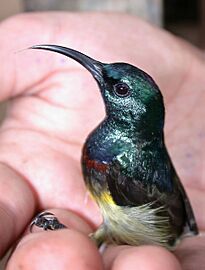
C. s. sovimanga
-

C. s. sovimanga roosting at night, Ranomafana National Park
.jpg)
_roosting_at_night_Ranomafana.jpg)
