
Southern grizzled skipper facts for kids
Quick facts for kids Southern grizzled skipper |
|
|---|---|
.jpg) |
|
| Male | |
Scientific classification  |
|
| Kingdom: | Animalia |
| Phylum: | Arthropoda |
| Class: | Insecta |
| Order: | Lepidoptera |
| Family: | Hesperiidae |
| Genus: | Pyrgus |
| Species: |
P. malvoides
|
| Binomial name | |
| Pyrgus malvoides (Elwes & Edwards, 1897)
|
|
| Script error: The function "autoWithCaption" does not exist. | |
| Synonyms | |
|
|
Script error: No such module "Check for conflicting parameters".
The Southern Grizzled Skipper, Pyrgus malvoides, is a small and quick butterfly. It belongs to a group of butterflies called skippers, which are known for their fast, darting flight. This butterfly is found in parts of Europe.
Contents
What Does It Look Like?
This butterfly has a wingspan of about 24 to 26 millimeters. That's about the size of a large coin!
It looks very much like another butterfly called the Grizzled Skipper (Pyrgus malvae). In fact, you can't tell them apart just by looking at their outside features. Scientists need to look at their internal body parts, like their reproductive organs, to know the difference.
-
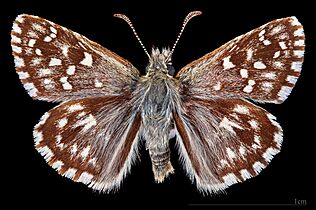
Pyrgus malvoide ♂ (top view)
-
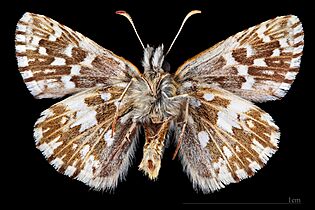
Pyrgus malvoide ♂ △ (bottom view)
_Pyrgus_malvoides_-_France_-_male_dorsal.jpg)
_Pyrgus_malvoides_-_France_-_male_ventral.jpg)
However, you can tell the Southern Grizzled Skipper apart from other types of Pyrgus butterflies. Both Pyrgus malvoides and Pyrgus malvae have clear spots near the edges of their upper wings. This helps to identify them from other Pyrgus species.
Where Does It Live?
The Southern Grizzled Skipper lives in many parts of southern and central Europe. You can find it from Portugal and Spain across southern and central France. It also lives in southern Switzerland, parts of Austria (like Vorarlberg and Tyrol), and in Italy and Istria.
What Kind of Places Does It Like?
This butterfly likes to live in different kinds of habitats, especially those that are fresh and moist. In the Alps, it prefers places with good microclimates. These are small areas with specific weather conditions. It likes open ground, like gravel, rocks, or areas where cattle have disturbed the soil.
Scientists have not yet found the Southern Grizzled Skipper living in the exact same spots as the Grizzled Skipper (Pyrgus malvae). It is also hard to know exactly which plants the caterpillars eat in the wild because the two species look so similar. However, it's thought that their food plants are very similar to those of the Grizzled Skipper.
You can find this butterfly at different heights. In Bavaria, it lives from about 800 meters up to 2000 meters above sea level. In the central Alps, it can be found even higher, up to 2500 meters.
Life Cycle and Food
When Do They Fly?
Adult Southern Grizzled Skippers can be seen flying from April to September. In Bavaria, they usually have one generation each year. This means the butterflies fly from mid-May to mid-July. In other places, like Italy, they might have two or even three generations in a year, but this is not common in Bavaria.
What Do Caterpillars Eat?
The young butterflies, called larvae or caterpillars, eat leaves from different plants. They especially like plants from the Potentilla family, also known as cinquefoils. They also eat Agrimonia (agrimony) and Fragaria (strawberry) species. Their favorite food is Potentilla erecta.
Caterpillars have been found on plants like Potentilla neumanniana, Potentilla pusilla, and Potentilla erecta. They have also been seen eating Fragaria vesca (wild strawberry) when raised by scientists.
Some of the plants caterpillars are known to eat include:
- Potentilla tabernaemontani (Switzerland, France)
- Potentilla pusilla (Switzerland, France, Italy)
- Potentilla erecta (Switzerland, Spain)
- Potentilla aurea (Austria)
- Potentilla reptans (France, Italy, Spain)
- Fragaria vesca (Spain, Switzerland)
- Agrimonia eupatoria (France, Spain)
- Rubus idaeus (raspberry) (Switzerland, France, Italy)
Most of these food plants belong to the Rosaceae family, which includes roses and many fruit plants. The caterpillars grow quite slowly. You can often find several caterpillars on the same plant even in the middle of summer.
Protecting the Southern Grizzled Skipper
In Switzerland, the Southern Grizzled Skipper is seen as a typical butterfly of rough meadows and pastures. In Bavaria, it is found in wet meadows and grasslands where animals graze.
This butterfly could be in danger if these traditional meadows are used for intensive farming. It could also be threatened if the meadows are left completely unused and become overgrown. Keeping these habitats healthy is important for the butterfly's survival.
How Scientists Classify It
The Southern Grizzled Skipper is very closely related to the Grizzled Skipper (Pyrgus malvae). They are so similar that they don't have strong natural barriers that stop them from reproducing together. As mentioned, you can't tell them apart just by looking at them from the outside. However, their internal reproductive parts are quite different.
Another difference is that Pyrgus malvoides usually has two generations of butterflies each year. The Pyrgus malvae rarely has a second generation.
Even though these two species can breed with each other, in nature, they usually stay separate. There's only a very small area where you might find their mixed offspring. Because of this clear separation and the differences in their internal structures, Pyrgus malvoides is usually considered its own species, even though some people might list it as a subspecies of Pyrgus malvae.
Generally, butterflies of this pair found in Portugal, Spain, southern France, Italy, southern Switzerland, and parts of Austria are Pyrgus malvoides. Those found in Germany (with few exceptions), Scandinavia, Poland, northern Switzerland, Greece, and across Asia are Pyrgus malvae.
