
Space-based solar power facts for kids


Space-based solar power (SBSP) is an exciting idea about collecting sunlight in outer space and sending it to Earth. Imagine giant satellites orbiting our planet, gathering energy from the Sun all the time! This energy could then be used to power homes, schools, and cities.
One big advantage is that in space, there are no clouds or atmosphere to block the sunlight. This means satellites can collect much more energy than solar panels on Earth. Also, they can face the Sun almost constantly, even when it's nighttime on Earth. These systems change sunlight into other forms of energy, like microwaves, which can travel through the air to special receivers on the ground.
In the 1970s, people started thinking seriously about space-based solar power. They saw it as a way to get clean energy for everyone. Some also considered its potential for defense technologies, like protecting against incoming objects.
More recently, scientists have made progress. In May 2020, the US Naval Research Laboratory tested generating solar power in a satellite. In August 2021, the California Institute of Technology (Caltech) announced plans for a test. Caltech's MAPLE project successfully beamed power to Earth in 2023, showing that this technology is possible.
Contents
The Story of Space Solar Power

The idea of collecting solar energy in space isn't new. In 1941, science fiction writer Isaac Asimov wrote a story about a space station sending energy from the Sun to planets. Real solar panels have been used on spacecraft since 1958, like on the Vanguard I satellite.
The specific idea of large-scale space-based solar power for Earth was first described in 1968. In 1973, Peter Glaser received a patent for his method. He imagined satellites with huge antennas, up to one square kilometer, sending power using microwaves to even bigger antennas on Earth, called rectennas.
In the 1970s, NASA and other companies studied Glaser's idea. They found it promising but also very expensive. Getting all the necessary materials into orbit was a huge challenge. Despite the difficulties, the concept showed enough potential for more research.
Early Studies and Challenges
From 1978 to 1986, the United States Department of Energy and NASA worked together to study space solar power. This was the biggest study of its kind, costing $50 million. They looked into many aspects, from engineering to how people might accept the idea.
However, the project eventually stopped due to high costs and many unknowns. Experts felt that more research was needed before moving forward. Some challenges included how to send energy from space without wires and the large amount of land needed for receiving antennas on Earth.
Even though the beams are designed to be safe, the huge size of the receiving antennas would still take up a lot of space. Also, equipment in space faces dangers like radiation and tiny space rocks, which could cause damage over time.
Global Interest Grows
Today, many countries are actively working on space-based solar power. These include Japan, China, Russia, India, the United Kingdom, the US, and the European Space Agency.
Japan made space solar power a national goal in 2008. Their space agency, JAXA, has a plan to make it a reality. China also has big plans. In 2019, they started building a test base and aimed to launch a working space power station by 2035.
In 1997, NASA revisited the idea, noting that new technologies could help reduce the cost of sending things into space. However, some experts, like Pete Worden from NASA, still pointed out that it was much more expensive than solar power on Earth, mainly because of launch costs.
In 2012, China even suggested working with India on space solar power, showing how countries are thinking about this together.
NASA's Exploratory Research
In 1999, NASA started its Space Solar Power Exploratory Research and Technology program (SERT). This program aimed to design future space power systems that could provide huge amounts of electricity to Earth.
SERT looked at different ways to collect sunlight, like using inflatable structures with lenses or solar heat engines. They studied systems in various orbits around Earth. Their conclusions suggested that space solar power could be a serious option for meeting energy needs in the 21st century, especially if launch costs to space could be greatly reduced.
Recent Developments
In 2015, JAXA successfully beamed 1.8 kilowatts of power over 50 meters by converting electricity to microwaves and then back again. This was an important step in proving the technology. Mitsubishi Heavy Industries also showed they could transmit 10 kilowatts over 500 meters.
A company called Aetherflux, which received $50 million in funding, focused on beaming solar power using infrared lasers from small satellites in Low Earth Orbit. In December 2025, Aetherflux shifted its focus to space-based data centers.
Why Space Solar Power is a Good Idea
Space-based solar power has many exciting benefits:
- Constant Sunlight: In space, it's always sunny! Satellites can collect energy 24 hours a day, almost all year long. This is much more than solar panels on Earth, which only work during the day and can be blocked by clouds.
- More Intense Sunlight: There's no atmosphere in space to block or absorb sunlight. This means satellites receive much stronger sunlight, about 1.5 times more intense than on Earth's surface.
- Flexible Power Delivery: Power from space could be sent directly to areas that need it most. A satellite could quickly redirect energy to different places on Earth, helping with baseload (constant) or peak load (highest demand) power needs.
- Less Environmental Impact: Space solar power does not create greenhouse gases, unlike power plants that burn oil, gas, or coal. It also doesn't use up fresh water resources, which is a problem for some power plants on Earth.
- High Efficiency: Space solar power systems can generate much more electricity than regular solar panels on Earth. They also produce almost no hazardous waste.
- Reduced Carbon Footprint: If space-based solar power provided even a small part of our energy, it could significantly reduce the amount of carbon pollution we put into the air.
Challenges of Space Solar Power
Even with its advantages, space-based solar power faces some big challenges:
- High Launch Costs: Sending all the necessary equipment and materials into space is very expensive.
- Beam Spreading: When microwaves travel from space to Earth, they spread out. This means the receiving antennas on the ground need to be very large, sometimes kilometers wide.
- Maintenance in Space: Fixing or maintaining equipment in space is much harder and more costly than on Earth. It often requires robots or highly trained astronauts.
- Hostile Space Environment: Equipment in space is exposed to harsh conditions, like radiation and tiny space rocks (micrometeoroids), which can cause damage over time.
- Space Debris: Large objects in space, like solar power satellites, are at risk from space debris (junk orbiting Earth). Collisions could create even more debris, making space travel more dangerous.
- Large Ground Stations: The special antennas on Earth that receive the power (rectennas) would need to be very large, taking up significant land.
- Energy Losses: Energy is lost during the many steps of converting sunlight to electricity, then to microwaves, and back to electricity on Earth.
- Waste Heat: Getting rid of extra heat in space is difficult, especially for systems designed to absorb a lot of sunlight.
- Decommissioning: At the end of their life, these satellites would need to be safely removed from orbit to avoid adding to the space debris problem. This process would also be costly.
- Autonomous Control: Since these systems are in space, they would need to be controlled and maintained mostly by themselves, which requires advanced robotic systems.
How Space Solar Power Works
Space-based solar power systems generally have three main parts:
- Collecting Energy: Giant mirrors or solar cells in space gather sunlight. These can be flat panels or systems that concentrate sunlight.
- Sending Power: The collected energy is changed into wireless power, usually microwaves or laser beams, and sent towards Earth.
- Receiving Power: On Earth, a special antenna called a rectenna receives the microwave or laser beam and converts it back into electricity for our homes and cities.
Microwave Power Transmission
Scientists have shown that microwaves can transmit power over long distances. In 1964, William C. Brown demonstrated a model helicopter powered by a microwave beam. Later, in the 1970s, tests successfully beamed tens of kilowatts of power over a mile.
Microwave beams do spread out as they travel. A large antenna in space, about one kilometer wide, would spread its beam to about 10 kilometers in diameter by the time it reaches Earth. The goal is to make this transmission as efficient as possible.

Laser Power Beaming
Another way to send power is using lasers. Lasers can create very focused beams, meaning the transmitting and receiving antennas could be much smaller. In the 1980s, NASA explored using solar-powered lasers for space-to-space power.
Laser Solar Satellites are smaller and would need to work together in groups. While they might have lower overall costs, there are safety concerns because laser beams are very concentrated. Scientists are working on ways to make sure these beams are always safe and directed correctly.
Where to Put the Satellites

Most plans suggest placing space power stations in geostationary orbit. This is a special orbit where a satellite stays above the same spot on Earth. This makes it easier to keep the antennas lined up and provides almost continuous power.
However, the antennas needed for microwave transmission from geostationary orbit are very large. For example, a 1-kilometer transmitting antenna in space would need a 10-kilometer receiving antenna on Earth. Using shorter wavelengths could make antennas smaller, but these beams are more affected by rain and clouds.
Some ideas also involve using satellites in Low Earth Orbit (LEO), which is closer to Earth. This would require smaller antennas but would mean the receiving stations on Earth would need to constantly shift or store energy for when a satellite passes overhead.
Earth-based Receiver
The receiving station on Earth, called a rectenna, would likely be made of many small antennas connected with special electronic parts. These rectennas are very efficient at turning microwave broadcasts from space back into electricity, with about 85% efficiency. They would typically be several kilometers wide.
Powering Space Missions

Space-based solar power could also be used to power bases or vehicles on the Moon or Mars. This would save a lot of weight because the power source wouldn't need to be launched from Earth. It could also power other spacecraft or satellites, helping with future human exploration missions.
Building from Space
One big challenge is the cost and amount of material needed to launch from Earth. Scientists have explored ways to build these satellites using materials already in space.
Using Materials from the Moon
Gerard K. O'Neill suggested building space solar power satellites using materials from the Moon. Launching materials from the Moon is potentially much cheaper than from Earth because the Moon has less gravity and no atmosphere. This idea would require setting up mining and manufacturing facilities on the Moon.
Studies have shown that using lunar resources could be cheaper than Earth-based materials, even for a system of just thirty large solar power satellites. Advanced techniques like mass drivers (like a giant catapult) or a lunar space elevator could help launch materials from the Moon.
Using Materials from Asteroids
Asteroid mining is another idea. Some asteroids might have valuable materials that could be used to build satellites. Capturing an asteroid and bringing it into Earth orbit could provide enough material for many solar power satellites, greatly reducing the need to launch materials from Earth.
Safety of Space Solar Power
A major concern is making sure the powerful microwave beams are safe for people and animals on the ground. The beams are designed to have a maximum intensity that is much lower than direct sunlight.
With careful design, most of the beam's energy would fall only on the receiving antenna. However, it's very important that the satellite's beam is always pointed correctly. If it were to accidentally point off-course, it could be harmful.
To ensure safety, several measures are planned:
- Controlled Areas: The areas where the receiving antennas are located would be fenced off to prevent people from entering.
- Aircraft Safety: Most aircraft, like airplanes, have metal shells that act like a Faraday Cage, protecting passengers from microwaves. Other aircraft, like balloons, would need to avoid the beam's path using controlled airspace.
- Wildlife Protection: The beams must not be so strong that they could harm birds or other wildlife.
- Fail-Safe Systems: A special "pilot" beam from the ground would guide the satellite's power beam. If this pilot beam is lost for any reason, the power beam would automatically spread out and become harmless, preventing it from being focused incorrectly.
Scientists are also studying the long-term effects of sending microwaves through the ionosphere, a layer of Earth's atmosphere.
Timeline of Space Solar Power
In the 20th Century
- 1941: Isaac Asimov published "Reason," a science fiction story about a space station transmitting solar energy.
- 1968: Peter Glaser introduced the concept of a "solar power satellite" system.
- 1973: Peter Glaser received a US patent for his method of transmitting power over long distances using microwaves from space.
- 1978–1981: The United States Department of Energy and NASA conducted extensive studies on the solar power satellite concept.
- 1995–1997: NASA performed a "Fresh Look" study of space solar power.
- 1998: Japan's space agency began developing a space solar power system.
- 1999: NASA's Space Solar Power Exploratory Research and Technology program (SERT) began.
In the 21st Century
- 2001: Japan's NASDA (now part of JAXA) announced plans for an experimental satellite.
- 2007: The US Pentagon's National Security Space Office released a report on collecting solar energy from space.
- 2010: The Indian Space Research Organisation and US' National Space Society launched a joint forum to work on space-based solar power.
- 2015: The Space Solar Power Initiative (SSPI) was established between Caltech and Northrop Grumman Corporation.
- 2015: JAXA successfully beamed 1.8 kilowatts of power 50 meters wirelessly.
- 2016: China's military suggested exploiting Earth-Moon space for industrial development, including space-based solar power satellites.
- 2019: China created a test base for SBSP and announced plans to launch a working megawatt-grade station by 2035.
- 2020: The US Naval Research Laboratory launched a test satellite. The USAF also planned its Space Solar Power Incremental Demonstrations and Research Project (SSPIDR).
- 2021: Caltech announced plans to launch a SBSP test array by 2023.
- 2022: The Space Energy Initiative in the UK announced plans to launch the first power station in space by the mid-2040s.
- 2022: The European Space Agency proposed a program called SOLARIS to operate Solar Power Satellites from 2030.
- 2023: On March 3, Caltech's MAPLE experiment successfully demonstrated wireless power beaming in space and beamed detectable power to Earth.
- 2025: Researchers at King's College London estimated that by 2050, space-based solar could provide Europe with most of its renewable energy needs.
- 2025: Aetherflux pivoted to space-based data centers.
Images for kids
-
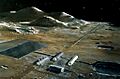
A Lunar base with a mass driver (the long structure that goes toward the horizon). NASA conceptual illustration
-
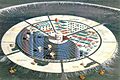
An artist's conception of a "self-growing" robotic lunar factory.
-
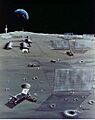
Microwave reflectors on the moon and teleoperated robotic paving rover and crane.
-
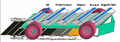
"Crawler" traverses Lunar surface, smoothing, melting a top layer of regolith, then depositing elements of silicon PV cells directly on surface
-
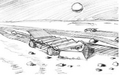
Sketch of the Lunar Crawler to be used for fabrication of lunar solar cells on the surface of the Moon.
-
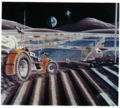
Shown here is an array of solar collectors that convert power into microwave beams directed toward Earth.
-
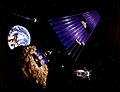
A solar power satellite built from a mined asteroid.


See also
- Attitude dynamics and control
- Friis transmission equation
- Future energy development
- Orbital station-keeping
- Project Earth (TV series)
- Solaris SBSP
- Space-based data center
- Space mirror (climate engineering)
- Znamya
