
Solar panels on spacecraft facts for kids
.jpg)
Solar panels are like special power plants for spacecraft! They capture sunlight and turn it into electricity. This electricity powers almost everything on a spacecraft, from its computers to its cameras. Without solar panels, many of our amazing space missions wouldn't be possible. They are essential for satellites, space stations, and even some robots exploring other planets.
Near Earth, spacecraft use solar panels a lot. Almost all satellites and all crewed space stations have used them. The International Space Station (ISS) has the largest solar panel array ever built in space. It covers 3,244 square meters and has a 73-meter "wingspan"! Other crewed spacecraft like Soyuz, Shenzhou, Crew Dragon, and Orion also use solar power.
As spacecraft travel farther from the Sun, sunlight becomes weaker. This makes it harder for solar panels to generate enough power. For missions to Mars, the outer planets, or those leaving our Solar System, scientists sometimes use radioisotope thermoelectric generators (RTGs). These are like small nuclear batteries. However, even for distant planets like Jupiter, larger solar panels have been used successfully by missions like Juno, Jupiter Icy Moons Explorer, and Europa Clipper.
Contents
A Look Back: How Solar Power Began
The idea of using sunlight for power isn't new. In 1940, a scientist named Russell Shoemaker Ohl at Bell Labs created the first working silicon solar cell. It was very simple, only turning 1% of sunlight into electricity.
Years later, in 1954, Bell Labs showed off their improved solar panels. They used them to power a small toy Ferris wheel and a radio! These early panels were about 6% efficient. They were too expensive for everyday use back then.
Everything changed with the space race! In 1958, the United States launched Vanguard 1, the second artificial satellite. Scientists realized that solar cells could keep the satellite's batteries charged. This made the satellite much lighter than if it only used batteries. Vanguard 1 used silicon solar cells that were about 10% efficient.
Soon after, the Soviet space program launched Sputnik 3. It also carried experimental silicon solar cells. These cells helped power its transmitters and other instruments for almost two years!
The success of these early satellites inspired companies like Spectrolab to make even better solar cells for space. They helped power missions like Pioneer 1 in 1958. They also provided the first cells to travel to the Moon on the Apollo 11 mission's ALSEP package. Over time, solar cells became much more powerful. Their efficiency increased from about 12% for silicon cells in the 1970s to about 30% for modern gallium arsenide (GaAs) cells. Today, these advanced cells are used on almost all solar-powered spacecraft.
Powering Space Missions: What Solar Panels Do

Solar panels in space have two main jobs:
- Powering the spacecraft: They provide electricity for all the important parts of a spacecraft. This includes sensors that collect data, heaters to keep instruments warm, coolers to prevent overheating, and communication systems to send information back to Earth.
- Electric propulsion: Some spacecraft use electricity from solar panels to power special engines. These are sometimes called electric propulsion or solar-electric propulsion. These engines gently push the spacecraft through space, allowing it to travel very far using only a small amount of fuel.
Scientists measure how good solar panels are by how much power they make compared to their weight. They also look at how well the panels can be folded up to fit into a rocket. Another important factor is how much they cost.
To get the most power, spacecraft solar panels are usually covered almost completely with rectangular solar cells. This is different from the round cells often seen on Earth.
How Spacecraft Use Solar Panels

Solar panels need to have a lot of surface area to catch enough sunlight. They also need to be able to turn and point directly at the Sun, no matter how the spacecraft itself is moving. Imagine a sunflower always turning its face towards the sun – spacecraft panels do something similar!
All electrical devices create some heat, and solar panels are no exception. This heat needs to be released into space so the spacecraft doesn't get too hot.
Spacecraft are built with special motors that can pivot the solar panels. This way, the panels can always face the Sun, even if the spacecraft is spinning or changing direction. A tracking system often helps keep the panels pointed correctly.
Sometimes, mission controllers might intentionally turn the solar panels away from the Sun. This happens if the spacecraft's batteries are full, or if they need less power. On the International Space Station, they sometimes do this to reduce drag from the Earth's atmosphere.
Protecting Panels from Space Radiation

Space is full of different kinds of radiation. This includes radiation from the Sun, like solar wind and solar flares. There are also powerful cosmic rays from deep space. Around Earth, we have radiation belts.
This radiation can slowly damage solar panels over time, making them less efficient. The amount of damage depends on the type of solar cell and where the spacecraft is. To protect the panels, they are often covered with special glass, like fused silica or lead glass. These coverings can help reduce the damage and keep the panels working longer.
The Evolution of Space Solar Cells
Up until the early 1990s, solar panels in space mainly used crystalline silicon solar cells. But since then, cells made from Gallium arsenide became more popular. These cells are better because they turn more sunlight into electricity. They also degrade more slowly than silicon in the harsh space radiation environment.
Today, the most advanced solar cells are called multi-junction photovoltaic cells. These cells have several layers of different materials, like indium gallium phosphide, gallium arsenide, and germanium. Each layer captures a different part of the sunlight spectrum, making them super efficient. Some of these cells can convert over 39% of sunlight into power!
Famous Spacecraft Powered by the Sun

Solar power has been used for many incredible missions! It works best for spacecraft that are not too far from the Sun, generally within the orbit of Jupiter.
- The Hubble Space Telescope, which orbits Earth, uses solar panels.
- The Magellan, Mars Global Surveyor, and Mars Observer missions to Mars all relied on solar power.
- The Rosetta spacecraft, launched in 2004, used its large solar panels to travel all the way to a comet, even past Jupiter's orbit!
- The Juno mission, launched in 2011, is a groundbreaking example. It was the first mission to Jupiter to use solar panels instead of nuclear power. It arrived at Jupiter on July 4, 2016, and has 50 square meters of panels!
- On Mars, the Tianwen-1 orbiter currently uses solar panels. The InSight lander, Ingenuity helicopter, and Zhurong rover also used solar panels during their missions on the Red Planet.
- The Dawn spacecraft used ion thrusters powered by solar panels to visit the asteroid 4 Vesta and the dwarf planet Ceres.
- The International Space Station (ISS) has enormous solar arrays. These arrays cover about 27,000 square feet and can generate up to 240 kilowatts of electricity! This powers everything on the station, supporting astronauts and scientific experiments.
The Future of Solar Power in Space
_(4).jpg)
Scientists are always looking for ways to make solar panels even better for future space missions. They want to make them lighter and more powerful. Lighter panels mean spacecraft can carry more scientific instruments or travel further. More powerful panels could allow solar-powered missions to explore even more distant parts of our Solar System.
New ideas include using very thin, flexible solar cells that can be rolled up like a blanket. They are also developing special lenses called Fresnel lenses to concentrate sunlight onto smaller solar cells. This design uses a flat lens that takes a large area of sunlight and focuses it onto a smaller spot. This allows a smaller, more expensive solar cell to be used, potentially cutting costs. Concentrators work best in space because the Sun is a single, bright light source.
Images for kids
-
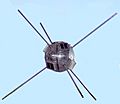
Vanguard 1, the first solar powered satellite
-
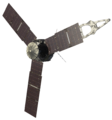
The Juno space probe
-
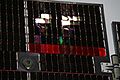
A section of one of Juno's solar panels
-
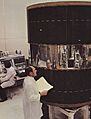
Solar panel drum at Hughes Aircraft Company, c. 1979
-
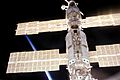
Solar panels on the International Space Station, September 2000
-
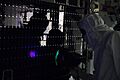
Black light test of Dawn's triple-junction gallium arsenide solar cells
-
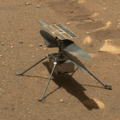
The Mars helicopter Ingenuity's batteries are powered by solar panels.


.png)

See also
- For solar arrays on the International Space Station, see ISS Solar Arrays or Electrical system of the International Space Station
- Ingenuity Mars 2020 helicopter runs on batteries powered by solar panels
- Nuclear power in space
- Photovoltaic system
- Solar cell
- Space-based solar power
