
Jupiter facts for kids

Jupiter in true colour, taken by the Hubble Space Telescope in January 2024
|
|||||||||||||
| Designations | |||||||||||||
|---|---|---|---|---|---|---|---|---|---|---|---|---|---|
|
Named after
|
Jupiter | ||||||||||||
| Adjectives | Jovian | ||||||||||||
| Orbital characteristics | |||||||||||||
| Epoch J2000 | |||||||||||||
| Aphelion | 5.4570 AU (816.363 million km) | ||||||||||||
| Perihelion | 4.9506 AU (740.595 million km) | ||||||||||||
| 5.2038 AU (778.479 million km) | |||||||||||||
| Eccentricity | 0.0489 | ||||||||||||
|
|||||||||||||
| 398.88 d | |||||||||||||
|
Average orbital speed
|
13.06 km/s | ||||||||||||
| 20.020° | |||||||||||||
| Inclination |
|
||||||||||||
| 100.464° | |||||||||||||
| January 21, 2023 | |||||||||||||
| 273.867° | |||||||||||||
| Known satellites | 97 (as of 2025[update]) | ||||||||||||
| Physical characteristics | |||||||||||||
|
Mean radius
|
69886±0.4 km 10.969 x of Earth |
||||||||||||
|
Equatorial radius
|
71488±0.4 km
|
||||||||||||
|
Polar radius
|
66842±0.4 km 10.516 x of Earth's |
||||||||||||
| Flattening | 0.06499 | ||||||||||||
| 6.1457×10¹⁰ km2 120.5 × of Earth's |
|||||||||||||
| Volume | 1.4309×10¹⁵ km3 1,321 × of Earth's |
||||||||||||
| Mass | (1.898125±0.000088)×1027 kg | ||||||||||||
|
Mean density
|
1.326 g/cm3 | ||||||||||||
| 24.79 m/s2 2.528 g0 |
|||||||||||||
|
Moment of inertia factor
|
0.2756±0.0006 | ||||||||||||
| 59.5 km/s | |||||||||||||
| 9.9258 h (9 h 55 m 33 s) | |||||||||||||
|
Sidereal rotation period
|
9.9250 hours (9 h 55 m 30 s) | ||||||||||||
|
Equatorial rotation velocity
|
12.6 km/s | ||||||||||||
| 3.13° (to orbit) | |||||||||||||
|
North pole right ascension
|
268.057°; 17h 52m 14s | ||||||||||||
|
North pole declination
|
64.495° | ||||||||||||
| Albedo | |||||||||||||
| Temperature | 88 K (−185 °C) (blackbody temperature) | ||||||||||||
|
|||||||||||||
| −2.94 to −1.66 | |||||||||||||
| −9.4 | |||||||||||||
| 29.8" to 50.1" | |||||||||||||
| Atmosphere | |||||||||||||
|
Surface pressure
|
200–600 kPa (30–90 psi) (opaque cloud deck) |
||||||||||||
| 27 km (17 mi) | |||||||||||||
| Composition by volume | |||||||||||||
.svg)
Jupiter is the fifth planet from the Sun and the biggest planet in our Solar System. Jupiter is a gas giant, meaning it is mostly made of gases like hydrogen and helium, with no solid surface.
Jupiter takes almost 12 Earth years to orbit the Sun.
You can often see Jupiter in the night sky. It is the third brightest object after the Moon and Venus. People have watched Jupiter since ancient times. It is named after Jupiter, the most important god in ancient Roman religion.
Jupiter's atmosphere has colorful bands and huge storms, like the famous Great Red Spot. This storm has been raging for hundreds of years! Because Jupiter spins very fast, it bulges out at its middle, making it look a bit flattened.
Jupiter has at least 97 moons! The four largest ones, called the Galilean moons, are Io, Europa, Ganymede, and Callisto. You can even see them with binoculars. Ganymede is bigger than the planet Mercury! Jupiter also has a faint system of planetary rings made of dust.
Many spacecraft have visited Jupiter since 1973, helping us learn more about this amazing planet.
Contents
Jupiter's Name
In ancient Greek and Roman times, Jupiter was named after the most important god. The Greeks called him Zeus, and the Romans called him Jupiter. The International Astronomical Union officially named the planet Jupiter in 1976. They also named its newly found moons after the god's friends and family.
How Jupiter Formed and Moved
Scientists believe Jupiter is the oldest planet in our Solar System. It formed only about one million years after the Sun. This was about 50 million years before Earth formed!
Jupiter likely started forming far from the Sun, where it was cold enough for water and other gases to freeze into solids. First, it grew a solid core. Then, it gathered a huge amount of gas to create its thick atmosphere.
During its early years, Jupiter's huge mass created gaps in the gas and dust disk around the Sun. It also moved closer to the Sun and then back out to its current spot. This movement greatly affected how the other planets in our Solar System formed.
Jupiter's Physical Features
Jupiter is a gas giant, which means it is mostly made of hydrogen and helium. These are gases, but deep inside Jupiter, they act more like liquids. Jupiter is the largest planet in our Solar System. Its diameter at the equator is about 142,976 kilometers. This makes its volume 1,321 times bigger than Earth's!
What Jupiter is Made Of
Jupiter's atmosphere is about 76% hydrogen and 24% helium by mass. It also has tiny amounts of other elements. These include carbon, oxygen, sulfur, and neon. There are also compounds like ammonia and water vapour.
Deep inside the planet, the material is much denser. It is about 71% hydrogen, 24% helium, and 5% other elements. The amounts of hydrogen and helium in Jupiter's atmosphere are very similar to what scientists think the early Solar System was made of.
Jupiter's Size and Mass

Jupiter is about eleven times wider than Earth. Its mass is 318 times that of Earth. This means Jupiter is 2.5 times heavier than all the other planets in our Solar System put together!
Jupiter is so massive that its center of gravity with the Sun is actually just above the Sun's surface. Scientists sometimes use "Jupiter mass" to describe the weight of other large objects in space.
Jupiter gives off more heat than it gets from the Sun. This heat comes from its inside slowly shrinking. This process causes Jupiter to shrink by about 1 millimeter each year. When Jupiter first formed, it was hotter and about twice its current size.
Scientists believe Jupiter is about as big as a planet of its type can get. If it had much more mass, its gravity would squeeze it even smaller!
How Jupiter Rotates

Jupiter spins faster than any other planet in our Solar System. It completes one full turn in just under ten hours! This fast spin makes Jupiter bulge out at its equator. Its middle is about 7% wider than its poles.
Because Jupiter is not solid, different parts of its atmosphere spin at slightly different speeds. The atmosphere near the equator spins a bit faster than the atmosphere near the poles.
Jupiter's axis is tilted only 3.13 degrees. This small tilt means Jupiter does not have strong seasons like Earth does.
Jupiter's Inside Story
Scientists used to think Jupiter either had a solid core or no core at all. But data from the Juno mission changed this view. It showed that Jupiter has a fuzzy, spread-out core. This core mixes into the layers around it. It is made of heavy elements and is 7 to 25 times the mass of Earth.
Outside this core is a layer of a special kind of liquid hydrogen. This is called "metallic hydrogen." Even further out, the hydrogen is in a "supercritical fluid" state. This means it is not quite a liquid or a gas. It gradually gets hotter and denser as you go deeper into the planet.
Scientists even think that droplets of helium and neon fall like rain deep inside Jupiter. There might even be rainfalls of diamonds!
The temperature and pressure inside Jupiter get higher and higher as you go inward. At the cloud tops, the temperature is around -108 degrees Celsius. But deep in the core, it is estimated to be about 20,000 degrees Celsius!
Jupiter's Atmosphere

Jupiter's atmosphere is mostly made of hydrogen and helium. It also contains smaller amounts of other gases like water, methane, and ammonia. This atmosphere stretches down about 3,000 kilometers below the cloud layers.
Cloud Layers

Jupiter is always covered in clouds made of ammonia crystals. These clouds form colorful bands at different latitudes. The lighter bands are called zones, and the darker ones are called belts. These bands move in different directions, causing storms and swirling patterns. Winds in these bands can reach speeds of 100 meters per second!
The cloud layer is about 50 kilometers deep. It has at least two layers of ammonia clouds. Scientists think there might be a layer of water clouds underneath. This is because lightning flashes have been seen in Jupiter's atmosphere. These lightning bolts can be a thousand times more powerful than Earth's lightning!
The Great Red Spot and Other Storms

The Great Red Spot is Jupiter's most famous feature. It is a giant, long-lasting storm located south of the equator. People have observed it since at least 1831, and possibly even earlier. This storm is bigger than Earth! It spins counterclockwise and takes about six days to complete one rotation.
The Great Red Spot has shrunk over time. In the late 1800s, it was about 41,000 kilometers across. By 2015, it was about 16,500 by 10,900 kilometers. The Juno mission measured its depth to be around 300 to 500 kilometers.
The Juno mission also found groups of cyclones at Jupiter's poles. The northern group has nine cyclones, with a large one in the center. The southern group has a central storm surrounded by five large storms and one smaller one.
In 2000, another storm formed in Jupiter's southern hemisphere. It looked similar to the Great Red Spot but was smaller. This storm, called Oval BA, even changed from white to red, earning it the nickname "Little Red Spot."
In 2017, a "Great Cold Spot" was found at Jupiter's north pole. This spot is 24,000 kilometers across and much cooler than the surrounding area. It might be another giant storm, similar to the Great Red Spot.
Jupiter's Magnetosphere

Jupiter has the strongest magnetic field of any planet in our Solar System. This field is like a giant magnetic bubble around the planet, called the magnetosphere. It is created by the swirling movements of liquid metallic hydrogen deep inside Jupiter.
This magnetosphere is so huge that it stretches out almost to the orbit of Saturn on the side away from the Sun! Jupiter's four largest moons orbit inside this protective magnetic bubble. This protects them from the solar wind, which is a stream of charged particles from the Sun.
The moon Io has many volcanoes that release a lot of sulfur dioxide gas. This gas gets ionized in Jupiter's magnetosphere, creating a ring of charged particles around Io's orbit. These particles, along with others from Jupiter's atmosphere, form a plasma sheet. This plasma spins with Jupiter, creating strong radio signals that can be detected from Earth.
Jupiter's Orbit and How We See It
Jupiter is the only planet whose center of gravity with the Sun is actually outside the Sun itself. The average distance between Jupiter and the Sun is about 778 million kilometers. Jupiter takes 11.86 years to complete one orbit around the Sun.
Jupiter's orbit is almost a perfect circle. It is only slightly closer to the Sun at its closest point (perihelion) than at its farthest point (aphelion).
You can usually see Jupiter's four largest moons and its cloud belts with a small telescope. A larger telescope can even show you the Great Red Spot when it faces Earth.
Jupiter's Gravity and Influence
As the most massive planet, Jupiter's strong gravity has played a big role in shaping our Solar System. For example, the gaps in the asteroid belt are mostly caused by Jupiter's gravitational pull.
Jupiter's gravity also controls many asteroids that travel in front of and behind it in its orbit. These are called Trojan asteroids. The first one, 588 Achilles, was found in 1906.
Many short-period comets belong to the "Jupiter family." These comets are thought to come from the Kuiper belt beyond Neptune. Jupiter's gravity can pull them into shorter orbits around the Sun.
Impacts on Jupiter

Scientists used to think Jupiter protected the inner Solar System from comets. However, some studies suggest Jupiter's gravity might also pull comets towards Earth. This topic is still being debated by scientists.
In July 1994, Comet Shoemaker–Levy 9 famously crashed into Jupiter. Observatories around the world, including the Hubble Space Telescope, watched this event closely.
How We've Observed and Explored Jupiter
Early Observations
People have been watching Jupiter for thousands of years. Ancient Babylonians and Chinese astronomers recorded observations of Jupiter. The Chinese even used Jupiter's 12-year orbit to create their Chinese zodiac.
In the 4th century BC, the Chinese astronomer Gan De might have seen one of Jupiter's moons with his unaided eye. If true, this would be almost 2,000 years before Galileo's discovery!
In the 2nd century, the Greek astronomer Claudius Ptolemaeus created a model to explain Jupiter's movement around Earth. He calculated its orbital period to be about 11.86 years.
Telescope Discoveries

In 1610, the Italian scientist Galileo Galilei used a telescope to discover Jupiter's four largest moons. These are now known as the Galilean moons. This was the first time anyone saw moons orbiting another planet! This discovery helped support the idea that planets orbit the Sun, not Earth.
Around the same time, Simon Marius also discovered these moons independently. He gave them the names we use today: Io, Europa, Ganymede, and Callisto.
In the 1660s, Giovanni Domenico Cassini observed spots in Jupiter's atmosphere. He also noticed that Jupiter was flattened at its poles and estimated how fast it spun.
The Great Red Spot might have been seen as early as 1664 by Robert Hooke. It was definitely drawn in detail by Samuel Heinrich Schwabe in 1831.
In the 1670s, Ole Rømer used observations of Jupiter's moons to figure out that light does not travel instantly. He used this to make the first estimate of the speed of light.
In 1892, E. E. Barnard discovered a fifth moon, Amalthea, using a telescope. This was the last moon to be found by simply looking through a telescope.
Radio Telescope Discoveries
In 1955, scientists discovered that Jupiter sends out bursts of radio waves. These bursts helped them figure out Jupiter's exact rotation rate. They found that Jupiter emits different types of radio signals. Some are affected by Io's interaction with Jupiter's magnetic field. Others come from a belt of electrons around Jupiter's equator.
Space Exploration of Jupiter
Since 1973, many robotic spacecraft have visited Jupiter. These missions have taught us a lot about the giant planet.
Flyby Missions
| Spacecraft | Closest approach |
Distance (km) |
|---|---|---|
| Pioneer 10 | December 3, 1973 | 130,000 |
| Pioneer 11 | December 4, 1974 | 34,000 |
| Voyager 1 | March 5, 1979 | 349,000 |
| Voyager 2 | July 9, 1979 | 570,000 |
| Ulysses | February 8, 1992 | 408,894 |
| February 4, 2004 | 120,000,000 | |
| Cassini | December 30, 2000 | 10,000,000 |
| New Horizons | February 28, 2007 | 2,304,535 |
The Pioneer missions in 1973 and 1974 sent back the first close-up images of Jupiter. They also discovered that the radiation around Jupiter was much stronger than expected.
The Voyager missions in 1979 greatly improved our understanding of Jupiter's moons and discovered its faint rings. They also confirmed that the Great Red Spot was a huge storm.
The Ulysses probe flew by Jupiter in 1992 and 2004. It studied Jupiter's magnetosphere. The Cassini probe flew by in 2000 on its way to Saturn, providing high-resolution images. The New Horizons probe passed Jupiter in 2007 on its journey to Pluto.
The Galileo Mission

The Galileo mission was the first spacecraft to orbit Jupiter. It arrived on December 7, 1995. It spent over seven years studying Jupiter and its moons. Galileo even watched Comet Shoemaker–Levy 9 crash into Jupiter in 1994.
A special probe from Galileo parachuted into Jupiter's atmosphere in December 1995. It collected data for almost an hour before being destroyed by the extreme pressure and heat. The Galileo orbiter itself was deliberately sent into Jupiter in 2003. This was to prevent it from accidentally crashing into and possibly contaminating the moon Europa, which might have life.
The Juno Mission

NASA's Juno mission arrived at Jupiter on July 4, 2016. Its goal is to study the planet in detail from a polar orbit. Juno has completed many orbits, sending back amazing images and data.
The mission was extended several times.
Future Missions
Scientists are very interested in Jupiter's icy moons, which might have oceans hidden beneath their surfaces. The European Space Agency's Jupiter Icy Moon Explorer (JUICE) mission was launched on April 14, 2023. NASA's Europa Clipper mission was launched on October 14, 2024. Both missions will study Jupiter and its icy moons.
Other future plans include China's Tianwen-4 mission, which aims to launch an orbiter to Jupiter around 2035. There are also plans for interstellar probes that would use Jupiter's gravity to help them travel to the far reaches of our Solar System.
Jupiter in Culture
_-_Napoli_MAN_9553.jpg)
People have known about Jupiter since ancient times because it is visible in the night sky. The Babylonians saw Jupiter as their god Marduk. They used its 12-year orbit to define the constellations of their zodiac.
The Romans called it Jupiter, their supreme god of thunder, lightning, and the sky.

In Vedic astrology, Hindu astrologers named the planet after Brihaspati, the teacher of the gods, calling it "Guru" (meaning "Teacher"). In some Asian cultures, Jupiter is called the "wood star" or "year star." This is based on the Chinese Five Elements and its movement through the sky each year.
Interesting facts about Jupiter
- The symbol for Jupiter,
 , comes from an old Greek letter. It was a short way to write "Zeus."
 - The word Jovian is used to describe things related to Jupiter. For example, Jupiter's moons are sometimes called Jovian moons.
- This giant planet has a mass almost 2.5 times greater than all the other planets combined!
- It is so large that all the other planets could fit inside it!
- The ancient Greeks called the planet Zeus, their most important god.
- Jupiter is on average about 484 million miles (or 778 million kilometers) from the Sun.
- It takes sunlight about 43 minutes to reach Jupiter.
- Jupiter is so enormous that it's more than 11 times wider than Earth.
- It is sometimes called the Solar System's "vacuum cleaner." This is because its huge gravity well attracts many asteroids and comets.
- The planet experiences about 200 times more impacts than Earth.
- Jupiter is usually the fourth brightest object in the sky, after the Sun, the Moon, and Venus. Sometimes, Mars can appear brighter. Its brightness changes depending on how close it is to Earth.
- The famous Great Red Spot on Jupiter is bigger than Earth!
- The orange and brown colors in Jupiter's clouds come from compounds that change color when exposed to sunlight.
.svg)
Images for kids
-
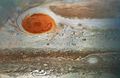
Close up of the Great Red Spot imaged by the Juno spacecraft in April 2018
-
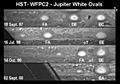
Formation of Oval BA from three white ovals
-
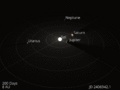
Orbit of Jupiter and other outer Solar System planets
-
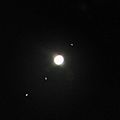
Jupiter and four Galilean moons seen through an amateur telescope
-
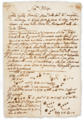
Galileo's original observation note of Jupiter moons
-
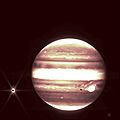
Jupiter viewed in infrared by JWST (July 14, 2022)
-
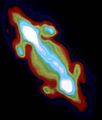
Image of Jupiter and its radiation belts in radio
-
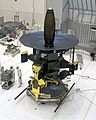
Galileo in preparation for mating with the rocket, 2000
-
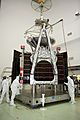
Juno preparing for testing in a rotation stand, 2011
-
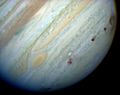
Brown spots mark Comet Shoemaker–Levy 9's impact sites on Jupiter
-
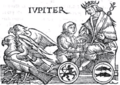
Jupiter, woodcut from a 1550 edition of Guido Bonatti's Liber Astronomiae
-
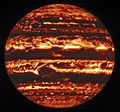
Infrared view of Jupiter, imaged by the Gemini North telescope in Hawaiʻi on January 11, 2017
-
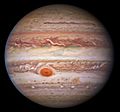
Jupiter imaged in visible light by the Hubble Space Telescope on January 11, 2017
-
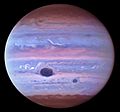
Ultraviolet view of Jupiter, imaged by Hubble on January 11, 2017
-
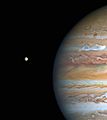
This image of Jupiter and Europa, taken by Hubble on 25 August 2020, was captured when the planet was 653 million kilometres from Earth.

.jpg)


_Commissioning_Image.jpg)


See also
 In Spanish: Júpiter (planeta) para niños
- Outline of Jupiter
- Eccentric Jupiter
- Hot Jupiter
- Super-Jupiter
- Jovian–Plutonian gravitational effect
- List of gravitationally rounded objects of the Solar System
