
Stove facts for kids
Quick facts for kids Stove |
|
|---|---|

An Indonesian traditional brick stove, still used in some country areas.
|
|
| Classification | Major appliance |
| Powered | |
A stove is a helpful machine that makes heat. People use stoves for two main things: to cook food or to warm up a room. You can find stoves that use different types of fuel, like natural gas, electricity, gasoline, wood, or even coal.
Most stoves are made from strong materials like cast iron, steel, or stone. Over time, people have worked hard to make stoves better. They want stoves to be safer and to create less air pollution. Modern stoves, like pellet stoves, burn fuel very cleanly. Other types, called airtight stoves, use their fuel more completely. This helps reduce the amount of smoke and other things released into the air. Scientists and engineers are always working to invent even better stoves.
Contents
The History of Stoves
Cooking with Fire
For a very long time, people cooked their food over open fires. This started almost two million years ago! Early humans used simple hearths, which were circles of stones. These fires were important for warmth and cooking in their homes. Even today, many people around the world still cook over open fires.
Later, people began to use pots and other containers. They would place these pots on supports over the fire. A common support was a base made of three stones. This simple idea was one of the first steps towards what we now call a stove. In some places, these three-stone setups grew into U-shaped structures made of mud or brick.
Early Stove Designs


.jpg)
Ancient civilizations, like the Egyptians and Romans, used ovens made of stone and brick. These were mainly for baking bread. In Korea, people developed special stoves called Agungi and buttumak. These stoves sent smoke and heat under the floor to warm the house. This was an early form of Underfloor heating.
Later, in places like Scandinavia, stoves had long iron chimneys with special parts called baffles. These baffles helped trap more heat before the smoke left. Russian stoves, which are still used today in some northern countries, are very good at holding heat. They have thick stone flues that can stay warm for a long time after the fire goes out. During colonial times in America, people used beehive-shaped brick ovens for baking. They carefully controlled the temperature by managing the wood and ashes.
The oldest stove found in France dates back to 1490. It was made of brick and tile in the Alsace region.
Ceramic Stoves
People have used clay ovens for thousands of years to cook food. Another type of stove, called a masonry heater, was created long ago. These heaters are designed to burn fuel very hot and completely. They store a lot of heat in their thick walls. This stored heat then slowly warms a room for a long time. The outside of these stoves usually stays cool enough to touch safely.
_28.jpg)
_30.jpg)
_32.jpg)
Gallery of Ceramic Stoves
-

An 18th-century tiled stove in the Palais Rohan, Strasbourg, France.
-
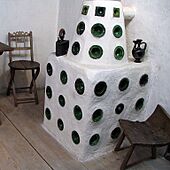
A traditional clay stove from Serbia, displayed in the Ethnographic Museum in Belgrade.
-

A fancy Baroque-style stove in the Neues Schloss Schleißheim, Germany.
-
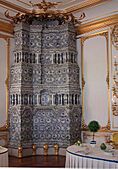
A beautiful tiled stove used for heating in the dining room of the Catherine Palace in Saint Petersburg.
-

A Rococo-style stove in the bathroom of Madame du Barry at the Palace of Versailles, France.
-

A glazed ceramic oven from the early 19th century at Schloss Wolfshagen, Germany.
-

A Neoclassical stove decorated with ribbons, in the Schloss Senftenberg, Germany.
-

A Neoclassical stove in Schloss Rosegg, Austria.
-
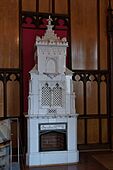
A Gothic Revival-style stove in the Nuremberg Transport Museum, Germany.
-
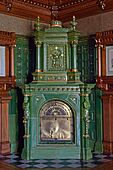
A Renaissance Revival tiled stove in Schloss Grafenegg, Austria.
-
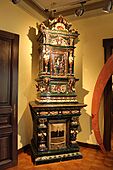
A Renaissance Revival tiled stove in the Šustalova vila, Czech Republic.
-
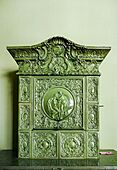
A Neo-Rococo glazed ceramic stove in Lviv, Ukraine.
-
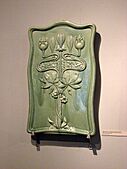
An Art Nouveau stove tile from a Russian exhibition.
-

The middle part of an Art Nouveau stove in a city house in Bucharest, Romania.


.jpg)
.jpg)

.jpg)
Cast-Iron Stoves

The first cast-iron stove was made in Massachusetts in 1642. It was a simple iron box.
In 1742, Benjamin Franklin designed a much better stove, now called the Franklin stove. It was a big improvement because it used less wood than a regular fireplace. It had special paths for hot gases to release heat into the room. This stove became very popular in North America for warming homes.
Around 1800, Count Rumford created a cast-iron oven for cooking. Soon after, Isaac Orr made circular cast-iron stoves with grates for cooking. The potbellied stove also became popular in the early 1800s. These iron stoves kept getting better, adding chimneys, ovens, and ways to heat water.
Gas Stoves

The first use of gas for cooking was reported in 1802. However, the first gas stove sold to the public was in 1834, invented by James Sharp. By the end of the 1800s, gas stoves became popular. They were easier to control and needed less cleaning than wood or coal stoves.
Today, many homes use gas stoves. They offer good temperature control and heat up quickly. However, scientists are studying gas stoves because they can release gases into the air. These gases might not be good for the air inside homes and could affect people's health. Gas stoves also release gases that contribute to climate change.
Electric Stoves

Electric stoves became popular once homes started having electricity. One of the first electric stoves was shown in 1892 by Thomas Ahearn in Canada.
As central heating became common, stoves in the 1900s were mostly used for cooking. Old iron stoves that burned wood or coal made kitchens too hot in summer. They were replaced by steel ranges that used natural gas or electricity.
Induction Stoves

The idea for induction stoves came about in the early 1900s. In the 1950s, General Motors showed off a demonstration induction stove. It could heat water with a newspaper placed between the stove and the pot! This showed how safe and convenient it was.
Modern induction stoves first became available in the United States in the 1970s. They were quite expensive at first. Today, many companies make induction stoves. These stoves are praised for being energy-efficient and easy to clean. They also offer precise heat control. Unlike gas stoves, induction stoves do not release certain gases into the air.
Types of Stoves
Stove Purpose
Cooking Stoves
A kitchen stove is an appliance made for cooking food. These stoves use direct heat to cook. Many also have an oven for baking. Older cooking stoves often used wood. Modern ones can use gas or electricity.
Heating Stoves
Stoves are also used to warm up rooms. Benjamin Franklin's stove helped make heating stoves popular. Today, wood stoves are still used to heat homes. They can be a cost-effective way to stay warm.
Stove Fuels
Wood-Burning Stoves
A wood-burning stove burns wood or other wood-based fuels like sawdust bricks. These stoves are usually made of strong metal like cast iron or steel. They have a closed firebox and controls for air flow. The first wood-burning stove was patented in 1557. Wood-burning stoves are still common in many parts of the world today.
Coal-Burning Stoves
For a long time, coal stoves were very common for heating. Coal burns much hotter than wood, so coal stoves must be built to handle high heat. Coal stoves have a grate that lets air flow under the fire. This helps the coal burn better.
Anthracite coal became popular in the 1800s in the United States. It burned hot and produced little soot. By 1860, most American homes used anthracite coal for heating. However, storing large amounts of coal was difficult for many families. This challenge helped lead to the development of gas stoves.
Gas Stoves
Gas stoves were first introduced in 1802. Today, many homes use them. People choose gas stoves because they offer good temperature control and are durable. However, gas stoves can release gases like methane and benzene. These gases can affect indoor air quality and contribute to climate change.
Electric Stoves
The electric stove was first patented in 1859. It became widely used in the 1910s. Induction stoves, a type of electric stove, became common in the 1970s. Electric stoves are known for being cost-effective and easy to clean. They also offer stable bases for pots. However, they cannot work during power outages. Unlike gas stoves, induction stoves do not release benzene emissions from the cooktop itself.
How Stoves Work Efficiently
Open fires are not very efficient; much of their heat is lost. Enclosed stoves are much better. By putting the fire in a chamber and connecting it to a chimney, a strong draft pulls fresh air in. This makes the fire burn hotter and more completely. The enclosure also helps control the air flow and keeps heat from escaping.
Early improvements included the "fire chamber," which enclosed the fire on three sides. In 1735, the first stove that completely enclosed the fire appeared. It was called the Castrol stove. This design improved heat efficiency even more by hanging pots in holes on top.
In 1743, Benjamin Franklin tried to make fireplaces more efficient with his Franklin stove. It was still open-faced but worked better than older fireplaces.
Modern stoves often have special features to burn fuel more completely. Some use a catalytic converter, which helps burn gases and smoke particles. Others have special designs that create a longer, hotter path for gases. Many modern stoves also have a window so you can see the fire. These improvements mean less pollution and more heat for your home.
Modern Stove Designs
People are always looking for ways to make stoves better. This is especially true for stoves that burn biomass, like wood, in many countries. Older wood-burning stoves use a lot of fuel and create a lot of smoke. This smoke can cause health problems for people and harm the environment.
New designs aim to make stoves more efficient and cleaner. When stoves are more efficient, people spend less time gathering fuel. They also breathe in less smoke, which improves their health. This also helps reduce deforestation and air pollution.
Pellet stoves are a type of biofuel stove. They burn small, clean-burning pellets made from things like wood sawdust or corn. These stoves are very efficient and don't need a traditional chimney. They can be vented through a small pipe in an outside wall. Pellet stoves are becoming very popular for heating homes around the world.
Other efficient stoves use a method called Top Lit updraft (T-LUD). These stoves burn small pieces of wood or other plant materials very efficiently. They can be up to 50% efficient, much better than older stoves. Stoves that use alcohol, like ethanol, are another clean-burning option.
Airtight Stoves

An air-tight stove is a wood-burning stove designed to burn fuel in a controlled way. This makes them very efficient and helps keep heating or cooking temperatures steady. They are made of metal and have openings that can be closed to control air flow.
These stoves are often used to heat buildings in winter. You put wood in, light it, and then control the air flow to manage the burn. Many modern airtight stoves have a damper that forces exhaust through an afterburner. This chamber burns any remaining fuel. Some even have a catalytic converter, which helps burn gases at a lower temperature.
Using an airtight stove means you first leave the vents open until coals form. Then, you close the damper and adjust the air vent to slow the burning. A well-loaded and controlled airtight stove can burn safely for eight hours or more. These features lead to more complete burning of wood and less pollution. They also help regulate the fire's intensity and create a strong draft up the chimney, making them very efficient.
Stove Emission Rules
Many countries have laws to control how much pollution stoves can release. In the United States, the United States Environmental Protection Agency (EPA) has rules for wood stoves. These rules require new wood stoves to limit the amount of tiny particles they release into the air. Modern stoves are much cleaner, producing very little visible smoke. This is because they burn fuel more completely, making them 60% to 70% efficient.
There are also efforts to reduce waste from other types of fuel. For example, in California, a law was approved in 2022 to stop the sale of disposable propane cylinders. These cylinders are often used by campers and create a lot of waste. The goal is to encourage the use of refillable cylinders instead.
Research and Development
Making stoves safer and cleaner is an important area of modern technology. Older cookstoves, especially in developing countries, can be fire hazards. They also produce a lot of smoke that can cause serious health problems.
Engineers and scientists are working together to design better stoves. Groups like the Aprovecho Research Center and Envirofit International are creating affordable, efficient, and healthy cookstoves for people around the world. The Bill & Melinda Gates Foundation also supports research to improve stove designs. These efforts help reduce health problems from smoke and protect the environment.
See also
 In Spanish: Estufa (calefacción) para niños
- Foot stove
- List of cooking appliances
- List of stoves
- Multi-fuel stove
- Pellet baskets
- Portable stove
