
Stygian ringlet facts for kids
Quick facts for kids Stygian ringlet |
|
|---|---|
 |
|
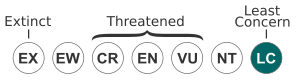
| Conservation status | |
Scientific classification  |
|
| Kingdom: | Animalia |
| Phylum: | Arthropoda |
| Class: | Insecta |
| Order: | Lepidoptera |
| Family: | Nymphalidae |
| Genus: | Erebia |
| Species: |
E. styx
|
| Binomial name | |
| Erebia styx (Freyer, 1834)
|
|
| Script error: The function "autoWithCaption" does not exist. | |
| Synonyms | |
|
Erebia reichlini Herrich-Schäffer, 1860 |
|
Script error: No such module "Check for conflicting parameters".
The Stygian ringlet (Erebia styx) is a type of butterfly. It belongs to a group often called "browns" because of their colors. You can find this butterfly in certain parts of the Alps mountains. It likes dry, rocky areas made of limestone. This butterfly looks very much like another one called the Styrian ringlet. Sometimes, people even thought they were the same species!
Contents
What Does the Stygian Ringlet Look Like?
This butterfly has a wingspan of about 46 to 56 millimeters (that's about 1.8 to 2.2 inches). The top side of its wings is mostly brown. Near the edges, there are reddish bands. These bands can be different sizes. In male butterflies, the bands might have some brown dust on them.
Eyespots on the Wings
Inside these reddish bands, you'll see black spots with white centers. These are called eyespots. They look a bit like eyes! The front wing usually has a large eyespot near its tip. This one often has two white centers. The back wing usually has three or four eyespots.
Underside of the Wings
The underside of the male's front wing is mostly orange. The part closest to the body is dusty brown. It also has a brown border. This border is different from the Styrian ringlet's. It doesn't get narrower towards the back of the wing. It also has a small, dark "tooth" shape pointing into the orange part. This "tooth" is harder to see in female butterflies. The underside of the back wing is mostly brownish. It's darker near the body.
Different Types of Stygian Ringlets
There are a few different types, or subspecies, of the Stygian ringlet.
E. s. triglites
This type lives in the Bergamo Alps and near Monte Generoso. It has stronger markings than the main type, E. s. styx. Its reddish bands are larger. The eyespots on the top of its front wing are also bigger. Sometimes, the underside of its back wing doesn't have any eyespots at all.
E. s. trentae
This type is found in the Julian Alps. It has even stronger markings. Its eyespots are large and have very bright white centers.
Where Does the Stygian Ringlet Live?
You can find the Stygian ringlet in the Alps mountains. They live at heights between 600 and 2,200 meters (about 2,000 to 7,200 feet) above sea level. They are found in northern Italy, including the Dolomites. They also live in parts of south-east Switzerland, south-east Germany (in the Allgäu Alps), and parts of Austria. You can also find them in the Julian Alps in Slovenia.
Preferred Habitat
These butterflies like steep limestone slopes. These areas often have scattered trees and bushes. They prefer places that are warm, dry, and rocky.
Life Cycle
The Stygian ringlet goes through several stages in its life.
Eggs
The eggs are shaped like small barrels. They are grey-brown with brown spots. They also have noticeable ridges on them.
Caterpillars
When the eggs hatch, tiny caterpillars emerge. These caterpillars are grey-brown with lighter and darker stripes. They can grow to be about 20 to 25 millimeters (about 0.8 to 1 inch) long. They eat different kinds of grasses, especially a type called Sesleria varia.
The caterpillars take up to two years to grow into butterflies. They spend their first winter and their second-to-last growth stage (called an instar) sleeping.
Pupae
When a caterpillar is ready to change into a butterfly, it forms a pupa. This stage is also called a chrysalis. The chrysalis is green and brown. The caterpillar usually forms its chrysalis among stones and grass.
Adult Butterflies
The adult butterflies fly from early July until early September. They produce only one group of offspring (a single brood) each year.
Name Origin
The name "Stygian" comes from ancient Greek stories. Styx was the name of a nymph, a nature spirit, and also the goddess of a famous river in those stories.
