
Swinny's horseshoe bat facts for kids
Quick facts for kids Swinny's horseshoe bat |
|
|---|---|
| Conservation status | |
Scientific classification  |
|
| Kingdom: | Animalia |
| Phylum: | Chordata |
| Class: | Mammalia |
| Order: | Chiroptera |
| Family: | Rhinolophidae |
| Genus: | Rhinolophus |
| Species: |
R. swinnyi
|
| Binomial name | |
| Rhinolophus swinnyi Gough, 1908
|
|
 |
|
| Swinny's horseshoe bat range | |
| Script error: The function "autoWithCaption" does not exist. | |
Script error: No such module "Check for conflicting parameters".
The Swinny's horseshoe bat (Rhinolophus swinnyi) is a small bat found in Africa. It belongs to a group of bats known for their unique nose shapes. An African collector named H. H. Swinny first discovered this bat. You can find these bats in countries like Angola, Republic of the Congo, Mozambique, South Africa, Tanzania, Zambia, Zimbabwe, and Malawi.
Contents
How Scientists Identify Swinny's Horseshoe Bat
Scientists first thought the Swinny's horseshoe bat was a type of R. denti or R. simulator bat. This was because they looked very similar. They had similar body shapes, sizes, and even used similar echolocation calls.
However, newer studies looked at the bats' DNA. These genetic tests showed that the Swinny's horseshoe bat is actually its own unique species. It is not just a subspecies of the others.
Where Swinny's Horseshoe Bats Live
Swinny's horseshoe bats live only in Africa. They are found across a large part of the continent. Their wings are quite large compared to their body size. This helps them fly well but means they do not travel very far.
These bats live in small groups, usually with about 10 bats. There are fewer than 1,000 adult bats in each colony. Scientists believe there are around 10,000 Swinny's horseshoe bats in total.
All About Swinny's Horseshoe Bats
What Swinny's Horseshoe Bats Look Like
Swinny's horseshoe bats are small. They are about 70 mm long, which is less than 3 inches. They weigh around 7.6 grams, which is about the same as two pennies.
The most special part of these bats is their nose area. It has three parts: the lancet, the sella, and the nose leaf. The nose leaf is shaped like a horseshoe. Its size and shape can be different for each bat.
Their back fur is grey to brown, and their belly is lighter, from pale brown to off-white. They have short, pointy ears. Their wings and the skin between their legs are light brown or light grey. These bats fly slowly but can turn very quickly. Their large wings help them lift off and move easily.
Swinny's Horseshoe Bat Habitat and Behaviour
Swinny's horseshoe bats mostly live in montane forests and savanna woodlands. They like to rest in wet, safe caves. They also use old mining sites as homes.
Like most bats, they are active at night. During the day, they rest in dark parts of caves. They hang from the ceiling, either alone or in pairs. Sometimes, they share their roosts with other bat species, like R. simulator.
These bats use echolocation to find their way in the dark. They also use it to hunt for food and to find mates. They make high-pitched sounds, usually around 106.7 kHz.
Scientists are still learning about how these bats reproduce and raise their young.
What Swinny's Horseshoe Bats Eat
Swinny's horseshoe bats are insectivores, meaning they eat insects. They mostly eat adult Lepidoptera, which are moths and butterflies. They also eat other insects like termites, beetles, flies, and crickets.
Threats and Conservation
Swinny's horseshoe bats face some dangers. These include farming, cutting down trees for wood, and people building new homes. These activities can destroy the bats' forest homes.
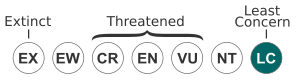
However, the IUCN Red List says that the Swinny's horseshoe bat is a species of "least concern." This means their population is stable, and they are not currently at risk of disappearing.
