
Volcanic rock facts for kids

Imagine the Earth's powerful volcanoes erupting! When molten rock, called lava, bursts out and cools down on the surface, it forms special rocks known as volcanic rocks. These rocks are like snapshots of Earth's fiery past and present. They are super common, especially in the oceans and near where Earth's giant plates meet. In fact, volcanic rocks cover about 8% of all the land on our planet!
Sometimes, volcanic rocks are also called "extrusive igneous rocks" because they form when magma (molten rock underground) "extrudes" or comes out onto the surface. They can be found mixed with other types of rocks and even form parts of sedimentary rocks.
Contents
Volcanic Rocks: Earth's Fiery Creations
How Volcanic Rocks Form
Volcanic rocks are created in two main ways: from flowing lava or from explosive eruptions that throw out fragmented material.
Lava Flows: Smooth and Jagged Rocks
When lava flows out of a volcano and cools, it hardens into solid rock. You might have heard of different types of lava flows:
- Pāhoehoe (pronounced "pah-hoy-hoy") is lava that cools with a smooth, ropy surface.
- ʻAʻā (pronounced "ah-ah") is lava that cools into a rough, jagged, and blocky surface.
These lava flows create coherent volcanic rocks like basalt, andesite, and rhyolite.
Tephra: Explosive Fragments
Sometimes, volcanoes erupt explosively, blasting pieces of rock, ash, and gas into the air. This fragmented material is called tephra. Tephra comes in different sizes:
- Volcanic bombs are large, semi-molten chunks of rock. They are thrown out and often get aerodynamic shapes as they fly through the air. They solidify before hitting the ground.
- Lapilli are smaller rock fragments, about the size of peas to walnuts (2 to 64 mm). They can be lava droplets or broken pieces of older rock.
- Volcanic ash consists of very fine particles, smaller than 2 mm, like dust. It's made of pulverized rock, minerals, and glass. Ash can travel very far and affect air quality and even the climate.
What Do Volcanic Rocks Look Like?

Volcanic rocks often have a very fine-grained texture. This means their crystals are too small to see without a microscope. Some can even look like glass, like obsidian.
You might also see larger crystals, called phenocrysts, embedded in the finer rock. These phenocrysts formed earlier, deep inside the volcano, before the lava erupted.
Another cool feature is a vesicular texture. This means the rock has tiny holes or bubbles. These holes are left behind by gases that were trapped in the molten lava as it cooled. Pumice is a great example; it's so full of these gas bubbles that it can even float on water!
The Building Blocks: Chemistry and Minerals
All rocks are made of different chemical elements and minerals. Scientists classify volcanic rocks based on what they are made of. For example, some volcanic rocks have a lot of silica (a common compound of silicon and oxygen), while others have less. This chemical makeup helps us understand where the magma came from and how it changed over time.
Most volcanic rocks share common minerals. Rocks with more silica often contain minerals like quartz and feldspar. Rocks with less silica might have minerals like olivine and pyroxene.
Sometimes, a magma can pick up crystals from other rocks as it travels. These are called xenocrysts. A famous example is diamonds found in kimberlites. The kimberlite magma doesn't create the diamonds; it just brings them up from deep within the Earth to the surface!
Naming Volcanic Rocks


Volcanic rocks are named based on their chemical makeup and how they look.
- Basalt is a very common volcanic rock with low silica content. It's often dark-colored.
- Rhyolite is a volcanic rock with high silica content, usually lighter in color.
- Other common volcanic rocks include andesite, dacite, trachyte, and latite.
Rocks formed from explosive eruptions, like those made of ash and bombs, are called pyroclastic rocks. These are often rich in silica. Examples include tuff (hardened ash) and ignimbrite (rock formed from hot ash and gas flows).
You might hear people use terms like "lava stone" or "lava rock." While these sound cool, geologists prefer "volcanic rock" because lava is molten, and rock is solid. "Lava stone" can describe many different types of volcanic rocks, so it's always better to use a more specific name if you know it!
See also
- Extrusive rock
- Intrusive rock
Images for kids
-
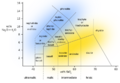
A technical classification diagram for extrusive rocks.
-
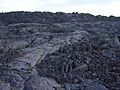
ʻAʻā lava next to Pāhoehoe lava at the Craters of the Moon National Monument and Preserve, USA.
-
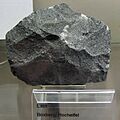
An example of latite, a type of volcanic rock from Germany.
-
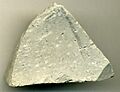
A sample of rhyolite rock.
-
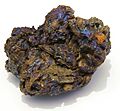
Basaltic scoria from Amsterdam Island in the Indian Ocean.
-
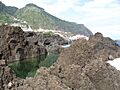
Volcanic rocks found in Porto Moniz, Madeira.


