
Woman facts for kids
A woman is an adult human who is female. The word "woman" is used to talk about the biological sex of a person. It can also mean any female human, no matter their age, especially when talking about things like Women's rights.
Most women have a uterus, also called a womb. This is a special body part inside a woman where a baby can grow before it is born.
Contents
Women's Rights and Roles
For a long time, women in many parts of the world did not have the same rights as men. They often faced unfair treatment. For example, in many countries, women did not have the right to vote until the 20th century.
Since the early 1900s, women in many developed countries have gained many more rights and freedoms. They can now vote, work in many different jobs, and have more choices in their lives. However, women in some parts of the world still face challenges and unfair treatment.
Changing Roles Through History
In ancient times, women often had specific roles in their communities. They might have been responsible for gathering food, preparing meals, and taking care of children. Men often had roles like hunting or building.
Today, these roles have changed a lot. Women work in almost every type of job, from science and business to politics and art. Many women balance careers with family life, and it's common to see women leading companies or countries.
Symbols for Women
The symbol for the Roman goddess Venus is often used to represent women. This symbol looks like a circle with a small cross below it.
Famous Women in History
Throughout history, many women have made important contributions to the world. They have been leaders, scientists, artists, and activists.
Women in world history

Women have shaped history since ancient times. Archaeologists have discovered many records of powerful ancient women:
- Neithhotep was an early queen of Ancient Egypt.
- Peseshet lived in Egypt around 2600 BCE and worked as a respected doctor.
- Puabi was a famous queen of Ur who was buried with fine treasures.
- Enheduanna was a high priestess in the ancient city of Ur. She is the very first named author and poet in human history.
- Kubaba was an ancient queen who ruled the city of Kish.
In later centuries, women made remarkable scientific breakthroughs. Hypatia was a famous mathematician and astronomer in the ancient world. In modern times, Marie Curie studied physics and chemistry, winning two Nobel Prizes.
Culture and leadership

For centuries, unfair customs limited what women were allowed to study or achieve. Many people believed women should only focus on domestic work. Women had to fight hard for women's rights and equal educational opportunities. The women's suffrage movement campaigned for the right to vote in elections. In 1960, Sirimavo Bandaranaike of Sri Lanka became the world's first female prime minister.
Today, feminist movements continue to work toward gender equality. More women than ever lead governments, write books, run companies, and conduct vital research. Equal rights help ensure that every girl and woman can reach her full potential.
Images for kids
-
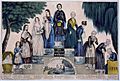
"The Life & Age of Woman - Stages of Woman's Life from the Cradle to the Grave", 1849. This image shows how people in the 1800s saw the different stages of a woman's life.
-
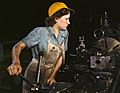
During World War II, some women performed jobs that were usually done by men, like working in factories.
-
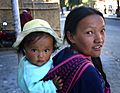
A mother and child in Bhutan.
-
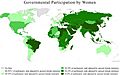
A world map from 2010 showing how many women participate in government in different countries.
-
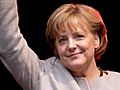
Angela Merkel was named one of the most powerful women in the world many times.
-
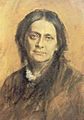
German composer Clara Schumann in 1878.
-
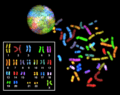
A karyotype of a human female. This shows all the chromosomes in a person's cells.
-
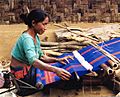
A woman weaving. Making textiles like cloth has traditionally been a job for women in many cultures.


.jpg)


.jpg)


See also
 In Spanish: Mujer para niños
