
1940–1946 in French Indochina facts for kids
French Indochina in the 1940s was a group of countries in Southeast Asia, including Cambodia, Laos, and Vietnam. At the time, Vietnam was divided into three parts: Tonkin, Annam, and Cochinchina. France controlled these areas as colonies.
In 1940, France ruled about 23 million Vietnamese people. They had a small number of French soldiers and a larger number of Vietnamese soldiers. There was also a strong police force called the Sûreté. The United States didn't pay much attention to Vietnam back then.
From 1940 to 1946, a group called the Việt Minh became very powerful. They were led by communists and wanted Vietnam to be free from France. The Việt Minh was strongest in northern Vietnam (Tonkin). Other groups also wanted independence in central (Annam) and southern (Cochinchina) Vietnam.
During World War II (1939–1945), Japan sent many soldiers to Vietnam, which weakened France's control. The Việt Minh also fought against the Japanese. Towards the end of World War II, the United States gave some help to the Việt Minh to fight Japan.
After World War II, France tried to take back control of Vietnam, Cambodia, and Laos. This led to fighting in 1946 between France and the Việt Minh. The U.S. first supported Vietnam's independence. But because of the Cold War and fears of communism, the U.S. later started supporting France.

Key events during these years included:
- The creation of the Việt Minh by Ho Chi Minh in 1941.
- Japan taking over the government of Vietnam from France in March 1945.
- The decision at the Potsdam Conference in July 1945 to divide Indochina. The British would take charge in the south, and China in the north.
- The August Revolution in August and September 1945, when Ho Chi Minh declared Vietnam independent from France.
- The start of the First Indochina War, usually dated to December 1946. This was when France tried to fully regain control.
This story continues in 1947–50 in the Vietnam War and other articles. The article First Indochina War tells more about Vietnam's fight for freedom from France.
Contents
Events in 1940
Japan wanted to station soldiers in Tonkin, but the French government did not agree. However, during World War II, Japan still sent many soldiers and sailors to Vietnam. The French government structure was allowed to stay in place.
Japan's growing power in Vietnam encouraged local groups to rebel against French rule. These revolts happened in Bac Son, near China, and in Cochin China. The American Consul in Saigon reported that many people were killed or put in prison.
Events in 1941
Ho Chi Minh and the Việt Minh
The Communist Party of Vietnam held an important meeting in Pac Bo village, near the Chinese border. This meeting was led by Ho Chi Minh, who was then known as Nguyen Ai Quoc. It was Ho Chi Minh's first time back in Vietnam since 1911. He had lived in many countries like England, France, the U.S., the USSR, and China.
At this meeting, the Việt Minh was created. It was a large group focused on getting independence from both France and Japan. Ho Chi Minh brought together the ideas of Vietnamese nationalism and international communism. For a while, the Việt Minh focused more on patriotism and national pride than on communist goals. They changed their plan about taking land from landlords. Instead, they promoted reducing rent for farmers and only taking land from French rulers and Vietnamese "traitors."
The leaders also decided that Vietnam would only become independent through armed rebellion. This rebellion would combine city nationalism with rural uprisings. Armed forces were to be set up everywhere the Communist Party was active. Võ Nguyên Giáp became the main leader of these armed forces.
Japan's Expansion and U.S. Response
Japan demanded and received permission from the French government to set up military bases in southern Vietnam. They already had bases in northern Vietnam.
News that Japanese warships were near Cam Ranh Bay in Vietnam made the U.S. take strong action. The U.S. froze Japanese money, stopped trade, and stopped selling oil to Japan. These actions were very serious for Japan's economy. The U.S. was now willing to risk war rather than let Japan become more powerful.
The United States declared war on Japan after Japan bombed Pearl Harbor in Hawaii. Japan also launched attacks across Southeast Asia. By then, Japan already had 50,000 troops in Vietnam with France's permission.
Events in 1943
An American Navy officer, Milton E. Miles, suggested sending U.S. agents into Vietnam. These agents would organize local groups in the Central Highlands to fight the Japanese. This plan was approved but never carried out. However, the U.S. did set up a network of Vietnamese and French people to gather information.
Events in 1944
Roosevelt's View on Indochina
U.S. President Roosevelt wrote that "Indo-China should not go back to France." He felt that France had ruled the country for a hundred years, and the people were worse off. Roosevelt imagined that after World War II, Indochina would be managed by the United Nations.
Việt Minh's Growing Power
The French police found a Việt Minh base in Cao Bằng Province with weapons. They warned that authority needed to be "re-established." At this time, the Việt Minh controlled much of the border areas in northern Vietnam.
25 December The Việt Minh forces won their first battle against the French. They took over small French outposts and captured weapons.
U.S. General Albert Coady Wedemeyer reported that Ambassador Patrick J. Hurley was unhappy with aid given to intelligence groups in Vietnam. Hurley believed that the British, French, and Dutch were working to keep their empires. He felt the U.S. should not help them, as this went against U.S. policy. Hurley was following President Roosevelt's ideas.
The Việt Minh claimed to have 500,000 members. Most of these were in northern Vietnam (Tonkin). The Việt Minh's military and political structure was strongest there.
Events in 1945
Early 1945: Famine and U.S. Policy
U.S. Air Force planes mistakenly shot down three British bombers over Indochina. The British were doing secret operations there without telling the U.S.
A terrible famine began in northern Vietnam. About one million people died within a few months. This was about 10 percent of the population in Tonkin and Annam. Vietnamese people blamed France and Japan for this disaster. The Việt Minh were praised for taking rice supplies and giving them to the poor.
At the Yalta Conference, President Roosevelt said he was "in favor of anything that is against the Japanese in Indochina." He added that the U.S. should not side with the French.
U.S. General Claire Lee Chennault in China said that any help given to Vietnam should not be seen as helping France's political goals.
Japanese Takeover and French Reaction
Japan demanded full control of the French colonial government in Vietnam, including banks and armed forces. When the French did not agree quickly, the Japanese took over by force. They defeated the French in several battles. Japan did this because they feared the U.S. would invade Vietnam. They wanted to strengthen their defenses and remove French influence. Japan convinced the former emperor Bảo Đại to declare Vietnam independent from France. A new government was set up, led by Trần Trọng Kim.
U.S. General Robert B. McClure in China allowed air support for the French fighting the Japanese. However, President Roosevelt in Washington said he wanted to end colonization in Southeast Asia. He did not want any military help given to the French in Indochina.
French Leader Charles de Gaulle in Paris criticized the U.S. and its allies for not helping the French in Indochina. De Gaulle stated that France would regain control of Indochina.
U.S. and Việt Minh Cooperation
Ho Chi Minh and Phạm Văn Đồng met with American Captain Charles Fenn from the Office of Strategic Services (OSS). Three days later, the OSS agreed to give radio equipment, weapons, and ammunition to the Việt Minh. Ho agreed to gather information, rescue American pilots, and damage Japanese sites. Fenn was impressed by Ho.
Under pressure from the French and his advisors, President Roosevelt allowed American aid to the French in Indochina. Historians disagree if this was a change in Roosevelt's policy against France returning to power.
France declared that it would regain control of Vietnam. They announced an Indochinese Federation, offering more rights to the people but keeping control of defense and foreign affairs. Vietnamese nationalists did not like this, especially the continued division of Vietnam into three parts.
Ho Chi Minh met with U.S. General Chennault in Kunming, China. Chennault thanked Ho for rescuing American pilots. Ho asked for and received a signed photo of Chennault. He used this to show he had U.S. support.
The United States Department of War told General Wedemeyer in China to support French forces in Vietnam. This was allowed if it did not take too many resources from U.S. priorities. Wedemeyer had limited resources and mostly dropped medicine to the French.
Shift in U.S. Policy
U.S. President Franklin Roosevelt died. Harry S. Truman became president.
U.S. Under Secretary of the Army Robert A. Lovett said that Roosevelt's ban on a clear U.S. policy for Indochina was a "serious embarrassment" to the military. This started a debate among government agencies in Washington.
A policy paper given to President Truman by the State Department's European office supported a pro-French policy in Indochina. Southeast Asian experts at the State Department later complained that this paper left out information about President Roosevelt's opposition to the French.
The United States Department of State approved a policy paper. It stated that the U.S. would not oppose France regaining control of Indochina. However, the U.S. would try to make sure France gave the Indochinese people more freedom. This was a big change from Roosevelt's policy.
U.S. General Wedemeyer in China complained about a "British and French plan to reestablish their pre-war political and economic positions in Southeast Asia." He said they were using American supplies to "invade Indochina" and bring back French rule. Washington replied that the U.S. now "welcomes French participation in the Pacific War."
The U.S. Secretary of State sent a report to President Truman. It said that "the United States recognizes French sovereignty over Indochina." So, the U.S. had reversed Roosevelt's policy.
OSS in Vietnam and Potsdam Conference
Three U.S. soldiers from the OSS, led by Major Allison Thomas, parachuted into the Việt Minh's base camp in northern Vietnam. They were welcomed. Thomas reported that the "Việt Minh league is not Communist." He said they stood for freedom and reforms against French harshness. The Americans wanted to organize a group to attack a Japanese railroad. Ho Chi Minh introduced himself as Mr. Hoo.
The Potsdam Conference decided that the British would accept the surrender of Japanese troops in Indochina south of the 16th parallel. China would accept their surrender north of the 16th parallel.
August Revolution and Declaration of Independence
The August Revolution began. The Việt Minh declared a general uprising to take political power in Vietnam. Ho Chi Minh was chosen to lead the National Liberation Committee. This call for uprising came after news that Japan would surrender.
The Việt Minh organized a very large protest in Hanoi. They took control of the city government and much of northern Vietnam.
American intelligence officer Major Archimedes L. Patti arrived in Hanoi. He was there to free American prisoners of war held by the Japanese. A French team, led by Jean Sainteny, came with Patti. They were supposedly there to care for French prisoners. Ho Chi Minh warned Patti that Sainteny's real goal was to bring back French control. Patti reported that the "Việt Minh [are] strong and belligerent and definitely anti-French." He suggested no more French people, especially armed ones, should enter Indochina. Patti refused to release 4,500 French soldiers imprisoned by the Japanese in Hanoi.
Ho Chi Minh entered Hanoi. The Việt Minh force that took control of Hanoi had about 200 men. The Việt Minh army had about 1,200 trained men and hundreds of thousands of militia members. Most of them did not have firearms.
Japan signed the surrender document in Tokyo Bay, ending World War II.
In Hanoi, Ho Chi Minh declared independence from France. He announced the creation of the Democratic Republic of Vietnam and formed his government. In his speech, Ho mentioned the U.S. Declaration of Independence. He asked the World War II allies to "oppose the wicked schemes of the French imperialists" and "recognize our freedom and independence."
In Saigon and southern Vietnam, there was political chaos. Different religious groups and political factions fought, often violently. The Việt Minh organized a large protest. This led to attacks on French residents. A new team of American OSS personnel used Japanese soldiers to protect French citizens.
The main force of a 150,000-man Chinese army arrived in Hanoi. They were there to accept the surrender of Japanese forces and keep order north of the 16th parallel. Ho Chi Minh first worked with the Chinese. The Chinese quickly removed the French from the Governor-General's Palace. American advisors were with the Chinese but were told not to get involved in French-Chinese relations or conflicts.
To fight disorder and set up Vietnamese rule in southern Vietnam, nationalists formed a Committee of the South in Saigon. This committee had 13 people, including 4 communists, and was led by a nationalist.
British forces, part of the Indian Army, arrived in Saigon. They were led by General Douglas Gracey and numbered 20,000. They came to accept the surrender of Japanese troops south of the 16th parallel. Gracey refused to meet with Vietnamese leaders. He said that French control of Vietnam was "only a matter of weeks."
General Philip E. Gallagher, commander of the U.S. military mission in Hanoi, reported that Ho Chi Minh was "a product of Moscow." But he also said that Ho's party "represented the real aspirations of the Vietnamese people for independence."
General Gracey, the British commander in Saigon, declared martial law. He released and armed over 1,000 French soldiers held prisoner by the Japanese.
The French Flag flew again over the main government buildings of Saigon. Some historians see this as the start of the Việt Minh war against the French.
In Saigon, the Việt Minh called for a general strike. They and other nationalist groups attacked French, British, Japanese, and other European civilians. About 20,000 French citizens lived in Saigon. Over the next few days, 150–300 French and Eurasian civilians and about 200 Vietnamese were killed.
Lt. Colonel A. Peter Dewey, son of U.S. presidential nominee Thomas E. Dewey, was killed in Saigon. He was likely killed by mistake by Việt Minh soldiers. He was the first American to die in Vietnam. Dewey was in Saigon to arrange for American prisoners of war to return home. He had complained about British and French soldiers' actions in Saigon. The British commander, Douglas Gracey, had forbidden him from flying a U.S. flag on his vehicle. The Việt Minh likely thought he was French.
Dewey believed that "Cochinchina is burning, the French and the British are finished here, and we [the United States] ought to clear out of Southeast Asia."
French general Marcel Alessandri, visiting Hanoi, asked U.S. General Gallagher for help. He wanted the Chinese military to release all French prisoners, rearm French police and military, and return control of the radio station and public services to the French. The Chinese commander only agreed to release French prisoners.
In a meeting with U.S. Army officers, Ho Chi Minh "expressed the fear that the Allies considered Indochina a conquered country." He worried that the Chinese came as conquerors. Gallagher and Patti tried to reassure him and urged him to keep talking with the French.
U.S. General Gallagher in Hanoi reported a "noticeable change in the attitude of the Annamites [Vietnamese] here." This happened after they realized the U.S. would not interfere and would probably help the French.
French general Philippe Leclerc de Hauteclocque arrived in Saigon with a regiment of French soldiers. He, General Gracey, and many Japanese troops pushed the Việt Minh out of Saigon. They also captured nearby areas. More than 1,000 Japanese soldiers left their posts rather than fight with the British and French. They fought on the side of the Việt Minh. By early November, the British and Japanese fighting the Việt Minh had lost 19 and 54 soldiers killed, respectively.
The British and French governments made an agreement in London. The British recognized France as the "sole legitimate authority" south of the 16th parallel. The United Kingdom agreed to help transport French troops to southern Vietnam. This was to support General Leclerq. The agreement also called for "close and friendly cooperation between the French and British commanders." The ships used to transport French soldiers included eight U.S. vessels. This was the first major American aid to the French in Vietnam.
French General Leclerq, with 35,000 French, British, and Japanese soldiers, launched an attack. They fought against nationalist forces, including the Việt Minh, who controlled much of the southern Vietnamese countryside. By mid-December, Leclerq had taken control of most towns and cities south of the 16th parallel. The Việt Minh and others began a guerrilla war against the French. A journalist noted that "What was needed was not 35,000 men...but 100,000 and Cochinchina was not the only problem."
Former Catholic monk and supporter of French leader Charles de Gaulle, Thierry d'Argenlieu, arrived in Saigon. He was the High Commissioner for Indochina. D'Argenlieu believed that the French empire, including Indochina, should remain fully under French control.
At a meeting in Hanoi, the Indochina Communist Party officially dissolved itself. They said this was to promote national unity in the fight for independence from France. Other nationalist groups had criticized the communists' control of the Việt Minh. Ho Chi Minh seemed to decide that unity was more important than communist ideas for the moment.
Ho Chi Minh began talks in Hanoi with French Commissioner for Tonkin, Jean Sainteny. Ho was worried that the 150,000 Chinese troops in northern Vietnam would not leave. He also worried they were helping the Việt Minh's rival nationalist groups. Ho decided to seek cooperation with the French, even if it meant delaying Vietnam's independence.
U.S. General Gallagher left Hanoi and closed the U.S. advisory mission in northern Vietnam. The French blamed the U.S. for working with the Việt Minh. The Việt Minh blamed the U.S. for helping France regain control.
The French estimated that the Việt Minh army in northern Vietnam, mostly Tonkin, had 28,000 men.
Events in 1946
New Government and Elections
After talks with other nationalist groups, a new government was set up in Hanoi. Ho Chi Minh became president, and Nguyen Hai Than became vice president. Elections were planned for a national assembly. Some seats were guaranteed to two nationalist organizations. Earlier, Ho had ended the communist party of Vietnam to show his nationalist goals.
In an election for the National Assembly in northern Vietnam, the Việt Minh and allied nationalist groups won 300 out of 350 seats. Most observers thought the elections were fair, though there were some claims of voter intimidation.
French Military Actions and Negotiations
French General Leclerq declared that his military campaigns had "entirely achieved" the "pacification of Cochinchina [southern Vietnam]." Author Bernard Fall later said that Leclerq only controlled Cochin China "to the extent of 100 yards on either side of all major roads."
Despite his apparent success, General Leclerq asked France to make concessions to the Việt Minh. At this time, Ho Chi Minh was talking with French representative Sainteny in Hanoi. De Gaulle and d'Argenlieu were against any concessions for Vietnam's independence.
Twenty-one thousand French soldiers sailed from Saigon to Tonkin. Their goal was to reoccupy northern Vietnam. This was meant to pressure Ho Chi Minh in his talks with France and to free 3,000 French soldiers still held prisoner in Hanoi.
France completed an agreement with the Chinese government for Chinese soldiers to leave Vietnam north of the 16th parallel.
Việt Minh leader Ho Chi Minh sent a telegram to U.S. President Truman. He asked the U.S. "to interfere urgently in support of our [Vietnamese] independence." This was one of several letters Ho sent to the U.S. asking for support. The U.S. never replied to him.
The British finished their withdrawal from Vietnam south of the 16th parallel. French forces were left in control of the government of Cochinchina.
In the morning, the French fleet of 35 ships and 21,000 men tried to land at Haiphong in Tonkin. Chinese soldiers occupying the harbor stopped their landing. The Chinese and French ships exchanged fire. The Chinese then pressured both the French and the Vietnamese to sign an agreement.
In the afternoon, Ho Chi Minh and Sainteny signed a temporary agreement. France recognized the "Republic of Vietnam" as a "free state" within the French Union. The Vietnamese agreed to let 25,000 French troops stay in Tonkin for five years to replace the Chinese. France agreed to allow an election to decide if the three regions of Vietnam would be united.
Other nationalists strongly criticized Ho Chi Minh for this agreement. It offered Vietnam less than full independence, and only on a temporary basis.
Rebel leader Nguyễn Bình in Cochinchina announced the creation of a National United Front. This group aimed to unite nationalist groups to fight the French and gain independence. In June, Nguyen joined the Communist party but kept some independence from the Việt Minh in northern Vietnam.
Ho Chi Minh left Vietnam for talks about Vietnamese independence in Paris. He was warmly welcomed in France.
French High Commissioner for Indochina Thierry d'Argenlieu in Saigon said that the March 6 agreement between the Việt Minh and the French did not apply to Cochinchina. He announced the formation of the Republic of Cochin China for southern Vietnam.
General Leclerc (who had left Vietnam) wrote a letter to the French ruling party. He stated that the war in Vietnam was almost won. He said France should not give many concessions to the Vietnamese negotiators in Paris. Leclerc warned that French representatives should not be "fooled by the deceptive language" of Ho Chi Minh.
The last Chinese soldiers left northern Vietnam.
A commander named Nguyen Son in the Central Highlands showed the limited military strength of the Việt Minh. He had about 12,000 fighters, but one of his brigades had only 1,500 rifles for 4,000 men. Still, Nguyen was able to stop a French attack aimed at capturing the coastal city of Qui Nhơn.
The U.S. vice-consul in Hanoi, James L. O'Sullivan, reported "an imminent danger of an open break between the French and Viet Nam." He said that while the French could quickly take over the country, they could not keep it peaceful "except through a long and bitter military operation."
A report by French authorities in southern Vietnam (Cochinchina) was much more negative than earlier reports. Rebel groups, previously thought destroyed, had reformed. The Việt Minh was gaining strength because people were "semi-complicit." This meant they openly worked with the French but secretly helped the Việt Minh.
In Paris, Ho Chi Minh reached a temporary agreement with France. A ceasefire in southern Vietnam was to start on October 30. However, France did not promise independence for Vietnam. The fact that the ceasefire worked showed how much control the Việt Minh had over nationalist groups in southern Vietnam, even though their main power was in the north.
Ho Chi Minh arrived in Haiphong after being away for over 4 months. He had been negotiating, with little success, for Vietnamese independence with the French government in Paris. While he was away, Việt Minh military leader Võ Nguyên Giáp had prepared for war with the French. After the Chinese army left in June, Giap had crushed the pro-Chinese nationalist groups in northern Vietnam, killing many of their followers. Despite a ceasefire, he fought the French when they tried to expand their control outside the cities. Historian Frederik Logevall noted that the Việt Minh, "previously had genuine legitimacy in calling themselves a broad-based nationalist front" but were now "synonymous with the Communist movement."
The French estimated that Việt Minh fighters in northern Vietnam (mostly Tonkin) numbered 40,000 to 45,000. This was an increase from 28,000 at the end of 1945. In southern Vietnam, there were probably only about 5,000 Việt Minh fighters who were fully loyal. However, many other nationalist rebel groups existed. The French had 75,000 soldiers in Vietnam, with more than half in the north.
The Việt Minh in Hanoi demanded that the three regions of Vietnam—Tonkin, Annam, and Cochinchina—be united into one country.
The anti-communist leader of the French-backed government of Cochinchina, Dr. Nguyen Van Thinh, died.
Fighting broke out in Haiphong between the French and the Việt Minh. A ceasefire was arranged.
The French commander in Tonkin was ordered "to teach a hard lesson to those [the Việt Minh] who have so treacherously attacked us." He was told to take complete control of Haiphong and force the Vietnamese government and army to surrender.
After giving the Việt Minh an ultimatum to leave Haiphong, the French, led by General Jean Étienne Valluy, began a naval and air bombardment of the city. This lasted 2 days and destroyed much of the Vietnamese and Chinese parts of the city. An estimated 6,000 civilians were killed. French Commissioner General d'Argenlieu in Paris approved the bombardment.
U.S. Policy and the Cold War
As American diplomat Abbot Low Moffat prepared to meet with Ho Chi Minh in Hanoi, Under Secretary of State Dean Acheson told him to "keep in mind Ho's clear record as [an] agent of international communism." Acheson said the worst outcome in Vietnam would be a "Communist-dominated, Moscow-oriented state." The policy debate in the State Department was won by those who prioritized keeping a friendly French government in power in Europe.
American diplomat Moffat reported to the State Department about his visit to Hanoi. Moffat had met with Ho Chi Minh. His task was to assure Ho of U.S. support for Vietnam's "autonomy." But he also had to warn Ho not to use force. Ho asked for U.S. help and offered a naval base to the U.S. at Cam Ranh Bay. Moffat reported that the Việt Minh communists controlled the Vietnamese government. He said a French presence in Vietnam was needed to prevent the spread of Soviet and Chinese communist influence. However, Moffat also showed sympathy for the Việt Minh's desire for independence. He said France had no choice but to compromise.
The U.S. Department of State in Washington informed its staff worldwide that the Việt Minh were communists. They stated that the French presence in Vietnam was essential "as an antidote to Soviet influence [and] future Chinese imperialism." So, the U.S. saw Vietnam as part of the growing Cold War tension between the Soviet Union and the United States. Some experts believe that at this moment, the U.S. could have prevented the First Indochina War (and later the Vietnam War). This could have happened if the U.S. had told France to follow the March 6 agreement, which recognized the Việt Minh as a legitimate government.
Socialist Léon Blum became premier of France. A few days earlier, Blum had said that "We must reach agreement [with the Việt Minh] on the basis of independence [for Vietnam]." Blum's rise to power came too late to slow down the move towards full war between the French and the Việt Minh. France feared that any concessions to the Việt Minh would cause rebellions in France's African colonies. They also worried about the Việt Minh taking over all French assets in Indochina.
French and Việt Minh forces clashed in Hanoi. There were casualties on both sides as the French advanced to take control of the city.
French leader Charles de Gaulle met with French High Commissioner for Indochina Thierry d'Argenlieu in France. He supported the Commissioner's firm stance against independence for Vietnam.
The Việt Minh launched their first large-scale attack against the French. The Việt Minh military leader, Võ Nguyên Giáp, had three divisions of soldiers near Hanoi. He used his few artillery pieces to attack the French. French negotiator Jean Sainteny was seriously hurt when a land mine exploded his car. It took the French two months to push the Việt Minh out of Hanoi. Fighting spread to all parts of Vietnam.
This date and the Việt Minh attack—which was actually a counter-attack—is often seen by pro-French historians as the beginning of the First Indochina War.
Ho Chi Minh broadcast a nationwide appeal by radio. He urged Vietnamese people to rise up and resist French rule.
The French Communist Party voted to support French troops in Vietnam. The communists were trying to keep a place in the French government and mainstream politics. They had little interest in supporting the Việt Minh in Vietnam.
U.S. State Department Asian expert John Carter Vincent wrote that the French lacked the military strength to control Vietnam. They also lacked public support in France for the war. He noted they had a weak and divided government. He predicted that guerrilla war would continue indefinitely.
The Việt Minh army had about 60,000 soldiers, with 40,000 having rifles. Another 40,000 were in militia and other groups.
Images for kids
-
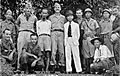
Ho Chi Minh (third from left standing) and Võ Nguyên Giáp (fifth from left standing) with American members of the OSS in 1945.
_and_the_OSS_in_1945.jpg)
