
African bullfrog facts for kids
Quick facts for kids African bullfrog |
|
|---|---|
 |
|
 |
|
| Conservation status | |
Scientific classification  |
|
| Kingdom: | Animalia |
| Phylum: | Chordata |
| Class: | Amphibia |
| Order: | Anura |
| Family: | Pyxicephalidae |
| Genus: | Pyxicephalus |
| Species: |
P. adspersus
|
| Binomial name | |
| Pyxicephalus adspersus Tschudi, 1838
|
|
| Script error: The function "autoWithCaption" does not exist. | |

Script error: No such module "Check for conflicting parameters".
The African bullfrog (Pyxicephalus adspersus) is a really big frog found in many parts of Africa. People also call it the giant bullfrog or the South African burrowing frog. Sometimes, because of its scientific name, it's even called the pixie frog!
These amazing frogs live in countries like Angola, Botswana, Kenya, Malawi, Mozambique, Namibia, South Africa, Tanzania, Uganda, Zambia, and Zimbabwe. They used to live in Eswatini too, but they are not found there anymore. Scientists are still learning about how this species relates to other similar frogs, like the edible bullfrog.
African bullfrogs like to live in places that can be wet or dry, such as savannas, dry shrublands, and around temporary freshwater lakes and marshes. You might even spot them in arable land (farmland), pastures, canals, and flooded ditches. They are one of the largest frogs on Earth! Only a few other frogs, like the goliath frog, are bigger.
Contents
What Does the African Bullfrog Look Like?
These frogs are quite impressive! Male African bullfrogs can weigh up to 1.4 kg (3.1 lb) (about the weight of a small laptop) and grow to 24.5 cm (9.6 in) long from their snout to their vent (the opening at the end of their body). That's almost as long as a standard ruler!
Interestingly, female African bullfrogs are usually about half the size of the males. This is a bit unusual for amphibians, as females are often larger.
Adult African bullfrogs have a dark olive-green color on their backs. Young frogs are bright green with a yellow stripe running down their back. Their bellies are white or creamy-yellow. When males are ready to breed, their front legs turn yellow.
What Do African Bullfrogs Eat?
African bullfrogs are very hungry eaters, also known as carnivores. They will eat almost anything that fits into their large mouths! Their diet includes insects and other small creatures without backbones (invertebrates), small rodents, reptiles, tiny birds, fish, and even other amphibians.
Sometimes, these frogs can even eat others of their own kind. For example, a male African bullfrog might occasionally eat some of the tadpoles he is guarding. Younger bullfrogs also sometimes eat tadpoles. There's a famous story from the Pretoria Zoo where an African bullfrog once ate 17 young Rinkhals snakes!
Surviving Dry Times
When their environment becomes very dry, African bullfrogs have a clever way to survive. They go into a dormant state, which is like a deep sleep. During this time, they create a special cocoon that covers their entire body, except for their nostrils. This cocoon helps them save water and prevents them from drying out. When it finally rains again, the water softens the cocoon, and the frog can crawl out, ready to be active once more!
Life Cycle and Reproduction
African bullfrogs usually start to breed after a good amount of rain, typically about 65 mm (2.6 in) over two days. They choose shallow, temporary water bodies like pools, ponds, and ditches to lay their eggs. The eggs are laid near the shallow edges, and fertilization happens above the water.
During the rainy season, male African bullfrogs make a loud, low-pitched "whoop" sound that lasts about a second. This is their call to attract females.
Males have different ways of finding a mate depending on their age. Younger males gather in small groups in shallow water. The larger, stronger males take the center of these breeding areas, called leks, and try to keep other males away. They often compete fiercely, and sometimes even fight aggressively, to win a female's attention.
A female frog will swim towards the group of males on the surface of the water. When she gets close, she dives underwater to avoid the smaller males. She then surfaces in the area defended by a larger, dominant male in the middle of the group. This helps her choose the strongest male to mate with.
A female can lay about 3,000 to 4,000 eggs at one time! The tadpoles hatch after two days and begin to eat plants, small fish, tiny invertebrates, and sometimes even each other.
The father frog is very protective. He continues to guard his young tadpoles, which grow and change into frogs within about three weeks. During this time, the male bullfrog will pounce and bite at anything he sees as a threat to his offspring. If the pond where the tadpoles live starts to dry up, the father will even use his legs and head to dig a canal. This canal helps connect the drying pond to a bigger, safer pond, ensuring his tadpoles have enough water. He keeps guarding them until they are old enough to take care of themselves, though he might still eat a few of them occasionally.
Conservation Status
Globally, the African bullfrog is listed as a species of "least concern." This means that there are still many of them in the wild, and they are not currently at high risk of disappearing.
However, before 2013, the African bullfrog was considered "near threatened" in South Africa. This was mainly because their natural homes (habitats) were being lost. Thankfully, people worked hard to help these frogs! Conservation efforts, like restoring their habitats, creating awareness campaigns, and putting legal protections in place, helped a lot. Because of these successful actions, the African bullfrog's status in South Africa improved, and it was reclassified to "least concern" in July 2013.
African Bullfrogs and Humans
African bullfrogs are popular as exotic pets in many countries around the world. Most of the frogs sold as pets are bred in captivity, meaning they were born and raised by people, not caught from the wild. Pet African bullfrogs can live for a very long time, sometimes up to 35 years! Many people find them to be easygoing and not too difficult to care for as pets.
In Namibia, the African bullfrog is also considered a special food, or a "delicacy."
Gallery
-
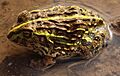
A large African bullfrog.
-
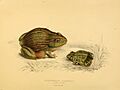
An adult and a juvenile African bullfrog.

.jpg)
See also
 In Spanish: Rana toro africana para niños
