
Anarhichas minor facts for kids
Quick facts for kids Anarhichas minor |
|
|---|---|
 |
|
| Recently caught individual from Upernavik Kujalleq, Greenland | |
| Conservation status | |
|
Invalid status (NatureServe)
|
|
Scientific classification  |
|
| Kingdom: | Animalia |
| Phylum: | Chordata |
| Class: | Actinopterygii |
| Order: | Scorpaeniformes |
| Family: | Anarhichadidae |
| Genus: | Anarhichas |
| Species: |
A. minor
|
| Binomial name | |
| Anarhichas minor (Ólafsson, 1772)
|
|
| Script error: The function "autoWithCaption" does not exist. | |
| Synonyms | |
|
|
Script error: No such module "Check for conflicting parameters".
Anarhichas minor, commonly called the spotted wolffish, is a giant ocean fish. People also call this creature the spotted sea cat or the leopardfish. It belongs to the marine fish family Anarhichadidae. This giant swimmer lives near the cold seabed across the northern waters of the world. It makes its home in the icy Arctic Ocean and deep regions of the North Atlantic Ocean.
In earlier decades, the number of these fish dropped very quickly in Canadian waters. Scientists noticed that their wild population fell by around 90 percent between the late 1970s and early 1990s. Because of this big drop, Canada now protects the animal as a threatened species under law. It is an amazing creature that plays a big part in keeping cold ocean habitats healthy.
Contents
Discovering the Spotted Wolffish
An Icelandic explorer, writer, and teacher of the Icelandic language named Eggert Ólafsson first wrote a scientific species description of the fish in 1772. He found the animal living in the cold waters around Iceland.
The spotted wolffish is one of four distinct kinds of wolffishes grouped in the genus Anarhichas. When scientists name animals, they give them a two-part scientific name. The second word is the specific name. For this fish, Ólafsson chose the word minor. In Latin, that word usually means smaller or lesser. However, Ólafsson intended it to mean "the second one." He picked this label because it was the second wolffish species ever discovered by scientists. Later on, other naturalists gave it different scientific labels such as Anarhichas leopardus, which was chosen by Louis Agassiz, and names penned by Pierre Joseph Bonnaterre, Marcus Elieser Bloch, and Johann Gottlob Theaenus Schneider.
What Does the Spotted Wolffish Look Like?
The spotted wolffish has a very unusual look that makes it easy to remember. Its long, thick body looks somewhat like a giant eel. It can grow to a massive length of over 1.8 m (5.9 ft). A full-grown adult can weigh as much as 23 kg (51 lb).
A Powerful Head and Strong Teeth
The fish has a heavy, rounded head with a blunt snout and small, watchful eyes. Its mouth contains large, sharp, canine-like teeth sticking out from the front of both jaws. Behind these front spikes sit flat crushing teeth. These strong jaws can easily break open hard rocks and tough shells found on the sea floor.
Fins and Body Shape
The body of the spotted wolffish has firm muscles and lacks pelvic fins on its belly. Along its back runs a single, long dorsal fin supported by flexible spiny rays. This large fin stretches all the way down to the base of its tail. At the very end of its body sits a small, slightly rounded tail fin. It also steers itself using wide, rounded pectoral fins on its sides.
Leopard-Like Skin Pattern
The skin of this species comes in shades of pale olive to deep, rich brown. Its upper body is covered with dark, irregularly shaped blackish-brown spots. These markings look just like the spots on a leopard.
Other related species live in the same chilly waters, but they look different. The spotted wolffish is easy to tell apart from the northern wolffish and the Atlantic wolffish because of these dark blotches. While the Atlantic wolffish has dark vertical stripes, the spotted wolffish always shows off its famous dotted coat.
Where Does the Spotted Wolffish Live?
Spotted wolffish live across a vast range of cold ocean waters. They swim on both sides of the chilly North Atlantic Ocean and into parts of the polar Arctic Ocean.
Cold Northern Waters
In North America, these creatures live from Labrador all the way up toward Baffin Bay. Farther south, they appear across the Labrador Shelf, around the famous fishing grounds of the Grand Banks, and out along the Scotian Shelf near Nova Scotia. In European and eastern waters, they swim from north of Russia and the Scandinavian Peninsula into the frosty Barents Sea. Some explorers have even spotted stray individuals as far south as Scotland and Ireland.
Life on the Ocean Floor
Spotted wolffish live far offshore in very deep, freezing water. They prefer temperatures below 5 °C (41 °F). They usually stay at depths between 50–800 m (160–2,620 ft). However, in the very cold Canadian Arctic, they sometimes venture into shallower waters just 25 m (82 ft) deep.
These animals like to rest on bottoms covered with coarse sand and crushed shells. They choose areas with large rocks nearby. The boulders give them safe caves to hide inside and provide solid ground for building safe nests. They do not travel in big groups or make long journeys across the sea. Instead, they live quiet lives and stick to their home territory.
Diet and Feeding Habits
The spotted wolffish is a skilled hunter that searches the seabed for food. Its diet mostly consists of tough, bottom-dwelling invertebrates. These are animals without backbones that protect themselves with hard outer coverings.
The wolffish uses its crushing jaws to eat crunchy crustaceans like crabs. It also devours shelled mollusks such as clams and sea snails, along with prickly echinoderms like sea urchins and starfish. When ordinary bottom prey is scarce, it hunts other ocean fish. It also searches for nests to eat fish eggs and newly hatched fish larvae. At times, scientists have even seen adult wolffish eat smaller members of their own kind.
Life Cycle and Reproduction
Spotted wolffish grow at a very slow pace compared to their cousins, like the northern wolffish. They take plenty of time to mature in the freezing water. A young wolffish does not reach adult breeding age until it is at least seven years old. Many of them survive for a long time, living up to 21 years in the wild.
Breeding takes place during the late summer, autumn, and early winter months. A female can lay up to 54,600 eggs during a single season. These eggs are quite large for a fish, measuring up to 6 mm (0.24 in) across. The female lays the eggs in tight clusters right on the ocean bottom. Once the eggs are placed safely near the rocks, the male stays behind to guard the nest. He protects the eggs from hungry predators until the young hatch.
Threats and Conservation Status
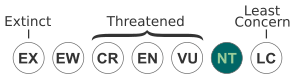
Spotted wolffish face several serious challenges in modern oceans. Because their numbers dropped sharply in the past, groups like the Committee on the Status of Endangered Wildlife in Canada studied them closely. The Canadian government officially added the spotted wolffish to the Species at Risk Act in June 2004. This important law helps protect the fish and its ocean home. In European waters, the IUCN lists the species as Near Threatened.
Human Impacts on Wolffish
People do not usually set out on boats just to hunt spotted wolffish. However, the species still gets harmed by overfishing targeting other creatures. Large boats called offshore trawlers drag heavy nets across the ocean floor. The wolffish are accidentally caught in these giant nets as bycatch.
Deep-water commercial trawling can also scrape and destroy rocky seabed habitats. When heavy fishing gear flattens the sea floor, it crushes the rock shelters that wolffish need for building their nests. By protecting deep-sea habitats and using better fishing methods, people can help save this spotted giant for the future.
