
Animism facts for kids
Animism is the belief that all things in the world have a spirit or a soul. This includes animals, plants, rocks, rivers, and even the weather. In animism, these are not just objects, but living beings with their own feelings and thoughts. The word "animism" comes from the Latin word anima, which means "soul" or "life".
This belief is very common in many indigenous cultures around the world. For people who believe in animism, everything in nature is alive and deserves respect. It is a worldview that sees humans as part of a large community of living beings, not separate from or more important than nature.
Contents
Who First Studied Animism?

The term "animism" was made popular in 1871 by an English anthropologist named Sir Edward Burnett Tylor. An anthropologist is someone who studies human cultures. Tylor thought that animism was one of the earliest forms of religion.
He believed that early humans came up with the idea of spirits to explain things they did not understand, like what happens in dreams. He thought that as societies became more scientific, people would stop believing in animism.
How Is Animism Understood Today?
Today, many scholars and people who follow animist beliefs see it differently than Tylor did. They do not see it as an early or simple belief. Instead, they see it as a way of living with respect for the world.
Animism is about building relationships with everything around us, from the smallest plant to the largest mountain. It teaches that humans are just one part of a large community of living beings. This view encourages people to take care of the environment and treat all parts of nature with care.
Animism in World Beliefs
Animism is not a single religion, but a belief found in many cultures and spiritual traditions around the world.
Shinto in Japan
Shinto is the traditional religion of Japan. A core belief in Shinto is the existence of kami. Kami are spirits or gods that live in natural things. A beautiful mountain, an old tree, a waterfall, or even a uniquely shaped rock can be home to a kami. People build shrines to honor these kami and show respect for nature.
Indigenous Beliefs Around the World
Many indigenous cultures have animistic views. For example:
- In parts of Africa, many traditional religions teach that spirits live in nature and that ancestors' spirits watch over the living.
- In the Philippines, traditional beliefs include spirits called Anito and Diwata that are connected to nature and ancestors.
- The Kalash people of Pakistan have ancient beliefs that see nature as sacred and full of life.
- In India, religions like Hinduism have a deep respect for nature. Rivers like the Ganges are considered sacred, and certain trees, like the Banyan tree, are worshipped.
What Is a Shaman?

In many animistic cultures, a shaman is a special person who can communicate with the spirit world. Shamans are seen as healers and spiritual guides.
They might perform rituals to ask spirits for help in healing someone who is sick, finding food, or bringing balance to the community. They act as a bridge between the human world and the world of spirits.
Living in an Animated World
For people with animist beliefs, the world is full of other "persons," not just other humans.
Animals and Plants
Animals are not just creatures; they are intelligent beings with their own communities and intentions. A hunter in an animist culture might perform a ritual to thank the spirit of an animal after a hunt.
Plants and trees are also seen as living persons. For example, some Māori communities in New Zealand say special prayers to sweet potatoes as they harvest them, recognizing a special connection with the plant.
Places and Elements
In animism, even the land itself can be alive. A mountain, a river, or a forest can be seen as a powerful living being. The weather, like a thunderstorm, can also be understood as a spirit. These beliefs encourage a deep respect for the environment and a sense of connection to the land.
Animism in Stories and Movies
Animist ideas are often found in stories, art, and movies. Many books by indigenous authors tell stories from an animist point of view, where nature is alive and communicates with humans.
You might have seen animism in animated movies, too. The famous Japanese director Hayao Miyazaki often shows nature as being full of spirits in his films, like My Neighbor Totoro and Spirited Away. In these movies, forests have ancient spirits, and rivers can have their own personalities.
Images for kids
-

Five Ojibwe chiefs in the 19th century. Studies of Ojibwe beliefs helped change how scholars understood animism.
-
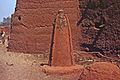
An animist altar in a Bozo village in Mali, Africa (1972).
-
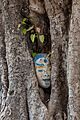
A sculpture of a human head that has become part of a tree trunk in Laos, showing a close connection between humans and nature.
-

During the Vat Purnima festival in India, married women tie threads around a banyan tree and pray.
-

A 1922 photograph of an Itneg priestess in the Philippines making an offering to guardian stones, which are believed to hold spirits called anito.


.jpg)


See also
 In Spanish: Animismo para niños
- Anima mundi (World soul)
- Ecotheology
- Hylozoism
- Panpsychism
- Religion and environmentalism
- Sacred trees
- Shamanism
