
Antwan Wilson facts for kids
Quick facts for kids
Antwan Wilson
|
|
|---|---|
_(cropped).jpg) |
|
| Chancellor of District of Columbia Public Schools | |
| In office February 1, 2017 – February 20, 2018 |
|
| Preceded by | John Davis (interim) |
| Succeeded by | Amanda Alexander (interim) |
| Superintendent of Oakland Unified School District | |
| In office June 2014 – February 2017 |
|
| Preceded by | Gary Yee |
| Succeeded by | Devin Dillon (acting) |
| Personal details | |
| Born | 1972 (age 53–54) Wichita, Kansas, U.S. |
| Spouse | Theresa |
| Children | 3 |
| Education | Nebraska Wesleyan University (1995, BA) Friends University (2000, MA) |
Antwan Wilson (born in 1972) is an American teacher and school leader. He became the Superintendent of the Oakland Unified School District in Oakland, California, in 2014. He left that job in February 2017. On December 20, 2016, he was chosen as the Chancellor of the District of Columbia Public Schools in Washington, D.C.. He started this new role on February 1, 2017.
Wilson resigned as the D.C. schools chancellor on February 20, 2018. This happened after news reports said he had found a special way for one of his children to get into a popular school, instead of using the normal lottery system.
Contents
Early Life and Education
Antwan Wilson was born around 1972 in Wichita, Kansas. He has a younger brother and a younger sister. He grew up in Wichita and Lincoln, Nebraska. For much of his childhood, his mother raised them alone. His family faced financial challenges, and his mother worked hard to support her children. He often lived in neighborhoods where there were problems with crime and gangs.
Antwan described himself as shy when he was a child. He went to public schools in Wichita and Lincoln. His family moved often to help the children attend better schools. He graduated from Lincoln High School. He was one of only a few minority students in advanced classes there.
When Antwan was a senior in high school, his mother was injured at work. He decided to go to a local college so he could stay home and help her while he studied. He attended Nebraska Wesleyan University. There, he earned a degree in history and social science education. Wilson first planned to study law and become a civil rights lawyer. But in his second year, he started thinking about how education could help end poverty and unfairness.
During a school break, he visited Chicago, Illinois. He watched Linda Murray, a famous teacher, in her classroom. This experience inspired him to add education classes. Eventually, he changed his main field of study to education. In 2000, Wilson earned his master's degree in educational leadership from Friends University in Wichita.
In 2014, Wilson also completed a program called Broad Superintendents Academy. This program trains school leaders.
Early Career in Schools
Wichita and Lincoln Schools
After college, Wilson decided to teach for at least five years. He taught for one year in Raleigh, North Carolina. Then, he taught for three years at a high school in Wichita. He also coached basketball and track. In 1999, Wilson became an assistant principal at Lincoln High School in Lincoln, Nebraska. After a year, he moved to be an assistant principal at Wichita South High School. Later, Wilson became the principal at Pleasant Valley Middle School in Wichita.
At Pleasant Valley, Wilson used the motto "Success for all. No excuses." He started many programs for students, teachers, and parents. These programs helped improve attendance, reduce behavior problems, and boost learning.
Leading Schools in Denver
In 2005, Wilson became the principal at Montbello High School in Denver, Colorado. This school was in a challenging area of the city. Students at Montbello had struggled, and attendance, graduation rates, and test scores were low. There were also many discipline problems and teachers often left. Wilson first brought in strict rules. Students could not skip classes or gather in large groups in hallways. Students who did not turn in homework had to use part of their lunch time to finish it. Instead of suspensions, students often had in-school detention combined with schoolwork.
Later, Wilson encouraged teachers to focus on basic skills and critical thinking. He also promoted more interactive teaching. This included building a strong community spirit at Montbello. Testing was used to find out what skills students needed to learn, not just to see who was failing. During Wilson's time there, state test scores improved, and suspensions went down.
In 2008, Wilson was promoted to High School Instructional Superintendent for the Denver Public Schools. A year later, he became Assistant Superintendent for Post-Secondary Readiness. In this role, Wilson helped start a program called "Denver Summit Schools." This program focused on the district's 11 lowest-performing schools. Each school got a special theme, help with behavior issues, and started offering Advanced Placement courses. Teachers received new training and more support. Enrollment at these schools increased, the dropout rate dropped by 60 percent, and test scores rose. This was especially true for minority students.
Leading Schools in Oakland
In 2014, Antwan Wilson was chosen as the superintendent of the Oakland Unified School District in Oakland, California. He was known for improving struggling schools in Denver. The Oakland school board voted to hire him. He started his four-year contract on July 1, 2014.
New Ideas and Changes
In Oakland, Wilson made several important changes. He created a new way to evaluate teachers and leaders. He also gave each school more freedom in choosing staff and trying new teaching ideas. Wilson also made some operations, especially finances, more centralized. This helped the district complete a financial audit for the first time in ten years. This improved the school district's credit rating, which saved money on interest and allowed for new spending. Wilson also sent more money directly to local schools and spent less on central administration.
Like in Denver, Wilson paid a lot of attention to the schools that were struggling the most. He started a program at the five most challenged schools. This included changing principals, updating lessons, and adding activities like art, choir, and speech and debate. He also worked with many groups to create "Oakland Promise." This plan aimed to triple the number of Oakland public school students going to college within 10 years. This program gained national attention. Wilson also focused on social-emotional learning, which helps students understand and manage their feelings.
Wilson also worked to connect Oakland's charter schools more closely with the public school system. In 2015, he started an effort for charter schools and public schools to use similar lessons, teaching methods, and staff training. The next year, Wilson tried to require parents to use one form to apply for either a public school or a charter school. His goal was to make admissions fairer and more open.
Under Wilson, the Oakland school district also reached a new agreement with its teacher and staff unions in 2016. This was the first time since 2009 that they had agreed on a contract.
Challenges and Criticisms
Wilson's time in Oakland was described as having "rocky" moments by the news. His plan to change low-performing schools caused some debate. The idea of a single application form for charter and public schools was strongly opposed by some teachers and parents. They worried it would make public schools more like charter schools. Some parents felt this could lead to African American students being grouped into the lowest-performing public schools and take away needed money from public schools.
Parents of special needs students also said Wilson tried to include their children in regular classrooms without enough staff or money to help them. This, they felt, could harm their children's learning. Wilson's training from the Broad Superintendents Academy also caused some concern. Critics worried he might support a plan to close all but the best public schools and turn the education system into charter schools. Some members of the Oakland school board, the teachers' union, and community groups criticized Wilson for moving too quickly and not listening enough to community concerns.
Despite these criticisms, many school board members strongly supported Wilson during his time in Oakland.
Wilson was also criticized for leaving the school district with a $30 million budget problem. This problem became public just a month before he left. It was caused by quickly adding new programs, unexpected costs in existing programs, and a $10 million loss in state money because fewer students enrolled. Wilson said he had balanced the budget every year before. He argued that asking for full funding and then making cuts later was a normal part of the budget process.
Leading Schools in Washington, D.C.
On November 21, 2016, Washington, D.C., Mayor Muriel Bowser nominated Wilson to be the Chancellor of the District of Columbia Public Schools. Mayor Bowser said Wilson was a "proven manager" who was "bold and strategic." She highlighted his ability to bring financial stability to school districts. Wilson announced that day that he was leaving his job in Oakland in February 2017. Wilson's nomination needed approval from the Council of the District of Columbia.
At a hearing on December 7, 2016, the D.C. city council asked Wilson about how he would solve problems in the city's schools. Wilson suggested longer school days, tutoring, and other help for students who were struggling. He also promoted more after-school activities for middle schoolers. Some people and groups were concerned about his nomination. They argued that his programs had only been somewhat successful in Denver and Oakland. However, the council approved his nomination unanimously on December 20. His first day on the job was February 1, 2017.
In November 2017, The Washington Post reported that Wilson had left the Oakland public school system with an unsolved financial crisis. The newspaper said Wilson had downplayed Oakland's $30 million budget problem to D.C. officials and the public. An Oakland principal, Carmelita Reyes, said that soon after Wilson announced his resignation, all school district budgets in Oakland were frozen because of the financial problems. The Post also reported that:
- Wilson hired many new executive staff and created new departments that were not planned for in the budget. He also paid these people more than the usual salary in Oakland.
- In his last year in Oakland, Wilson spent $11.8 million more than budgeted for supervisors and administrators. He also spent $6.8 million more than budgeted for professional and consulting services.
- During his two and a half years as Oakland superintendent, the school district consistently spent less than budgeted on books and classroom supplies.
- Wilson hired the head of a consulting firm that was already working for the Oakland school district. This person was paid $30,000 a month. This raised questions about a possible conflict of interest.
- Wilson's team in Oakland guessed that more students would enroll for the 2016–2017 school year than actually did. When fewer students enrolled, the district should have let go of several dozen teachers. Not doing so cost the district $3.2 million.
The financial problems in Oakland were so serious that a state team helping the district said in August 2017 that the Oakland public school district had "lost control of its spending." Auditors for the state of California also said that, under Wilson, the Oakland school district had "lost control of its spending." In November 2015, the Oakland Board of Education ordered $15.1 million in emergency budget cuts.
Both Superintendent Wilson and Mayor Bowser did not comment on the Oakland crisis when asked by the media in late 2017. Principal Reyes said that the school board shared responsibility with Wilson for the budget problems and new hires.
Resignation from D.C. Schools
In April 2017, local news reported that some D.C. government and school officials had received special permission to move their children to different schools without using the admissions lottery. Normally, students wanting to attend a school outside their assigned area must enter this lottery to ensure fairness. These special permissions had been given by Wilson's predecessor. In the summer of 2017, Wilson created a new rule. It said the D.C. schools chancellor could not grant non-lottery admissions without following specific exception rules.
On February 16, 2018, Wilson admitted in an interview that he had asked a deputy mayor to allow his daughter to transfer schools without the lottery. His daughter was having problems at Duke Ellington School of the Arts. He wanted her to move to Woodrow Wilson High School. His request was approved.
Many people and groups called for Wilson to resign. Wilson first refused. By February 20, seven of the 13 members of the D.C. Council had also called for his resignation. Mayor Muriel Bowser then placed Wilson on leave and asked him to resign. Wilson resigned later that afternoon.
Dr. Amanda Alexander, who led the DCPS Office of Elementary Schools, was appointed as the interim chancellor.
Professional Groups
While he was superintendent in Oakland, Wilson joined the National Commission on Social, Emotional, and Academic Development and Chiefs for Change. He is also an advisor to Code.org, which runs the popular Hour of Code program.
Personal Life
Antwan Wilson married his wife, Tresa, who is also an educator. They married while he was working in Wichita between 2000 and 2003. The couple has three daughters, including a set of twins.
Wilson is known for waking up every day at 3 A.M. to exercise, meditate, and get ready for the day. He looks up to his mother; his mentor and former teacher, Tim Carroll; Barack and Michelle Obama; football coach Vince Lombardi; and former basketball player Magic Johnson.
Images for kids
-
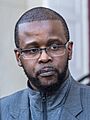
Antwan Wilson
