
Artemis I facts for kids

The Orion spacecraft approaching the Moon on day six of the mission
|
|
| Names |
|
|---|---|
| Mission type | Uncrewed lunar orbital flight test |
| Operator | NASA |
| Mission duration | 25 days, 10 hours, 52 minutes and 46 seconds |
| Distance travelled | 1.3 million miles (2.1 million kilometers) |
| Spacecraft properties | |
| Spacecraft |
|
| Manufacturer |
|
| Start of mission | |
| Launch date | November 16, 2022, 06:47:44 UTC (1:47:44 am EST) |
| Rocket | Space Launch System |
| Launch site | Kennedy, LC-39B |
| End of mission | |
| Recovered by | USS Portland |
| Landing date | December 11, 2022, 17:40:30 UTC (9:40:30 am PST) |
| Landing site | Pacific Ocean off Baja California |
| Orbital parameters | |
| Reference system | Selenocentric |
| Regime | Distant retrograde orbit |
| Period | 14 days |
| Flyby of Moon | |
| Closest approach | November 21, 2022, 12:57 UTC |
| Distance | 130 km (81 mi) |
| Moon orbiter | |
| Orbital insertion | November 25, 2022, 21:52 UTC |
| Orbital departure | December 1, 2022, 21:53 UTC |
| Flyby of Moon | |
| Spacecraft component | Orion |
| Closest approach | December 5, 2022, 16:43 UTC |
| Distance | 128 km (80 mi) |
 Mission insignia |
|
Artemis I, also known as Exploration Mission-1 (EM-1), was an important uncrewed space mission by NASA. It launched on November 16, 2022. This mission was the first big step in NASA's Artemis program. It marked a return to exploring the Moon, almost 50 years after the Apollo program.
The main goal of Artemis I was to test the Orion spacecraft and the powerful Space Launch System (SLS) rocket. They especially wanted to check Orion's heat shield. This test was vital for future Artemis missions. These missions aim to send humans back to the Moon. They also prepare for future scientific studies, including exploration of Mars.
The Orion spacecraft was put together in October 2021. The full rocket was moved to the launchpad in August 2022. There were some delays during testing and launch attempts. But Artemis I successfully launched on November 16, 2022. It lifted off from Launch Complex 39B at the Kennedy Space Center.
After reaching orbit around Earth, the rocket's upper part sent Orion towards the Moon. Orion then released ten small satellites called CubeSats. The spacecraft flew past the Moon on November 21. It then orbited the Moon for six days in a special path. Orion flew past the Moon again on December 5.
Finally, the Orion spacecraft returned to Earth. Its heat shield protected it as it entered the atmosphere. It splashed down safely in the Pacific Ocean on December 11, 2022. This mission proved that Orion and the Space Launch System were ready for missions with astronauts. The next mission, Artemis II, is currently flying astronauts around the Moon in April 2026.
Contents
How Artemis I Flew to the Moon
Artemis I used a powerful rocket called the Space Launch System (SLS) Block 1. This rocket had a main core stage and two large solid rocket boosters. These parts worked together to create a huge amount of thrust, about 4,000 metric tons, to lift off from Earth. The upper part of the rocket, called the Interim Cryogenic Propulsion Stage (ICPS), helped push the Orion spacecraft towards the Moon.
Once in Earth's orbit, the ICPS engine fired to send Orion and its small CubeSat satellites on a path to the Moon. After this push, Orion separated from the ICPS. The ICPS then released the ten CubeSats, which carried out various science experiments.
The Orion spacecraft traveled for about three weeks in space. For six days, it orbited the Moon in a special path called a distant retrograde orbit (DRO). During its journey, Orion flew very close to the Moon's surface, about 130 kilometers (80 miles) away. It also traveled farther from Earth than any human-rated spacecraft before, reaching about 432,210 kilometers (268,563 miles).
Mission Journey Timeline
Here is a summary of the key events during the Artemis I mission:
| Date | Time (UTC) | Event |
|---|---|---|
Launch |
||
| November 16 | 06:47:44 | Liftoff |
| 06:49:56 | Solid rocket booster separation | |
| 06:50:55 | Service module fairing jettisoned | |
| 06:51:00 | Launch abort system (LAS) jettisoned | |
| 06:55:47 | Core stage main engine cutoff (MECO) | |
| 06:55:59 | Core stage and ICPS separation | |
| 07:05:53 – 07:17:53 | Orion solar array deployment | |
| 07:40:40 – 07:41:02 | Perigee raise maneuver | |
| 08:17:11 – 08:35:11 | ICPS Trans-lunar injection (TLI) burn | |
| 08:45:20 | Orion/ICPS separation | |
| 08:46:42 | Upper-stage separation burn | |
| 10:09:20 | ICPS disposal burn | |
| Moon outbound transit | ||
| November 16 | 14:35:15 | First trajectory correction burn |
| November 17–20 | Outbound coasting phase | |
| November 21 | 12:44 | Outbound powered flyby burn |
| Orbiting Moon | ||
| November 21–24 | Transit to DRO | |
| November 25–30 | Distant retrograde orbit | |
| December 1 | 21:53 | DRO departure burn |
| December 1–4 | Exiting DRO | |
| Earth return | ||
| December 5 | 16:43 | Close lunar approach |
| December 5–11 | Return transit | |
| December 11 | 17:40:30 | Splashdown at the Pacific Ocean |

How the Mission Looked in Space


The Flight of Artemis I
-
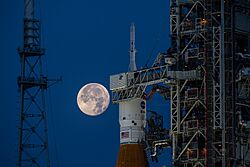
SLS on standby, ready for launch
-
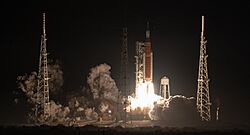
SLS just after engine ignition
-
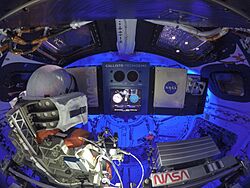
Inside Orion with mannequin Campos
-
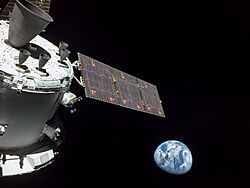
Orion on the first day of the mission
-
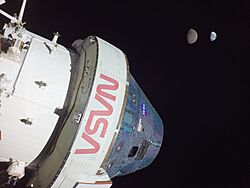
Orion, the Moon and Earth on day 13
-
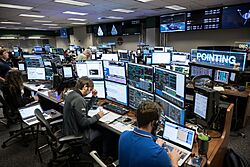
Mission control on day 14
-
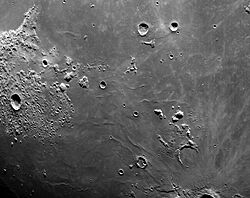
Details of the lunar surface, day 19
-
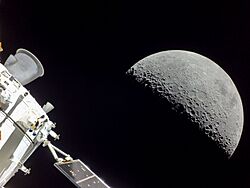
The Moon after return flyby, day 19
-

Artemis 1 before reentry, day 25
-
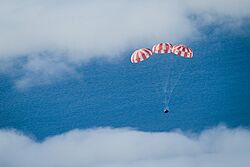
Orion descending to the Pacific Ocean
-
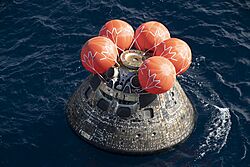
Orion shortly after splashdown
.jpeg)
.jpeg)
.jpg)
.jpg)


.jpeg)


Launch Day
.jpg)
After some delays, including fixing a fuel leak, Artemis I successfully launched. It lifted off at 1:47:44 am EST on November 16, 2022. The Orion spacecraft and its upper stage reached their planned orbit about 8 and a half minutes later. This was the first launch from Launch Complex 39B since 2009.
Journey to the Moon
About 89 minutes after launch, the upper stage fired its engine. This push sent Orion on its way to the Moon. Orion then separated from the upper stage. It used its own small engines to move safely away. The upper stage then released ten small CubeSat satellites. These satellites went on to do their own science missions.
On November 20, Orion entered the Moon's gravitational pull. This meant the Moon's gravity had a stronger effect on the spacecraft than Earth's.
Orbiting the Moon
On November 21, Orion flew behind the Moon. This caused a temporary loss of communication with NASA. While behind the Moon, Orion performed a special maneuver. This burn helped it enter a distant retrograde orbit (DRO) around the Moon. During this time, Orion came closest to the Moon's surface, about 130 kilometers (81 miles) away.
On November 26, Orion set a new record. It traveled farther from Earth than any human-rated spacecraft had before. It reached about 400,171 kilometers (248,655 miles) from Earth. The previous record was held by the Apollo 13 mission. On November 28, Orion reached its maximum distance from Earth, about 432,210 kilometers (268,563 miles).
On December 1, Orion left its orbit around the Moon. It began its journey back towards Earth.
Return to Earth
On December 5, Orion made another close pass by the Moon. It came within 128 kilometers (80 miles) of the lunar surface. This flyby helped it gain speed to head back to Earth. Again, it briefly lost communication as it passed behind the Moon.
On December 6, Orion left the Moon's gravitational pull. Over the next few days, mission control checked all systems. They prepared the spacecraft for its return to Earth. The landing site was chosen near Guadalupe Island, off the coast of Mexico.
Splashdown
On December 11, the Orion spacecraft separated from its service module. It then entered Earth's atmosphere at a speed of about 40,000 kilometers per hour (25,000 miles per hour). Orion used a special "skip entry" method. This helped slow it down in two stages. This method makes the landing smoother for future astronauts.
The Orion capsule splashed down safely in the Pacific Ocean at 9:40 am PST. After splashdown, a team from NASA and the US Navy recovered the spacecraft. They performed tests in the ocean before pulling Orion onto the USS Portland ship. On December 13, the Orion capsule arrived at the Port of San Diego.
What Orion Carried

The Orion spacecraft carried three special mannequins. These mannequins had sensors to collect data. This data showed what real astronauts might experience during a trip to the Moon.
- Captain Moonikin Campos: This mannequin sat in the commander's seat. It wore a special suit that astronauts will use. Sensors in the suit measured radiation, acceleration, and vibrations.
- Helga and Zohar: These were two phantom torsos. They were part of an experiment to measure radiation. Zohar wore a special AstroRad radiation vest. Helga did not wear a vest. This helped scientists compare how well the vest protected against radiation.
Besides the mannequins, Orion also carried some fun items. These included a plush doll of NASA's Snoopy and a Shaun the Sheep toy. These acted as zero-gravity indicators.
Orion also carried a technology demonstration called Callisto. This was developed by Lockheed Martin, Amazon, and Cisco. Callisto used video calls to connect with mission control. It also used the Amazon Alexa virtual assistant to respond to messages. People could even send messages to be displayed on Callisto during the mission!
Small Satellites (CubeSats)
_Secondary_Payload_Cubesat_(KSC-20210805-PH-CSH01_0009).jpg)
Ten small, low-cost satellites called CubeSats flew with Artemis I. They were carried in the rocket's stage adapter. These CubeSats performed various scientific research and technology tests.
Some of these CubeSats included:
- ArgoMoon: Designed to take pictures of the rocket's upper stage.
- BioSentinel: Carried yeast to study the effects of deep space radiation. Its mission was extended into November 2024.
- EQUULEUS: From Japan, it took images of Earth's plasmasphere and the Moon's far side. It even filmed a comet in February 2023.
- Lunar IceCube: Designed to search for water and other compounds on the Moon's surface. Contact was lost after launch.
- Lunar Polar Hydrogen Mapper (LunaH-Map): Aimed to find water ice in shadowed craters on the Moon. Its engines failed, and the satellite was lost.
- Near-Earth Asteroid Scout: A solar sail that was supposed to fly by an asteroid. Communications were not successful, and it was lost.
- OMOTENASHI: A Japanese lunar probe that tried to land on the Moon but failed to work correctly.
- LunIR: Flew by the Moon to collect thermal images of its surface. An issue prevented it from making observations.
- Team Miles: Planned to test a new type of engine in deep space. Contact was not made after deployment.
Public Engagement

The Artemis I mission patch was designed by NASA teams. The silver border represents the Orion spacecraft. In the middle, the SLS rocket and Orion are shown. Three lightning towers around the rocket symbolize the launchpad. The red and blue paths around the Moon represent the people from America and Europe who worked on Artemis I.
NASA promoted Artemis I as the start of its "Moon to Mars" program. To get people excited, NASA created a website. People could submit their names to be flown on a flash drive inside the Orion spacecraft. A digital copy of 14,000 essays from a contest was also carried aboard.
Images for kids
-
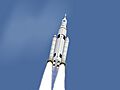
2011 illustration of an SLS launch
-
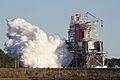
First static-fire attempt of the core stage performed on January 16, 2021
-
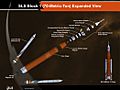
Block 1 variant of SLS rocket
-
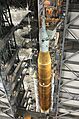
SLS with the Orion capsule stacked in the Vehicle Assembly Building, March 2022
-
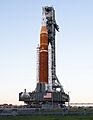
First rollout of SLS in March 2022. It was subsequently rolled back in for repairs.


.jpg)
See also
- List of Artemis missions
- List of missions to the Moon
