
List of missions to the Moon facts for kids


Missions to the Moon have been numerous and represent some of the earliest endeavours in space missions, with continuous exploration of the Moon beginning in 1959.
The first partially successful lunar mission was Luna 1 in January 1959, which became the first probe to escape Earth's gravity and perform a flyby of another astronomical body, passing near the Moon. Soon after, the first Moon landing—and the first landing on any extraterrestrial body—was carried out by Luna 2, which intentionally impacted the Moon on 14 September 1959. The far side of the Moon, permanently hidden from Earth due to tidal locking, was imaged for the first time by Luna 3 on 7 October 1959, revealing terrain never before seen.
Significant advances continued throughout the 1960s. In 1966, Luna 9 achieved the first controlled soft landing on the lunar surface, followed later that year by Luna 10, the first spacecraft to enter orbit around the Moon. In 1968, the Zond 5 mission became the first to carry terrestrial lifeforms—specifically tortoises—on a circumlunar approach that brought them close to the Moon and returned them safely to Earth, demonstrating biological viability in deep space.
The first crewed missions to the Moon were undertaken by the United States, forming the pinnacle of the Space Race. While the Soviet programme pivoted toward robotic sample return missions, the American Apollo program advanced through a sequence of increasingly complex missions. In December 1968, Apollo 8 became the first crewed spacecraft to orbit the Moon. On 20 July 1969, Apollo 11 accomplished the first crewed landing on the lunar surface, during which Neil Armstrong became the first human to set foot on the Moon. Concurrently, the Soviet Luna 15 robotic mission was also orbiting the Moon, marking the first known instance of simultaneous extraterrestrial operations by different nations.
Between 1969 and 1972, the United States carried out six successful Apollo landings, while the Soviet Union continued deploying uncrewed probes, including the Lunokhod programme—the first extraterrestrial rovers—and sample return missions through 1976. Following this period, there was a gap in dedicated lunar missions lasting until 1990. Since then, renewed interest in lunar exploration has seen additional missions conducted by a broader range of spacefaring entities. In chronological order following the Soviet Union and the United States, the Moon has been visited by Japan, the European Space Agency, China, India, Luxembourg, Israel, Italy, South Korea, the United Arab Emirates, Russia, and Pakistan.
In 2018, the far side of the Moon was targeted for the first time by a landing mission. On 3 January 2019, China's Chang'e 4 mission successfully landed in the Aitken basin, deploying the Yutu-2 rover, which commenced scientific operations on the unexplored lunar hemisphere. Five years later, China launched the Chang'e 6 sample return mission to the far side. Its lander touched down in Apollo crater on 1 June 2024 and collected the first lunar samples retrieved from the Moon's far hemisphere.
The first commercial mission to the Moon was the Manfred Memorial Moon Mission (4M), developed by LuxSpace, a subsidiary of the German aerospace company OHB AG, Launched on 23 October 2014 with the mission flying as a secondary payload aboard CNSA's Chang'e 5-T1 spacecraft.
The Moon has also been visited by a small number of spacecraft not dedicated to lunar study. Of these, four executed flybys using the Moon for gravity assist manoeuvres to alter their interplanetary trajectories. In addition, Explorer 49, a radio astronomy satellite launched by the United States in 1973, was placed into selenocentric orbit where the Moon itself served as a shield from terrestrial radio interference, enabling observations of deep-space radio signals.
20th century
|
Contents
|
- Legend
⚀ Cubesat or similar
| Mission | Launch date | Operator | Carrier rocket | Spacecraft | Mission type | Outcome | |
|---|---|---|---|---|---|---|---|
| 1 | Pioneer 0
(Able I) |
17 August 1958 |  USAF USAF |
Thor DM-18 Able I | Pioneer 0 | Orbiter | Launch failure |
| First attempted launch beyond Earth orbit; failed to orbit due to turbopump gearbox malfunction resulting in first-stage explosion. Reached apogee of 16 kilometres (10 mi). | |||||||
| 2 | Luna E-1 No.1 | 23 September 1958 |  OKB-1 OKB-1 |
Luna | Luna E-1 No.1 | Impactor | Launch failure |
| Failed to orbit; rocket disintegrated due to excessive vibration. | |||||||
| 3 | Pioneer 1
(Able II) |
11 October 1958 | NASA |
Thor DM-18 Able I | Pioneer 1 | Orbiter | Launch failure |
| Failed to orbit; premature second-stage cutoff due to accelerometer failure. Later known as Pioneer 1. Reached apogee of 113,800 kilometres (70,700 mi). | |||||||
| 4 | Luna E-1 No.2 | 11 October 1958 | OKB-1 |
Luna | Luna E-1 No.2 | Impactor | Launch failure |
| Failed to orbit; carrier rocket exploded due to excessive vibration. | |||||||
| 5 | Pioneer 2
(Able III) |
8 November 1958 | NASA |
Thor DM-18 Able I | Pioneer 2 | Orbiter | Launch failure |
| Failed to orbit; premature second-stage cutoff due to erroneous command by ground controllers; third stage failed to ignite due to broken electrical connection. Reached apogee of 1,550 kilometres (960 mi). | |||||||
| 6 | Luna E-1 No.3 | 4 December 1958 | OKB-1 |
Luna | Luna E-1 No.3 | Impactor | Launch failure |
| Failed to orbit; seal failure in hydrogen peroxide pump cooling system resulted in core-stage underperformance. | |||||||
| 7 | Pioneer 3 | 6 December 1958 | NASA |
Juno II | Pioneer 3 | Flyby | Launch failure |
| Failed to orbit; premature first-stage cutoff. Reached apogee of 102,360 kilometres (63,600 mi). | |||||||
| 8 | Luna 1
(E-1 No.4) |
2 January 1959 | OKB-1 |
Luna | Luna 1 | Impactor | Partial failure |
| Carrier rocket guidance problem resulted in failure to impact Moon, flew past in a heliocentric orbit. Closest approach 5,995 kilometres (3,725 mi) on 4 January. First spacecraft to fly by the Moon. | |||||||
| 9 | Pioneer 4 | 3 March 1959 | NASA |
Juno II | Pioneer 4 | Flyby | Partial failure |
| Second-stage overperformance resulted in flyby at greater altitude than expected, out of instrument range, with 58,983 kilometres (36,650 mi) of distance. Closest approach at 22:25 UTC on 4 March. First U.S. spacecraft to leave Earth orbit. | |||||||
| 10 | E-1A No.1 | 18 June 1959 | OKB-1 |
Luna | E-1A No.1 | Impactor | Launch failure |
| Failed to orbit; guidance system malfunction. | |||||||
| 11 | Luna 2
(E-1A No.2) |
12 September 1959 | OKB-1 |
Luna | Luna 2 | Impactor | Success |
| Successful impact at 21:02 on 14 September 1959. First spacecraft to impact the lunar surface. This made the Soviet Union the first country to impact the surface of the Moon. | |||||||
| 12 | Luna 3
(E-2A No.1) |
4 October 1959 | OKB-1 |
Luna | Luna 3 | Flyby | Success |
| Returned the first images of the far side of the Moon. | |||||||
| 13 | Pioneer P-3
Able IVB |
26 November 1959 |  NASA NASA |
Atlas-D Able | Pioneer P-3 | Orbiter | Launch failure |
| Failed to orbit; payload fairing disintegrated due to design fault. | |||||||
| 14 | Luna E-3 No.1 | 15 April 1960 | OKB-1 |
Luna | Luna E-3 No.1 | Flyby | Launch failure |
| Failed to orbit; premature third-stage cutoff. | |||||||
| 15 | Luna E-3 No.2 | 16 April 1960 | OKB-1 |
Luna | Luna E-3 No.2 | Flyby | Launch failure |
| Failed to orbit; rocket disintegrated ten seconds after launch. | |||||||
| 16 | Pioneer P-30
(Able VA) |
25 September 1960 |  NASA NASA |
Atlas-D Able | Pioneer P-30 | Orbiter | Launch failure |
| Failed to orbit; second-stage oxidizer system malfunction resulting in premature cutoff. | |||||||
| 17 | Pioneer P-31
(Able VB) |
15 December 1960 | NASA |
Atlas-D Able | Pioneer P-31 | Orbiter | Launch failure |
| Failed to orbit, exploded 68 seconds after launch, at an altitude of 12.2 kilometres (7.6 mi). Second stage ignited while first stage was still attached and burning. | |||||||
| 18 | Ranger 3
(P-34) |
26 January 1962 | NASA |
Atlas LV-3 Agena-B | Ranger 3 | Impactor | Spacecraft failure |
| Ranger 3 lander | Lander | Spacecraft failure | |||||
| Partial launch failure due to guidance problem; attempt to correct using spacecraft's engine resulted in it missing the Moon by 36,793 kilometres (22,862 mi). | |||||||
| 19 | Ranger 4
(P-35) |
23 April 1962 | NASA |
Atlas LV-3 Agena-B | Ranger 4 | Impactor | Spacecraft failure |
| Ranger 4 lander | Lander | Spacecraft failure | |||||
| Failed to deploy solar panels, ran out of power ten hours after launch; incidental impact on the far side of the Moon on 26 April. First spacecraft to impact the far side of the Moon.
The impact made the United States the 2nd country to impact the surface of the Moon. |
|||||||
| 20 | Ranger 5
(P-36) |
18 October 1962 | NASA |
Atlas LV-3 Agena-B | Ranger 5 | Impactor | Spacecraft failure |
| Ranger 5 lander | Lander | Spacecraft failure | |||||
| Solar panels erroneously disengaged from power system, failed 8+3⁄4 hours after launch when batteries were depleted. Missed the Moon as course correction was not completed. | |||||||
| 21 | Luna E-6 No.2 | 4 January 1963 | OKB-1 |
Molniya-L | Luna E-6 No.2 | Lander | Launch failure |
| Failed to depart Low Earth orbit; guidance system power failure prevented upper-stage ignition. | |||||||
| 22 | Luna E-6 No.3 | 3 February 1963 | OKB-1 |
Molniya-L | Luna E-6 No.3 | Lander | Launch failure |
| Failed to orbit; guidance failure. | |||||||
| 23 | Luna 4
(E-6 No.4) |
2 April 1963 | OKB-1 |
Molniya-L | Luna 4 | Lander | Spacecraft failure |
| Failed to perform mid-course correction, remained in high Earth orbit until given escape velocity by orbital perturbation. | |||||||
| 24 | Ranger 6
(P-54) |
30 January 1964 | NASA |
Atlas LV-3 Agena-B | Ranger 6 | Impactor | Spacecraft failure |
| Impacted on 2 February 1964, failed to return images due to power system failure. | |||||||
| 25 | Luna E-6 No.6 | 21 March 1964 | OKB-1 |
Molniya-M | Luna E-6 No.6 | Lander | Launch failure |
| Failed to orbit; third stage underperformed due to oxidiser valve failure. | |||||||
| 26 | Luna E-6 No.5 | 20 April 1964 | OKB-1 |
Molniya-M | Luna E-6 No.5 | Lander | Launch failure |
| Failed to orbit; power failure caused by broken connection resulted in premature third-stage cutoff. | |||||||
| 27 | Ranger 7 | 28 July 1964 | NASA |
Atlas LV-3 Agena-B | Ranger 7 | Impactor | Success |
| Impacted on 30 July 1964 at 13:25:48 UTC. | |||||||
| 28 | Ranger 8 | 17 February 1965 | NASA |
Atlas LV-3 Agena-B | Ranger 8 | Impactor | Success |
| Impacted on 20 February 1965 at 09:57:37 UTC. | |||||||
| 29 | Kosmos 60
(E-6 No.9) |
12 March 1965 | Lavochkin |
Molniya-L | Kosmos 60 | Lander | Launch failure |
| Upper stage failed to restart due to guidance system short circuit, Failed to depart low Earth orbit. | |||||||
| 30 | Ranger 9 | 21 March 1965 | NASA |
Atlas LV-3 Agena-B | Ranger 9 | Impactor | Success |
| Impacted on 24 March 1965 at 14:08:20 UTC. | |||||||
| 31 | Luna E-6 No.8 | 10 April 1965 | Lavochkin |
Molniya-L | Luna E-6 No.8 | Lander | Spacecraft failure |
| Third stage failed to ignite due to loss of oxidiser pressure, failed to orbit. | |||||||
| 32 | Luna 5
(E-6 No.10) |
9 May 1965 | Lavochkin |
Molniya-M | Luna 5 | Lander | Spacecraft failure |
| Loss of control after gyroscope malfunction, failed to decelerate for landing and impacted the Moon at 19:10 UTC on 12 May 1965. | |||||||
| 33 | Luna 6
(E-6 No.7) |
8 June 1965 | Lavochkin |
Molniya-M | Luna 6 | Lander | Spacecraft failure |
| Engine failed to shut down after performing mid-course correction manoeuvre, flew past the Moon in a heliocentric orbit. | |||||||
| 34 | Zond 3
(3MV-4 No.3) |
18 July 1965 | Lavochkin |
Molniya | Zond 3 | Flyby | Success |
| Flew past the Moon on 20 July 1965 at a distance of 9,200 kilometres (5,700 mi). Conducted technology demonstration for future planetary missions. | |||||||
| 35 | Luna 7
(E-6 No.11) |
4 October 1965 | Lavochkin |
Molniya | Luna 7 | Lander | Spacecraft failure |
| Attitude control failure shortly before landing prevented controlled descent; impacted the lunar surface 22:08:24 UTC on 7 October 1965. | |||||||
| 36 | Luna 8
(E-6 No.12) |
3 December 1965 | Lavochkin |
Molniya | Luna 8 | Lander | Spacecraft failure |
| Landing airbag punctured, resulting in loss of attitude control shortly before planned touchdown, impacted Moon on 6 December 1965 at 21:51:30 UTC. | |||||||
| 37 | Luna 9
(E-6 No.13) |
31 January 1966 | Lavochkin |
Molniya-M | Luna 9 | Lander | Success |
| First spacecraft to land successfully on the Moon. Touchdown on 3 February 1966 at 18:45:30 UTC. Returned data until 6 February at 22:55 UTC. With its soft landing, the Soviet Union became the first country to successfully land on the lunar surface. | |||||||
| 38 | Kosmos 111
(E-6S No.204) |
1 March 1966 | Lavochkin |
Molniya-M | Kosmos 111 | Orbiter | Launch failure |
| Upper stage lost attitude control and failed to ignite; spacecraft never left low Earth orbit. | |||||||
| 39 | Luna 10
(E-6S No.206) |
31 March 1966 | Lavochkin |
Molniya-M | Luna 10 | Orbiter | Success |
| Entered orbit at 18:44 UTC on 3 April 1966, becoming the first spacecraft to orbit the Moon. Continued to return data until 30 May. | |||||||
| 40 | Surveyor 1 | 30 May 1966 | NASA |
Atlas LV-3C Centaur-D | Surveyor 1 | Lander | Success |
| Landed in Oceanus Procellarum on 2 June 1966 at 06:17:36 UTC. Returned data until loss of power on 13 July. With its soft landing, the United States became the second country to successfully land on the lunar surface. | |||||||
| 41 | Explorer 33
(AIMP-D) |
1 July 1966 | NASA |
Delta E1 | Explorer 33 | Orbiter | Launch failure |
| Magnetospheric probe; rocket imparted greater velocity than had been planned, leaving spacecraft unable to enter orbit. Repurposed for Earth orbit mission which was completed successfully. | |||||||
| 42 | Lunar Orbiter 1 | 10 August 1966 | NASA |
Atlas SLV-3 Agena-D | Lunar Orbiter 1 | Orbiter | Partial failure |
| Orbital insertion at around 15:36 UTC on 14 August. Deorbited early due to lack of fuel and to avoid communications interference with the next mission, impacted the Moon at 13:30 UTC on 29 October 1966. | |||||||
| 43 | Luna 11
(E-6LF No.101) |
21 August 1966 | Lavochkin |
Molniya-M | Luna 11 | Orbiter | Partial failure |
| Entered orbit on 28 August 1966. Failed to return images; other instruments operated correctly. Conducted gamma ray and X-ray observations to study the composition of the Moon, investigated the lunar gravitational field, the presence of meteorites in the lunar environment and the radiation environment at the Moon.
Ceased operation on 1 October 1966 after power was depleted. |
|||||||
| 44 | Surveyor 2 | 20 September 1966 | NASA |
Atlas LV-3C Centaur-D | Surveyor 2 | Lander | Spacecraft failure |
| One thruster failed to ignite during mid-course correction manoeuvre, resulting in loss of control. Impacted the Moon at 03:18 UTC on 23 September 1966. | |||||||
| 45 | Luna 12
(E-6LF No.102) |
22 October 1966 | Lavochkin |
Molniya-M | Luna 12 | Orbiter | Success |
| Entered orbit on 25 October 1966 and returned data until 19 January 1967. Completed photography mission intended for Luna 11. | |||||||
| 46 | Lunar Orbiter 2 | 6 November 1966 | NASA |
Atlas SLV-3 Agena-D | Lunar Orbiter 2 | Orbiter | Success |
| Entered orbit at about 19:51 UTC on 10 November 1966 to begin photographic mapping mission. Impacted on the far side of the lunar surface following deorbit burn on 11 October 1967 at end of mission. | |||||||
| 47 | Luna 13
(E-6M No.205) |
21 December 1966 | Lavochkin |
Molniya-M | Luna 13 | Lander | Success |
| Successfully landed in Oceanus Procellarum at 18:01 UTC on 24 December 1966. Returned images from the surface and studied the lunar soil. Operated until depletion of power at 06:31 UTC on 28 December. | |||||||
| 48 | Lunar Orbiter 3 | 5 February 1967 | NASA |
Atlas SLV-3 Agena-D | Lunar Orbiter 3 | Orbiter | Success |
| Entered orbit at 21:54 UTC on 8 February 1967. Deorbited at end of mission and impacted the Moon on 9 October 1967. | |||||||
| 49 | Surveyor 3 | 17 April 1967 | NASA |
Atlas LV-3C Centaur-D | Surveyor 3 | Lander | Success |
| Landed at 00:04 UTC on 20 April 1967 and operated until 3 May. Visited by Apollo 12 astronauts in 1969, with some parts removed for return to Earth. | |||||||
| 50 | Lunar Orbiter 4 | 4 May 1967 | NASA |
Atlas SLV-3 Agena-D | Lunar Orbiter 4 | Orbiter | Success |
| Entered orbit at 21:54 UTC on 8 May 1967, operated until 17 July. Decayed from orbit, with lunar impact occurring on 6 October 1967. | |||||||
| 51 | Surveyor 4 | 14 July 1967 | NASA |
Atlas LV-3C Centaur-D | Surveyor 4 | Lander | Spacecraft failure |
| Contact with spacecraft lost at 02:03 UTC on 17 July, two and a half minutes before scheduled landing. NASA determined that the spacecraft may have exploded, otherwise it impacted the Moon. | |||||||
| 52 | Explorer 35 (AIMP-E) |
19 July 1967 | NASA |
Delta E1 | Explorer 35 (AIMP-E) |
Orbiter | Success |
| Magnetospheric probe, studying the Moon and interplanetary space. Deactivated on 27 June 1973. Presumed to have impacted the Moon during the 1970s. | |||||||
| 53 | Lunar Orbiter 5 | 1 August 1967 | NASA |
Atlas SLV-3 Agena-D | Lunar Orbiter 5 | Orbiter | Success |
| Final mission in the Lunar Orbiter series, entered selenocentric orbit on 5 August at 16:48 UTC and conducted a photographic survey until 18 August. Deorbited and impacted the Moon on 31 January 1968. | |||||||
| 54 | Surveyor 5 | 8 September 1967 | NASA |
Atlas SLV-3C Centaur-D | Surveyor 5 | Lander | Success |
| Landed in Mare Tranquillitatis at 00:46:44 UTC on 11 September. Last signals received at 04:30 UTC on 17 December 1967. | |||||||
| 55 | Soyuz 7K-L1 No.4L | 27 September 1967 | Lavochkin |
Proton-K/D | Soyuz 7K-L1 No.4L | Flyby | Spacecraft failure |
| Technology demonstration for planned crewed missions. Failed to reach orbit after a blocked propellant line caused one of the first-stage engines to not ignite. | |||||||
| 56 | Surveyor 6 | 7 November 1967 | NASA |
Atlas SLV-3C Centaur-D | Surveyor 6 | Lander | Success |
| Landed in Sinus Medii at 01:01:04 UTC on 10 November. Made brief flight from lunar surface at 10:32 UTC on 17 November, followed by second landing after travelling 2.4 metres (7 ft 10 in). Last contact at 19:14 UTC on 14 December. | |||||||
| 57 | Soyuz 7K-L1 No.5L | 22 November 1967 | Lavochkin |
Proton-K/D | Soyuz 7K-L1 No.5L | Flyby | Launch failure |
| Technology demonstration for planned crewed missions; unable to achieve orbit after second-stage engine failed to ignite. | |||||||
| 58 | Surveyor 7 | 7 January 1968 | NASA |
Atlas SLV-3C Centaur-D | Surveyor 7 | Lander | Success |
| Final Surveyor mission. Landed 29 kilometres (18 mi) from Tycho crater at 01:05:36 UTC on 10 January. Operated until 21 February 1968. | |||||||
| 59 | Luna E-6LS No.112 | 7 February 1968 | Lavochkin |
Molniya-M | Luna E-6LS No.112 | Orbiter | Launch failure |
| Failed to orbit after third stage ran out of fuel. | |||||||
| 60 | Luna 14
(E-6LS No.113) |
7 April 1968 | Lavochkin |
Molniya-M | Luna 14 | Orbiter | Success |
| Tested communications for proposed crewed missions and studied the mass concentration of the Moon. Entered orbit on 10 April at 19:25 UTC. | |||||||
| 61 | Soyuz 7K-L1 No.7L | 22 April 1968 | Lavochkin |
Proton-K/D | Soyuz 7K-L1 No.7L | Flyby | Launch failure |
| Technology demonstration for planned crewed missions. Failed to orbit after second-stage engine incorrectly commanded to shut down. Spacecraft was recovered using its prototype launch escape system. | |||||||
| 62 | Zond 5
(7K-L1 No.9L) |
14 September 1968 | Lavochkin |
Proton-K/D | Zond 5 | Flyby | Success |
| Two tortoises and other life forms on board a technology demonstration for planned crewed missions. Made a closest approach of 1,950 kilometres (1,210 mi) on 18 September, and circled the Moon before returning to Earth. Landed in the Indian Ocean on 21 September at 16:08 UTC, becoming the first Lunar spacecraft to be recovered successfully and carried the first Earth life to travel to and around the Moon. | |||||||
| 63 | Zond 6
(7K-L1 No.12L) |
10 November 1968 | Lavochkin |
Proton-K/D | Zond 6 | Flyby | Spacecraft failure |
| Technology demonstration for planned crewed missions. Carrying turtles, making this the second mission of Earthlings to travel in close proximity of the Moon, the flyby was on 14 November with a closest approach of 2,420 kilometres (1,500 mi). Reentered Earth's atmosphere on 17 November; recovery was unsuccessful after parachutes were prematurely jettisoned. | |||||||
| 64 | Apollo 8 | 21 December 1968 | NASA |
Saturn V | Apollo 8 | Crewed orbiter | Success |
| First crewed mission to the Moon; entered orbit around the Moon with four-minute burn beginning at 09:59:52 UTC on 24 December. Completed ten orbits of the Moon and presented a reading from the Book of Genesis before returning to Earth with an engine burn at 06:10:16 UTC on 25 December. Landed in the Pacific Ocean at 15:51 UTC on 27 December. | |||||||
| 65 | Soyuz 7K-L1 No.13L | 20 January 1969 | Lavochkin |
Proton-K/D | Soyuz 7K-L1 No.13L | Flyby | Launch failure |
| Technology demonstration for planned crewed missions. Failed to orbit after one of the four second-stage engines shut down prematurely. Third-stage engine also shut down prematurely. The spacecraft was recovered using its launch escape system. | |||||||
| 66 | Luna E-8 No.201 | 19 February 1969 | Lavochkin |
Proton-K/D | Luna E-8 No.201 | Lander | Launch failure |
| Lunokhod | Rover | Launch failure | |||||
| First launch of the Lunokhod rover. Launch vehicle disintegrated 51 seconds after launch and exploded. | |||||||
| 67 | Soyuz 7K-L1S No.3 | 21 February 1969 | OKB-1 |
N1 | Soyuz 7K-L1S No.3 | Orbiter | Launch failure |
| First launch of N1 rocket; intended to orbit the Moon and return to Earth. First stage prematurely shut down 70 seconds after launch; launch vehicle crashed 50 kilometres (31 mi) from launch site. Spacecraft landed some 35 kilometres (22 mi) from the launch pad after successfully using its launch escape system. | |||||||
| 68 | Apollo 10 | 18 May 1969 | NASA |
Saturn V | Apollo 10 | Orbiter | Success |
| Lunar Module Snoopy | Orbiter | Success | |||||
| Dress rehearsal for Apollo 11. Lunar Module with two astronauts on board descended to a distance of 14.326 kilometres (8.902 mi) above the lunar surface. | |||||||
| 69 | Luna E-8-5 No.402 | 14 June 1969 | Lavochkin |
Proton-K/D | Luna E-8-5 No.402 | Lander | Launch failure |
| Luna E-8-5 No.402 return craft | Sample Return | Launch failure | |||||
| Intended to land on the Moon and return lunar soil sample. Did not reach Earth orbit after fourth stage failed to ignite. | |||||||
| 70 | Soyuz 7K-L1S No.5 | 3 July 1969 | OKB-1 |
N1 | Soyuz 7K-L1S No.5 | Orbiter | Launch failure |
| Intended to orbit the Moon and return to Earth. All first-stage engines shut down 10 seconds after launch; launch vehicle crashed and exploded on the launch pad. Spacecraft landed safely 2 kilometres (1.2 mi) from the launch site after using launch escape sequence. | |||||||
| 71 | Luna 15
(E-8-5 No.401) |
13 July 1969 | Lavochkin |
Proton-K/D | Luna 15 | Lander | Spacecraft failure |
| Luna 15 return craft | Sample Return | Precluded | |||||
| Reached lunar orbit at 10:00 UTC on 17 July. Descent retro-rocket burn started at 15:47 UTC on 21 July. Contact lost three minutes after de-orbit burn; probably crashed on the Moon. | |||||||
| 72 | Apollo 11 | 16 July 1969 | NASA |
Saturn V | Apollo 11 | Orbiter | Success |
| Lunar Module Eagle | Lander/Launch Vehicle | Success | |||||
| First crewed landing on the Moon. The Lunar Module Eagle landed at 20:17 UTC on 20 July 1969. | |||||||
| 73 | Zond 7
(7K-L1 No.11L) |
7 August 1969 | Lavochkin |
Proton-K/D | Zond 7 | Flyby | Success |
| Technology demonstration for planned crewed missions. Carried four turtles in a lunar flyby on 10 August, with a closest approach of 1,200 kilometres (750 mi); returned to Earth and landed in Kazakhstan at 18:13 UTC on 14 August. | |||||||
| 74 | Kosmos 300
(E-8-5 No.403) |
23 September 1969 | Lavochkin |
Proton-K/D | Kosmos 300 | Lander | Launch failure |
| Kosmos 300 return craft | Sample return | Launch failure | |||||
| Third attempt at lunar sample return. After reaching low Earth orbit, the fourth-stage engine failed to fire for trans-lunar injection due to oxidizer leak. Spacecraft re-entered Earth's atmosphere about 4 days after launch. | |||||||
| 75 | Kosmos 305
(E-8-5 No.404) |
22 October 1969 | Lavochkin |
Proton-K/D | Kosmos 305 | Lander | Launch failure |
| Kosmos 305 return craft | Sample Return | Launch failure | |||||
| Fourth attempt at lunar sample return. After reaching low Earth orbit, the fourth-stage engine failed to fire for trans-lunar injection due to control system malfunction. Spacecraft re-entered Earth's atmosphere within one orbit after launch. | |||||||
| 76 | Apollo 12 | 14 November 1969 | NASA |
Saturn V | Apollo 12 | Orbiter | Success |
| Lunar Module Intrepid | Lander/Launch Vehicle | Success | |||||
| Second crewed lunar landing. | |||||||
| 77 | Luna E-8-5 No.405 | 6 February 1970 | Lavochkin |
Proton-K/D | Luna E-8-5 No.405 | Lander | Launch failure |
| Luna E-8-5 No.405 return craft | Sample return | Launch failure | |||||
| Failed to orbit | |||||||
| 78 | Apollo 13 | 11 April 1970 | NASA |
Saturn V | Apollo 13 | Orbiter | Spacecraft failure |
| Lunar Module Aquarius | Lander/Launch Vehicle | Precluded | |||||
| Rescue mission | Success | ||||||
| Lunar landing aborted following Service Module oxygen tank explosion en route to the Moon; flew past the Moon (free-return trajectory) and returned the crew safely to Earth. | |||||||
| 79 | Luna 16
(E-8-5 No.406) |
12 September 1970 | Lavochkin |
Proton-K/D | Luna 16 | Lander | Success |
| Luna 16 return craft | Sample return | Success | |||||
| First robotic sampling mission. | |||||||
| 80 | Zond 8
(7K-L1 No.14L) |
20 October 1970 | Lavochkin |
Proton-K/D | Zond 8 | Flyby | Success |
| Technology demonstration for planned crewed missions; returned to Earth successfully. | |||||||
| 81 | Luna 17
(E-8 No.203) |
10 November 1970 | Lavochkin |
Proton-K/D | Luna 17 | Lander | Success |
| Lunokhod 1 | Rover | Success | |||||
| Luna 17 deployed Lunokhod 1. | |||||||
| 82 | Apollo 14 | 31 January 1971 | NASA |
Saturn V | Apollo 14 | Orbiter | Success |
| Lunar Module Antares | Lander/Launch Vehicle | Success | |||||
| Third crewed lunar landing. | |||||||
| 83 | Apollo 15 | 26 July 1971 | NASA |
Saturn V | Apollo 15 | Orbiter | Success |
| Lunar Module Falcon | Lander/Launch Vehicle | Success | |||||
| Lunar Roving Vehicle | Rover | Success | |||||
| Fourth crewed lunar landing, and first to use the Lunar Roving Vehicle. | |||||||
| 84 | PFS-1 | 26 July 1971 | NASA |
Saturn V | PFS-1 | Orbiter | Success |
| PFS-1 was deployed from Apollo 15. | |||||||
| 85 | Luna 18
(E-8-5 No.407) |
2 September 1971 | Lavochkin |
Proton-K/D | Luna 18 | Lander | Spacecraft failure |
| Luna 18 return craft | Sample return | Spacecraft failure | |||||
| Failed during descent to lunar surface. | |||||||
| 86 | Luna 19
(E-8LS No.202) |
28 September 1971 | Lavochkin |
Proton-K/D | Luna 19 | Orbiter | Success |
| Entered an orbit around the Moon on 2 October 1971 after two midcourse corrections on 29 September and 1 October. | |||||||
| 87 | Luna 20
(E-8-5 No.408) |
14 February 1972 | Lavochkin |
Proton-K/D | Luna 20 | Lander | Success |
| Luna 20 return craft | Sample return | Success | |||||
| Luna 20 soft landed on the Moon in a mountainous area known as the Terra Apollonius (or Apollonius highlands) near Mare Fecunditatis (Sea of Fertility), 120 km from where Luna 16 had landed. | |||||||
| 88 | Apollo 16 | 16 April 1972 | NASA |
Saturn V | Apollo 16 | Orbiter | Success |
| Lunar Module Orion | Lander/Launch Vehicle | Success | |||||
| Lunar Roving Vehicle | Rover | Success | |||||
| 5th crewed lunar landing. | |||||||
| 89 | PFS-2 | 16 April 1972 | NASA |
Saturn V | PFS-2 | Orbiter | Success |
| PFS-2 deployed from Apollo 16. | |||||||
| 90 | Soyuz 7K-LOK No.1 | 23 November 1972 | OKB-1 |
N1 | Soyuz 7K-LOK No.1 | Orbiter | Launch failure |
| Failed to orbit; intended to orbit the Moon and return to Earth. | |||||||
| 91 | Apollo 17 | 7 December 1972 | NASA |
Saturn V | Apollo 17 | Orbiter | Success |
| Lunar Module Challenger | Lander/Launch Vehicle | Success | |||||
| Lunar Roving Vehicle | Rover | Success | |||||
| Sixth and last crewed lunar landing and last use of the Lunar Roving Vehicle; the orbiting command module included five mice. | |||||||
| 92 | Luna 21
(E-8 No.204) |
8 January 1973 | Lavochkin |
Proton-K/D | Luna 21 | Lander | Success |
| Lunokhod 2 | Rover | Success | |||||
| Deployed Lunokhod 2. | |||||||
| 93 | Explorer 49
(RAE-B) |
10 June 1973 | NASA |
Delta 1913 | Explorer 49 | Orbiter | Success |
| Radio astronomy spacecraft, operated in selenocentric orbit to avoid interference from terrestrial radio sources. | |||||||
| 94 | Mariner 10 | 3 November 1973 | NASA |
Atlas SLV-3D Centaur-D1A | Mariner 10 | Flyby | Success |
| Interplanetary spacecraft, mapped lunar north pole to test cameras. | |||||||
| 95 | Luna 22
(E-8LS No.206) |
29 May 1974 | Lavochkin |
Proton-K/D | Luna 22 | Orbiter | Success |
| Inserted into a circular lunar orbit on 2 June 1974 | |||||||
| 96 | Luna 23
(E-8-5M No.410) |
28 October 1974 | Lavochkin |
Proton-K/D | Luna 23 | Lander | Partial failure |
| Luna 23 return craft | Sample Return | Precluded | |||||
| Tipped over upon landing, precluding any sample return attempt. Functioned for three days on surface. | |||||||
| 97 | Luna E-8-5M No.412 | 16 October 1975 | Lavochkin |
Proton-K/D | Luna E-8-5M No.412 | Lander | Launch failure |
| Luna E-8-5M No.412 return craft | Sample Return | Launch failure | |||||
| Failed to orbit. | |||||||
| 98 | Luna 24
(E-8-5M No.413) |
9 August 1976 | Lavochkin |
Proton-K/D | Luna 24 | Lander | Success |
| Luna 24 return craft | Sample Return | Success | |||||
| Entered orbit on 11 August 1976 and landed in Mare Crisium at 16:36 UTC on 18 August. Sample capsule launched at 05:25 UTC on 19 August and recovered 96+1⁄2 hours later. Returned 170.1 grams (6.00 oz) of lunar regolith. Final mission to the Moon from the Soviet Union. | |||||||
| 99 | ISEE-3
(ICE/Explorer 59) |
12 August 1978 | NASA |
Delta 2914 | ISEE-3 | Flyby | Success |
| Five flybys in 1982 and 1983 en route to comet 21P/Giacobini–Zinner. | |||||||
| 100 | Hiten
(MUSES-A) |
24 January 1990 |  ISAS ISAS |
Mu-3S-II | Hiten | Orbiter | Success |
| Hagoromo | Orbiter | Spacecraft failure | |||||
| Designed for flyby, placed into selenocentric orbit during extended mission after failure of Hagoromo. Deorbited and impacted in USGS quadrangle LQ27 on 10 April 1993. Hagoromo was deployed from Hiten. The impact made Japan the 3rd country to impact the surface of the Moon. | |||||||
| 101 | Geotail | 24 July 1992 | ISAS/NASA |
Delta II 6925 | Geotail | Flyby | Success |
| Series of flybys to regulate high Earth orbit. | |||||||
| 102 | WIND | 1 November 1994 | NASA |
Delta II 7925-10 | WIND | Flyby | Success |
| Made two flybys on 1 December 1994 and 27 December 1994 to reach the Earth–Sun L1 Lagrangian point. | |||||||
| 103 | Clementine
(DSPSE) |
25 January 1994 | USAF/NASA |
Titan II (23)G Star-37FM | Clementine | Orbiter | Success |
| Completed Lunar objectives successfully; failed following departure from selenocentric orbit. | |||||||
| 104 | HGS-1 | 24 December 1997 | Hughes |
Proton-K/DM3 | HGS-1 | Flyby | Success |
| Communications satellite; made two flybys in May and June 1998 en route to geosynchronous orbit after delivery into wrong orbit. | |||||||
| 105 | Lunar Prospector
(Discovery 3) |
7 January 1998 | NASA |
Athena II | Lunar Prospector | Orbiter | Success |
| The mission ended on July 31, 1999 | |||||||
| 106 | Nozomi
(PLANET-B) |
3 July 1998 | ISAS |
M-V | Nozomi | Flyby | Success |
| Two flybys en route to Mars. | |||||||
21st century
|
Contents
|
- Legend
⚀ Cubesat or similar
| Mission | Launch date | Operator | Carrier rocket | Spacecraft | Mission type | Outcome | |
|---|---|---|---|---|---|---|---|
| 107 | WMAP | 30 June 2001 | NASA |
Delta II 7425-10 | WMAP | Flyby | Success |
| Flyby on 30 July 2001 to reach the Earth–Sun L2 Lagrangian point. | |||||||
| 108 | SMART-1 | 27 September 2003 |  ESA ESA |
Ariane 5G | SMART-1 | Orbiter | Success |
| Impacted Moon in USGS quadrangle LQ26 at end of mission on 3 September 2006. The impact made the ESA member states collectively the 4th to impact the surface of the Moon. | |||||||
| 109 | STEREO | 25 October 2006 | NASA |
Delta II 7925-10L | STEREO A | Flyby | Success |
| STEREO B | Flyby | Success | |||||
| Both component spacecraft entered heliocentric orbit on 15 December 2006. | |||||||
| 110 | ARTEMIS | 17 February 2007 | NASA |
Delta II 7925 | ARTEMIS P1 | Orbiter | Operational |
| ARTEMIS P2 | Orbiter | Operational | |||||
| Two THEMIS spacecraft moved to selenocentric orbit for extended mission; entered orbit July 2011. | |||||||
| 111 | SELENE | 14 September 2007 |  JAXA JAXA |
H-IIA 2022 | Kaguya | Orbiter | Success |
| Okina | Orbiter | Success | |||||
| Ouna | Orbiter | Success | |||||
| Deployed Okina and Ouna satellites. Kaguya and Okina impacted the Moon at end of mission. Ouna completed operations on 29 June 2009 but remains in selenocentric orbit. | |||||||
| 112 | Chang'e 1 | 24 October 2007 |  CNSA CNSA |
Long March 3A | Chang'e 1 | Orbiter | Success |
| Impacted Moon in USGS quadrangle LQ21 on 1 March 2009, at end of mission. The impact made China the 5th country and 6th as an agency to impact the surface of the Moon. | |||||||
| 113 | Chandrayaan-1 | 22 October 2008 |  ISRO ISRO |
PSLV-XL C11 | Chandrayaan-1 | Orbiter | Success |
| Moon Impact Probe | Impactor | Success | |||||
| Succeeded through mission. Orbit lasted 312 days, short of intended 2 years; However mission achieved most of its intended objectives. Terminated in 2009, remains in selenocentric orbit; discovered water ice on the Moon. Moon Impact Probe was deployed from the orbiter. It successfully impacted Moon's Shackleton Crater in the USGS quadrangle LQ30 at 20:31 on 14 November 2008 releasing underground debris that could be analyzed by the orbiter for presence of water/ice. With this mission, India became the 4th nation to impact the lunar surface and 5th as an agency. | |||||||
| 114 | LRO & LCROSS | 18 June 2009 | NASA |
Atlas V 401 | Lunar Reconnaissance Orbiter | Orbiter | Operational |
| LCROSS | Impactor | Success | |||||
| LCROSS observed impact of Centaur upper stage that launched it and LRO, then impacted itself. Impacts in USGS quadrangle LQ30. LRO entered orbit on June 23, 2009. | |||||||
| 115 | Chang'e 2 | 1 October 2010 | CNSA |
Long March 3C | Chang'e 2 | Orbiter | Success |
| Following completion of six month Lunar mission, departed selenocentric orbit for Earth–Sun L2 Lagrangian point and subsequently flew by asteroid 4179 Toutatis for a close encounter with the asteroid at a distance of 3.2 kilometers and a relative velocity of 10.73 km/s. | |||||||
| 116 | GRAIL | 10 September 2011 | NASA |
Delta II 7920H | Ebb (GRAIL-A) | Orbiter | Success |
| Flow (GRAIL-B) | Orbiter | Success | |||||
| Impacted the Moon in USGS quadrangle LQ01 on 17 December 2012 at end of mission. | |||||||
| 117 | LADEE | 7 September 2013 | NASA |
Minotaur V | LADEE | Orbiter | Success |
| Mission ended on 18 April 2014, when the spacecraft's controllers intentionally crashed LADEE into the far side of the Moon. | |||||||
| 118 | Chang'e 3 | 1 December 2013 | CNSA |
Long March 3B | Chang'e 3 | Lander | Operational |
| Yutu | Rover | Success | |||||
| Entered orbit on 6 December 2013 with landing at 13:12 UTC on 14 December. Yutu rover was deployed from Chang'e 3. With its soft landing, China became the third country to successfully land on the lunar surface. | |||||||
| 119 | Chang'e 5-T1 | 23 October 2014 | CNSA |
Long March 3C | Chang'e 5-T1 | Orbiter | Operational |
| Chang'e 5-T1 Return Capsule | Orbiter | Success | |||||
 LuxSpace LuxSpace |
Manfred Memorial Moon Mission | Flyby / Impactor (post mission) | Success | ||||
| Demonstration of re-entry capsule for Chang'e 5 sample-return mission at lunar return velocity. Orbiter may still be in lunar orbit. Manfred Memorial Moon Mission attached to third stage of CZ-3C used to launch Chang'e 5-T1. Impacted the Moon on 4 March 2022. The impact made Luxembourg the 7th country to impact the surface of the Moon. | |||||||
| 120 | TESS | 18 April 2018 | NASA |
Falcon 9 Full Thrust | TESS | Flyby | Success |
| Flyby on 17 May 2018 to designated high Earth orbit. | |||||||
| 121 | Queqiao | 21 May 2018 | CNSA |
Long March 4C | Queqiao relay satellite | Relay Satellite | Operational |
| Longjiang-1 | Orbiter | Spacecraft failure | |||||
| Longjiang-2 | Orbiter | Success | |||||
| Launched on the same rocket as Queqiao. Longjiang-1 never entered Moon orbit, while Longjiang-2 operated in lunar orbit until 31 July 2019, when it impacted the lunar surface. Queqiao entered designated Earth–Moon L2 orbit on 14 June in preparation of Chang'e 4 far-side lunar lander in December 2018. | |||||||
| 122 | Chang'e 4 | 7 December 2018 | CNSA |
Long March 3B | Chang'e 4 | Lander | Operational |
| Yutu-2 | Rover | Operational | |||||
| First spacecraft to soft land on the far side of the Moon (South Pole–Aitken basin). Landed 3 January 2019 and deployed the Yutu-2 rover. Cottonseeds sprouted in the lander in a biological experiment, the first plants to sprout on the Moon. | |||||||
| 123 | Beresheet | 22 February 2019 |  SpaceIL SpaceIL |
Falcon 9 | Beresheet | Lander | Spacecraft failure |
| First Israeli and first privately funded lunar lander mission. Technology demonstration. Instrumentation included a magnetometer and laser retroreflector. Spacecraft crashed into the lunar surface after main engine failure during descent from lunar orbit phase. The impact made Israel the 8th country to impact the surface of the Moon. | |||||||
| 124 | Chandrayaan-2 | 22 July 2019 | ISRO |
LVM3 | Chandrayaan-2 Orbiter | Orbiter | Operational |
| Vikram | Lander | Spacecraft failure | |||||
| Pragyan | Rover | Precluded | |||||
| Entered orbit on 20 August 2019. Lander separated from orbiter but crashed during a landing attempt on 6 September 2019, attributed to a software glitch. Both lander and rover were lost. Orbiter remained operational. | |||||||
| 125 | Chang'e 5 | 23 November 2020 | CNSA |
Long March 5 | Chang'e 5 Orbiter | Orbiter | Operational |
| Chang'e 5 Lander | Lander | Success | |||||
| Chang'e 5 Ascender | Launch Vehicle | Success | |||||
| Chang'e 5 Returner | Sample Return | Success | |||||
| First lunar sample return mission from China, which returned 1.731 kg (61.1 oz) of lunar samples on 16 December 2020. The orbiter received a mission extension and is currently in a distant retrograde orbit (DRO) of the Moon. | |||||||
| 126 | CAPSTONE | 28 June 2022 | NASA |
Electron | ⚀ CAPSTONE | Orbiter | Operational |
| Lunar orbiting CubeSat that will test and verify the calculated orbital stability planned for the Gateway space station. | |||||||
| 127 | Danuri | 4 August 2022 |  KARI KARI |
Falcon 9 | Danuri | Orbiter | Operational |
| Lunar Orbiter by the Korea Aerospace Research Institute (KARI) of South Korea. The orbiter, its science payload and ground control infrastructure are technology demonstrators. The orbiter will also be tasked with surveying lunar resources such as water ice, uranium, helium-3, silicon, and aluminium, and produce a topographic map to help select future lunar landing sites. | |||||||
| 128 | Artemis I | 16 November 2022 | NASA |
SLS Block 1 | Artemis I Orion MPCV CM-002 | Orbiter | Success |
| ⚀ LunaH-Map | Orbiter | Spacecraft failure | |||||
| ⚀ Lunar IceCube | Orbiter | Spacecraft failure | |||||
| ⚀ CubeSat for Solar Particles | Flyby | Spacecraft failure | |||||
| ⚀ Near-Earth Asteroid Scout | Flyby | Spacecraft failure | |||||
| ⚀ BioSentinel | Flyby | Success | |||||
| JAXA |
⚀ OMOTENASHI | Lander | Spacecraft failure | ||||
 ASI ASI |
⚀ ArgoMoon | Flybys | Success | ||||
| JAXA |
⚀ EQUULEUS | Flybys | Success | ||||
| Lockheed Martin |
⚀ LunIR | Flyby | Spacecraft failure | ||||
| Fluid & Reason |
⚀ Team Miles | Flyby | Success | ||||
| Uncrewed test of Orion spacecraft in lunar flyby and lunar Distant retrograde orbit. | |||||||
| 129 | Hakuto-R Mission 1 | 11 December 2022 | ispace |
Falcon 9 Block 5 | Hakuto-R | Lander | Spacecraft failure |
| Tomy/JAXA/Dodai |
SORA-Q | Rover | Precluded | ||||
 UAESA/MBRSC UAESA/MBRSC |
Rashid | Rover | Precluded | ||||
| NASA |
⚀ Lunar Flashlight | Orbiter | Spacecraft failure | ||||
| Lunar lander technology demonstration. Contact lost during final stage of landing and deemed a failure. Cause of failure determined to be a software bug associated with the altitude estimation system., Emirates Lunar Mission Rashid was a small rover demonstration. The impact made the United Arab Emirates the 9th country to impact the surface of the Moon. Lunar Flashlight initially scheduled to be launched on the Artemis I mission, moved to a Falcon 9 Block 5 after not making it for the payload integration deadline. NASA announced later that it would not make its planned orbit or monthly flybys due to thruster issues. | |||||||
| 130 | Jupiter Icy Moons Explorer | 14 April 2023 | ESA |
Ariane 5 ECA | Jupiter Icy Moons Explorer | Flyby | Success |
| Flew by the Moon on 19 August 2024 en route to Jupiter. | |||||||
| 131 | Chandrayaan-3 | 14 July 2023 | ISRO |
LVM3 | Propulsion Module | Orbiter | Success |
| Vikram | Lander | Success | |||||
| Pragyan | Rover | Success | |||||
| Launched on 14 July 2023, Orbit insertion on 5 August 2023, Lander separated from propulsion module on 17 August 2023, landed on 23 August 2023, 12:32 UTC and deployed the Pragyan rover. With its soft landing, India became the first country to successfully land near lunar south pole and fourth country to successfully land on the lunar surface. Later during extended operations, the Propulsion Module returned to Earth's orbit. | |||||||
| 132 | Luna 25 | 10 August 2023 |  Roscosmos Roscosmos |
Soyuz-2.1b/Fregat | Luna 25 | Lander | Spacecraft failure |
| Launched on 10 August 2023, Orbital insertion on 16 August 2023, failed orbital maneuver on 19 August 2023 set the spacecraft on the crash course with the Moon's surface. Loss of communication was confirmed by Roscosmos on 20 August 2023. | |||||||
| 133 | SLIM | 6 September 2023 | JAXA |
H-IIA | SLIM | Lander | Success |
| LEV-1 | Hopper | Success | |||||
| Tomy / JAXA / Doshisha University |
LEV-2 (Sora-Q) | Rover | Success | ||||
| Launched alongside XRISM as a co-passenger on 7 September 2023. Performed lunar swing-by, followed by lunar orbital insertion on 25 December 2023. SLIM landed intact and within 100 m of its target on 19 January 2024, 15:20 UTC, which met JAXA's criteria for a successful landing. However, it had landed with incorrect attitude to orient solar panels towards the Sun, which led to temporary power loss until the Sun was in the right position. LEV-1 and LEV-2 were successfully deployed and landed separately from SLIM shortly before its own landing. LEV-1 conducted six hops on lunar surface. With its soft landing, Japan became the fifth country to successfully land on the lunar surface. | |||||||
| 134 | Peregrine Mission One | 8 January 2024 | Astrobotic Technology |
Vulcan Centaur VC2 | Peregrine | Lander | Spacecraft failure |
 UNAM UNAM |
Colmena × 5 | Rovers | Precluded | ||||
| CMU |
⚀ Iris | Rover | Precluded | ||||
| Part of CLPS. Peregrine lander's reaction thrusters' leak deemed the spacecraft uncontrollable for landing and it decayed in the Earth's atmosphere 10 days later. | |||||||
| 135 | IM-1 | 14 February 2024 | Intuitive Machines |
Falcon 9 B5 | Nova-C Odysseus | Lander | Success |
| ERAU |
⚀ EagleCam | Deployable camera | Spacecraft failure | ||||
| First Nova-C mission. First private spacecraft to soft land on the Moon. Payloads successfully delivered for NASA CLPS and for private customers. Though it landed successfully, one of the lander's legs broke upon landing and it tilted up on other side, 18° due to landing on a slope, but the lander survived and payloads are functioning as expected. EagleCam was not ejected prior to landing. It was later ejected on 28 February but minimal data was obtained. | |||||||
| 136 | DRO A/B | 13 March 2024 | CAS |
Long March 2C | DRO-A | Relay Satellite | Operational |
| DRO-B | Relay Satellite | Operational | |||||
| Yuanzheng 1S upper stage failed to deliver spacecrafts into correct orbit. The satellites were intended to test Distant retrograde orbit. Tracking data appears to show China is attempting to salvage spacecraft and they appear to have succeeded in reaching their desired orbit. | |||||||
| 137 | Queqiao-2 | 20 March 2024 | CNSA |
Long March 8 | Queqiao-2 | Relay Satellite | Operational |
| Deep Space Exploration Laboratory (DSEL, Tiandu Lab) |
Tiandu-1 | Orbiter | Operational | ||||
| Tiandu-2 | Orbiter | Operational | |||||
| Relay satellite to support future missions of the Chinese Lunar Exploration Program targeting south pole region. Tiandu satellites are launched with them to test communications for future lunar satellite constellation technologies. | |||||||
| 138 | Chang'e 6 | 3 May 2024 | CNSA |
Long March 5 | Chang'e 6 Orbiter | Orbiter | Success |
| Chang'e 6 Lander | Lander | Success | |||||
| Chang'e 6 Ascender | Launch Vehicle | Success | |||||
| Chang'e 6 Returner | Sample Return | Success | |||||
| Jinchan | Rover | Success | |||||
 SUPARCO SUPARCO |
⚀ ICUBE-Q | Orbiter | Success | ||||
| First spacecraft to have collected lunar samples from the far side of the Moon (Apollo crater, South Pole–Aitken basin). ICUBE-Q is Pakistan's first lunar mission. Lander carries international payloads from ESA, France, Italy, and Sweden. It also carried a mini rover to conduct infrared spectroscopy of lunar surface. The orbiter went to Sun Earth L2 under mission extension. | |||||||
| 139 | Blue Ghost M1 | 15 January 2025 | Firefly Aerospace |
Falcon 9 B5 | Blue Ghost Lander | Lander | Success |
| Lunar lander, carrying NASA-sponsored experiments and commercial payloads to Mare Crisium. First fully-successful private lunar landing. | |||||||
| 140 | Hakuto-R Mission 2 | 15 January 2025 | ispace |
Falcon 9 B5 | Hakuto-R | Lander | Spacecraft failure |
| ispace Europe |
Tenacious | Rover | Precluded | ||||
| Launched on the same rocket as Blue Ghost. On 5 June 2025, the lander failed to complete its landing, impacting the lunar surface. | |||||||
| 141 | Lunar Trailblazer | 27 February 2025 | NASA |
Falcon 9 B5 | Lunar Trailblazer | Orbiter | Spacecraft failure |
| Lunar orbiter aimed to aid in the understanding of lunar water and the Moon's water cycle. Flyby on 3 March 2025. | |||||||
| 142 | Brokkr-2 | 27 February 2025 | AstroForge |
Falcon 9 B5 | Brokkr-2 | Flyby | Spacecraft failure |
| Asteroid probe intended to flyby the near-Earth asteroid 2022 OB5. Communication failure. Flyby on 3 March 2025. | |||||||
| 143 | Chimera-1 | 27 February 2025 | Epic Aerospace |
Falcon 9 B5 | Chimera-1 | Flyby | Success |
| Space tug planned TLI to Geosynchronous. Communication failure?. Flyby on 3 March 2025. | |||||||
| 144 | IM-2 | 27 February 2025 | Intuitive Machines |
Falcon 9 B5 | Nova-C | Lander | Partial failure |
| μNova | Hopper | Precluded | |||||
Lunar Outpost/ Nokia Nokia |
MAPP | Rover | Precluded | ||||
| MIT |
AstroAnt | Rover | Precluded | ||||
| Dymon |
Yaoki | Rover | Precluded | ||||
| Second Nova-C. Payloads delivery for NASA's CLPS and for private customers. MAPP and μNova were to test a new Nokia lunar communication system. Lander achieved a soft landing on 6 March but landed on its side, precluding recharging and deployment of payloads. Mission concluded one day after landing. | |||||||
| 145 | Artemis II | 1 April 2026 | NASA |
SLS Block 1 | Orion CM-003 | Flyby | Success |
| Crewed test of the Orion spacecraft on a free-return trajectory around the Moon. | |||||||
Statistics
Launches by decade
| Decade |
|
|---|---|
| 1950s |
13
|
| 1960s |
63
|
| 1970s |
23
|
| 1980s |
0
|
| 1990s |
7
|
| 2000s |
8
|
| 2010s |
10
|
| 2020s |
21
|
This is a list of 145 missions (including failed ones) to the Moon. It includes Flybys, Impact probes, orbiters, landers, rovers and crewed missions.
Mission milestones by country
This is a list of major milestones achieved by country. Recorded is the first spacecraft from each respective country to accomplish each milestone, regardless of mission type or intended outcome. For example, Beresheet was not intended to be an impactor, but achieved that milestone incidentally.
- Legend
Attempted Milestone achieved
Attempted Milestone not achieved
† First to achieve
* Done in collaboration with another country
| Country/
Agency |
Flyby | Orbit | Impact | Soft landing | Rover | Sample return | Crewed Orbiting/Flyby | Crewed landing |
|---|---|---|---|---|---|---|---|---|
| United States |
Pioneer 4, 1959 | Lunar Orbiter 1, 1966 | Ranger 4, 1962 | Surveyor 1, 1966 | LRV (Apollo 15), 1971 | Apollo 11, 1969 † | Apollo 8, 1968 † | Apollo 11, 1969 † |
| Soviet Union |
Luna 1, 1959 † | Luna 10, 1966 † | Luna 2, 1959 † | Luna 9, 1966 † | Lunokhod 1, 1970 † | Luna 16, 1970 | — | — |
| China |
Chang'e 5-T1, 2014 | Chang'e 1, 2007 | Chang'e 1, 2009 | Chang'e 3, 2013 | Yutu, 2013 | Chang'e 5, 2020 | — | — |
| India |
Chandrayaan 3, 2023 | Chandrayaan 1, 2008 | MIP, 2008 | Chandrayaan 3, 2023 | Pragyan, 2023 | — | — | — |
| Japan |
Hiten, 1990 | Hiten, 1993 | Hiten, 1993 | SLIM, 2024 | LEV-1, 2024 | — | — | — |
| Israel |
— | Beresheet, 2019 | Beresheet, 2019 | Beresheet, 2019 | — | — | — | — |
| Russia |
— | Luna 25, 2023 | Luna 25, 2023 | Luna 25, 2023 | — | — | — | — |
| ESA |
— | SMART-1, 2003 | SMART-1, 2006 | — | — | — | — | — |
 Canada Canada |
— | — | — | — | — | — | Artemis II, 2026* | — |
| Luxembourg |
4M, 2014 | — | 4M, 2022 | — | — | — | — | — |
| South Korea |
— | Danuri, 2022 | — | — | — | — | — | — |
| Italy |
ArgoMoon, 2022 | — | — | — | — | — | — | — |
| UAE |
— | — | Rashid, 2023 | — | Rashid, 2023 | — | — | — |
| Pakistan |
— | ICUBE-Q, 2024 | — | — | — | — | — | — |
| Mexico |
— | — | — | — | Colmena, 2024 | — | — | — |
Missions by organization/company
| Country/
Agency |
Agency or company |
Successful | Partial failure |
Failure | Success rate | Operational |
Total | Total for country |
|---|---|---|---|---|---|---|---|---|
| USSR |
Lavochkin | 16 | 2 | 22 | 40% | – | 40 | 58 |
| Energia | 2 | – | 16 | 11.11% | – | 18 | ||
 USA USA |
NASA | 37 | 2 | 14 | 67.27% | 4 | 55 | 57 |
| USAF | 1 | – | 1 | 50% | – | 2 | ||
 China China |
CNSA | 10 | – | – | 100% | 8 | 10 | 10 |
 Japan Japan |
ISAS | 2 | – | 2 | 50% | – | 4 | 8 |
| JAXA | 2 | – | 1 | 66.6% | 1 | 4 | ||
 India India |
ISRO | 2 | 1 | – | 66.6% | 2 | 3 | 3 |
| Various member states |
ESA | 1 | – | – | 100% | – | 1 | 1 |
 Luxembourg Luxembourg |
LuxSpace | 1 | – | – | 100% | – | 1 | 1 |
| South Korea |
KARI | 1 | – | – | 100% | 1 | 1 | 1 |
| USA (private company) |
Lockheed Martin | 1 | – | – | 100% | – | 1 | 1 |
| USA (private company) |
Fluid & Reason | 1 | – | – | 100% | – | 1 | 1 |
| USA (private company) |
Astrobotic Technology | – | – | 1 | 0% | – | 1 | 1 |
| USA (private company) |
Intuitive Machines | 1 | 1 | – | 50% | – | 2 | 2 |
| USA (private university) |
ERAU | – | – | 1 | 0% | – | 1 | 1 |
| USA (private company) |
Firefly Aerospace | 1 | – | – | 100% | – | 1 | 1 |
| Italy |
ASI | 1 | – | – | 100% | – | 1 | 1 |
 Israel Israel |
SpaceIL | – | – | 1 | 0% | – | 1 | 1 |
| Russia |
Roscosmos | – | – | 1 | 0% | – | 1 | 1 |
| UAE |
UAESA | – | – | 1 | 0% | – | 1 | 1 |
| Japan (private company) |
ispace | – | – | 1 | 0% | – | 1 | 1 |
 Pakistan Pakistan |
IST / SUPARCO | 1 | – | – | 100% | 1 | 1 | 1 |
 Canada Canada |
CSA | 1 | – | – | 100% | - | 1 | 1 |
Landing sites
Quick facts for kids
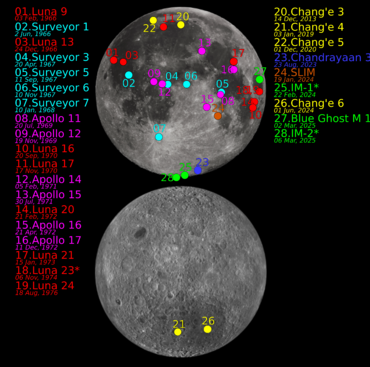 Clickable map of the locations of all successful soft landings on the near side of the Moon to date (top)
Dates are landing dates in Coordinated Universal Time. Except for the Apollo program, all soft landings were uncrewed. Asterisk indicates a partial success. |
As of March 2025, there have been a total twenty eight successful soft landings on the Moon carried out by five countries that include China, India, Japan, the Soviet Union, and the United States. Among these, a total of six soft landings were crewed (Apollo); all crewed soft landings were conducted by the United States. All two soft landings on the far side of the Moon were carried out by China, while soft landing near the lunar south pole was carried out by India's Chandrayaan-3 and Intuitive Machines' IM-1 Nova-C Odysseus and IM-2 Nova-C Athena lander.
Future missions
There are several future lunar missions planned or proposed by various nations and organizations.
Funded and are under development
Robotic
| Mission | Spacecraft | Launch date | Carrier rocket | Operator | Mission type |
|---|---|---|---|---|---|
| Blue Moon Pathfinder Mission 1 | Blue Moon | NET Q1 2027 | New Glenn | Blue Origin |
Lander |
| First mission for the Blue Moon lander platform developed by Blue Origin and will prove the viability of the platform and BE-7 engine. It has a cargo capacity of up to 3000 kg. | |||||
| Blue Ghost M2 | Blue Ghost lander | NET December 2026 | Falcon 9 B5 | Firefly Aerospace |
Lander |
| Elytra orbital vehicle | Orbiter | ||||
| Second mission of Firefly Aerospace, part of CLPS, includes 2 stage variant of blue ghost. | |||||
| Lunar Pathfinder | Lunar Pathfinder | NET December 2026 | Falcon 9 B5 | ESA |
Relay satellite |
| Lunar communications satellite to support future lunar missions, along with Blue Ghost M2. | |||||
| Griffin Mission 1 | Griffin lander | NET late 2026 | Falcon Heavy | Astrobotic Technology |
Lander |
| Chang'e 7 | Chang'e 7 Orbiter | August 2026 | Long March 5 | CNSA |
Orbiter |
| Chang'e 7 Lander | Lander | ||||
| Chang'e 7 Rover | Rover | ||||
| Chang'e 7 Hopper | Hopper | ||||
| Payloads include an orbiter, south pole lander, rover, and a mini flying probe to look for the presence of water-ice. | |||||
| IM-3 | Nova-C | NET late 2026 | Falcon 9 B5 | Intuitive Machines |
Lander |
| Khon2 | Relay satellite | ||||
| CADRE x3 | NASA |
Rovers | |||
| Lunar Vertex | NASA Lunar Outpost |
Rover | |||
| Third Nova-C. Payloads delivery for NASA's CLPS and for private customers. Lunar Vertex mission. | |||||
| Starship Demo mission | Starship HLS | March 2027 | Starship | SpaceX |
Lander |
| Uncrewed demo mission of Starship HLS. | |||||
| Starship cargo mission | Starship HLS | TBD | Starship | SpaceX |
Lander |
| First SpaceX lunar cargo mission, yet to be announced by SpaceX itself. | |||||
| FLEX | FLEX | TBD | Starship | Astrolab |
Rover |
| Large Lunar rover, can accommodate cargo and 2 astronauts. | |||||
| Astrobotic mission 3 | TBA | 2026 | Falcon Heavy | Astrobotic |
Lander |
| ⚀ LunaGrid-Lite CubeRover | Rover | ||||
| Lunaris Platform | Deployable platform | ||||
| Third lunar mission by Astrobotic, will land at lunar south pole. LunaGrid-Lite mission. | |||||
| ZeusX | ZeusX service module | Q4 2027 | TBD |  Qosmosys Qosmosys |
Orbiter |
| ZeusX lunar lander | Lander | ||||
| LIBER | Rover | ||||
| First lunar landing attempt for Singapore, lander can carry up to 800 kg to lunar surface. | |||||
| Mission 2.5 | Argo OTV | 2027 | TBD | Argo Space |
Transfer vehicle |
| Alpine | ispace-U.S. |
Relay satellite | |||
| ispace Mission 2.5. First satellite for ispace's Lunar Connect Service. | |||||
| Chandrayaan-4 | Chandrayaan-4 | 2027–2028 | LVM3 | ISRO |
Lander |
| Luna 26 | Luna 26 | 2028 | Soyuz-2.1b / Fregat | Roscosmos |
Orbiter |
| Orbiter, part of the Luna-Glob programme. Will scout for Luna 27 landing site. | |||||
| Chang'e 8 | Chang'e 8 Orbiter | 2028 | Long March 5 | CNSA |
Orbiter |
| Chang'e 8 Lander | Lander | ||||
| Chang'e 8 Rover | Rover | ||||
| Chang'e 8 Robot | Hopper | ||||
| South pole lander. Testing technology for using local resources and manufacturing with 3D printing. | |||||
| Mission 3 | ULTRA | 2028 | TBD | ispace |
Lander |
| Lupine | ispace-U.S. |
Relay satellite | |||
| ispace Mission 3. First flight of ispace's ULTRA lunar lander. | |||||
| TBD (Lunar Rover) | South pole Rover | 2028 | Long March 5 | SUPARCO |
Rover |
| Pakistans first Lunar Rover that will be launched aboard the Chang'e 8 mission as a part of the wider ILRS program. | |||||
| Uncrewed Blue Moon Demo mission | Blue Moon HLS | 2028 | New Glenn | Blue Origin |
Lander |
| Cislunar Transporter | 2028 | New Glenn | Lockheed Martin |
Transfer vehicle | |
| Demo mission of Blue Moon lander system in preparation for crewed landing in 2029. | |||||
| Artemis IV Starship HLS delivery | Starship HLS | 2028 | Starship | SpaceX |
Lander |
| Delivery of Starship HLS for Artemis IV mission. | |||||
| Artemis V Blue Moon HLS delivery | Blue Moon HLS | 2028 | New Glenn | Blue Origin |
Lander |
| Cislunar Transporter | 2028 | New Glenn | Lockheed Martin |
Transfer vehicle | |
| Delivery of Blue Moon HLS for Artemis V mission. | |||||
| Lunar Polar Exploration Mission (LUPEX) | LUPEX lander | 2028–2029 | H3 | ISRO |
Lander |
| LUPEX rover | JAXA |
Rover | |||
| Canadian lunar rover mission | Canadensys Lunar Rover | 2029 | TBD | Canadensys
|
Rover |
| First Canadian lunar rover. Will fly as part of NASA's Commercial Lunar Payload Services initiative with Blue Ghost 4. | |||||
| Mission 4 | ULTRA | 2029 | TBD | ESA ispace |
Lander |
| Lunar Orbiting Satellite 3 & 4 | ispace-U.S. |
Relay satellites | |||
| ispace Mission 4. ESA Mission for Advanced Geophysics and Polar Ice Exploration (MAGPIE). | |||||
| Luna 27 | Luna 27A and Luna 27B | 2029–2030 | Angara A5 / Fregat | Roscosmos |
Lander |
| Landers, part of the Luna-Glob programme. | |||||
| TBD (CLPS Lander) | Moon to Mars Initiative: Trailblazer (Roo-ver) | 2029–2030 | TBD |  Australian Space Agency Australian Space Agency |
Rover |
| Mission 5 | ULTRA | 2030 | Falcon 9 B5 | ispace-U.S. Draper |
Lander |
| Lunar Orbiting Satellite 5 | ispace-U.S. |
Relay satellite | |||
| ispace Mission 5. CLPS CP-12. | |||||
| Argonaut M1 | Argonaut Lander | 2031 | Ariane 64 | ESA |
Lander |
| Robotic Lander system. Will act as resupply vehicle for future Moonbase. | |||||
| KLEP | KLLR Lander | NET 2032 | KSLV-III | KARI |
Lander |
| KLLR Rover | Rover | ||||
| Second mission of the Korean Lunar Exploration Program. | |||||
| Lunar Voyage 3 | Mapp | TBA | TBA | Lunar Outpost |
Rover |
| First fully commercial mission of Lunar Outpost MAPP program. | |||||
Crewed
| Agency or company | Name | Spacecraft | Launch date | Launch vehicle | Notes |
|---|---|---|---|---|---|
| NASA |
Artemis IV | Orion, Starship HLS |
H1 2028 | SLS Block 1 Starship |
First Artemis crewed lunar landing. |
| NASA |
Artemis V | Orion, Blue Moon HLS |
Late 2028 | SLS Block 1 New Glenn |
Crewed surface expedition. |
| CMSA |
Chinese crewed lunar mission | Mengzhou, Lanyue |
~2030 | Long March 10 | Two launches of LM-10 to put a pair of astronauts on the Moon for a 6-hour stay. |
Proposed but full funding still unclear
Robotic and crewed
The following missions have been proposed but their full funding is unclear:
| Agency or company | Mission | Name of spacecraft | Proposed launch | Notes |
|---|---|---|---|---|
| GEC |
⚀ Doge-1 | September 2026 | 12U CubeSat, the mission is being paid for entirely with the cryptocurrency Dogecoin. First Canadian lunar mission. | |
| SpaceIL |
Beresheet 2 | Orbiter | TBD | One orbiter, two landers. |
| Lander 1 | ||||
| Lander 2 | ||||
 Airvantis Airvantis |
Garatéa-L | TBD | Proposed lunar CubeSat, Partnership between UKSA and ESA. | |
 OHB OHB
|
LSAS lander | TBD | Proposed commercial lander, will rideshare with a Geostationary satellite. | |
| Parsec |
Parsec lunar satellites | 2026 | Parsec lunar communication constellation. | |
 Turkish Space Agency Turkish Space Agency |
AYAP-1 | 2026 | Turkey will perform a hard landing on the Moon. | |
| ESA |
Lunar Meteoroid Impact Observer | 2027 | Proposed CubeSat to observe asteroid impacts on Far side of Moon. | |
 Delft University of Technology Delft University of Technology |
Lunar zebro | NET 2028 | Small swarming rover, radiation measurements | |
| Turkish Space Agency |
AYAP-2 | Lander | 2028 | Soft landing mission |
| Rover | ||||
| Roscosmos |
Zeus | 2030 | Nuclear Propelled Space Tug, might deliver payloads to the Moon | |
| CNSA
|
International Lunar Research Station (ILRS 1–5) |
2031–2035 | 5 crucial missions planned for comprehensive establishment of ILRS to complete the in-orbit and surface facilities. | |
| Roscosmos |
Luna 29 | 2032 | Orbiter, part of the Luna-Glob program. | |
| Roscosmos |
Luna 28 | 2034 | Proposed sample-return mission, part of the Luna-Glob program. May include a small rover. | |
| Roscosmos |
Luna 30 | 2036 | Lander, part of the Luna-Glob program. Will include Luna-Grunt rovers. | |
| ISRO |
Indian Lunar Crewed Mission | ~2040 | National effort to send an Indian astronaut to the Moon using India's own rocket and technology | |
| NASA |
BOLAS | TBD | 2 tethered CubeSats on a very low lunar orbit. | |
| Magellan Aerospace |
Autonomous Impactor for Lunar Exploration | TBD | Impactor for LEAP | |
| NASA |
Lunar Crater Radio Telescope | TBD | Radio telescope made by 4 rovers | |
| LiftPort Group |
Lunar space elevator | October 2028 | Creating a reusable, replaceable and expandable Lunar elevator to open up the resources present on the Moon | |
 ESC Aerospace ESC Aerospace |
LVICE² | 2027 | Measuring the concentration of micrometeorites | |
Lunar rovers
Unrealized concepts
1960s
- Soviet crewed lunar programs – The Soviet Union had been pursuing a crewed lunar flyby mission using Soyuz 7K-L1 launched aboard Proton-K and a crewed landing mission using Soyuz 7K-LOK and LK Lander launched aboard N1 rocket. After a series of N1 failures, both of these programs were cancelled in 1970 and 1976 respectively.
1970s
- Canceled Apollo missions – The Apollo program had three more missions lined up until Apollo 20, but the missions beyond Apollo 17, the sixth and final landing mission, were canceled due to budget constraints, change in technical direction and hardware delays. The ambitions shifted towards developing next generation rockets like Space Shuttle, the space station Skylab and in exploration programs such as Grand Tour program.
2000s
- Constellation Program – The Constellation program ran from 2004 to 2010 and would have utilised the Ares I and Ares V rockets alongside the Orion spacecraft and Altair lunar lander to return astronauts to the Moon by 2020 in preparation for crewed missions to Mars. It was cancelled in October 2010 by the Augustine Committee. However, the Orion was spared and finally launched in November 2022 with Constellation and its rockets revised as the Artemis Program and Space Launch System.
2010s
- Resource Prospector – Concept by NASA of a rover that would have performed a survey expedition on a polar region of the Moon. It was canceled in April 2018.
- Indo-Russian joint mission – A joint mission between India and Russia for a robotic lander and rover was under development since 2007. Russia was supposed to develop the lander while India would develop an orbiter, a rover and launch the composite. However, with failure of Fobos-Grunt mission, Russia was unable to provide the lander in time and requested India to accept the delay and risk. The collaboration ended with India repurposing its orbiter towards Mars with its Mars Orbiter Mission in 2013. India would later go on to develop and launch its Chandrayaan-2 and Chandrayaan-3 mission, using an indigenously developed lander.
2020s
- DearMoon was an unrealized tourist mission financed by Japanese entrepreneur Yusaku Maezawa. Maezawa and six to eight other civilians would have performed a lunar flyby in a SpaceX Starship. It was cancelled on June 1, 2024.
See also
 In Spanish: Anexo:Misiones espaciales lanzadas a la Luna para niños
- Exploration of the Moon
- List of extraterrestrial orbiters
- List of rovers on extraterrestrial bodies
- List of artificial objects on the Moon
- List of lunar probes
- Moon landing
- Timeline of Solar System exploration
- List of missions to Venus
- List of missions to Mars
- List of missions to minor planets
- List of missions to the outer planets
