
Battle of the Bay of Biscay facts for kids
Quick facts for kids Battle of the Bay of Biscay |
|||||||
|---|---|---|---|---|---|---|---|
| Part of the Battle of the Atlantic of World War II | |||||||
.jpg) Battle of the Bay of Biscay 1943 – Painting by Norman Wilkinson |
|||||||
|
|||||||
| Belligerents | |||||||
 United Kingdom United Kingdom |
 Germany Germany |
||||||
| Commanders and leaders | |||||||
 Charles Clark Harold Grant Charles Clark Harold Grant |
 Franz Kohlauf Hans Erdmenger † Franz Kohlauf Hans Erdmenger † |
||||||
| Strength | |||||||
| 2 light cruisers | 5 destroyers 6 torpedo boats 1 aircraft |
||||||
| Casualties and losses | |||||||
| 2 killed 1 cruiser damaged |
532 killed & wounded 1 destroyer sunk 2 torpedo boats sunk 1 torpedo boat damaged |
||||||
The Battle of the Bay of Biscay was a naval fight that happened on December 28, 1943. It was part of the larger World War II and the Battle of the Atlantic. This battle took place in the Bay of Biscay, a large gulf off the coast of France and Spain.
In this battle, two British Royal Navy ships, called light cruisers, fought against German Kriegsmarine destroyers and torpedo boats. The German ships were trying to meet and protect a "blockade runner." A blockade runner was a ship trying to sneak past enemy patrols to deliver important supplies. The British ships won this battle. They sank three German ships: the torpedo boats T26 and T25, and the destroyer Z27.
Contents
Why the Battle Happened
German Ships on a Secret Mission
In late 1943, Germany's navy, the Kriegsmarine, sent a group of destroyers and torpedo boats into the Bay of Biscay. Their secret mission, called Operation Bernau, was to meet two special ships. These ships, named Osorno and Alsterufer, were "blockade runners." They were bringing important supplies like tungsten and rubber all the way from Japan. These materials were vital for Germany's war effort.
The Osorno reached a French port on December 26. But it hit something in the water after being attacked by British planes. It had to be pulled ashore to unload its cargo. The other ship, Alsterufer, was still far away.
British Ships Get a Warning
The British knew about the German plan. They had secretly listened to German messages using a special code-breaking machine called Enigma at Bletchley Park. So, the British sent their own ships to stop the German blockade runners.
The closest British ships were the light cruisers HMS Glasgow and HMS Enterprise. They sailed towards the Bay of Biscay. Other British ships were also sent to help, but they were further away.

The Target Disappears
The German ships were ready to meet the Alsterufer. But they didn't know that a British bomber plane had already attacked the Alsterufer the day before. The Alsterufer caught fire and its crew had to leave the ship. Other British planes then finished it off.
This meant the Alsterufer was no longer a target. So, the British cruisers Glasgow and Enterprise were free to search for the German warships instead.
The Battle Begins
Finding the Enemy
British planes spotted the German ships around 1:00 PM. At the same time, a German plane saw the British cruisers. The German pilot quickly reported their position. Captain Charles Clark, commanding HMS Glasgow, knew they had been seen. He changed course to try and cut off the German ships.
The sea was getting very rough, with strong winds. This made it hard for the smaller German destroyers and torpedo boats to sail.
First Shots Fired
Despite the rough seas, Glasgow spotted the German destroyers at 1:32 PM. The two British cruisers sped up to full speed. They changed direction to block the German ships from getting back to their base.
Glasgow was the first to open fire with its powerful 6-inch guns. It used its radar to aim. Enterprise started shooting a few minutes later. The first German ships were not hit, but shells landed very close.
The Germans fired back. One of their destroyers, Z23, launched six torpedoes, but they all missed. German shells also landed close to Glasgow. Around 2:05 PM, a German shell hit Glasgow. It exploded in a boiler room, killing two sailors and hurting six others. Enterprise also had shells landing very close to it.
Torpedo Attacks and Smoke Screens
Soon, all the German ships were involved in the fight. The German torpedo boats tried to attack with torpedoes several times. But the rough seas made it very difficult.
Two German destroyers, Z32 and Z37, launched more torpedoes. This forced Glasgow to turn sharply to avoid them. One torpedo passed very close to Glasgow. Enterprise had moved away from Glasgow and was fighting on its own. After launching torpedoes, the German destroyers created a smoke screen to hide. Then they turned back to join their group.

The Chase and Sinking Ships
The German force then split up. Glasgow turned to chase one group of destroyers to the north. Enterprise went west to cut them off. The Germans launched another torpedo attack. But soon after Z27 fired its torpedoes, it was hit by a shell from Enterprise. The shell hit its boiler room, causing a huge fire and making it lose speed.
Meanwhile, Glasgow focused its fire on T25. This torpedo boat was hit several times, damaging its back torpedo tubes and anti-aircraft guns. Many of its crew were killed or wounded. Another shell hit T25, destroying its mast and funnel. T25 was now badly damaged.
Glasgow then started firing at T26. T22 tried to help T25 and T26 by firing its own torpedoes and guns at the British cruisers. But its torpedoes missed. T22 was also hit and had to retreat, laying down a smoke screen. T26 was hit badly in its boiler room and signaled that it was sinking.

The two British cruisers turned back. Glasgow went to find other damaged German ships, especially T25. Instead, Glasgow found Z27, which was drifting and silent. Glasgow fired at close range, hitting the destroyer's ammunition storage. This caused a huge explosion, killing the German commander and his crew.
At the same time, Enterprise finished off T26 with a torpedo. Then, Enterprise moved in to sink T25. T25's bridge and upper deck were a mess of twisted metal, but it was still floating. Enterprise got closer, fired its guns, and then launched a torpedo. Within minutes, T25 was a burning wreck and sank.
After the Battle
The two British cruisers, Glasgow and Enterprise, met up again. They had sunk three German ships without much damage to themselves. They then headed back to Plymouth, arriving on December 29. They were low on fuel and ammunition. Glasgow had one hit, with two crew members killed and three wounded. Enterprise had only minor damage from shell pieces.
The surviving German ships, T22 and Z23, went to a port near the Spanish border. The rest of the German ships returned to their base.
Out of 672 German sailors on the three sunken ships, 93 were saved from Z27, 100 from T25, and 90 from T26. British and Irish ships, Spanish destroyers, and German submarines helped rescue them. About 62 survivors were taken prisoner by British ships. A small Irish steamer, the MV Kerlogue, rescued 168. Four were rescued by Spanish destroyers and were kept in Spain.
This battle, along with the sinking of the German battleship Scharnhorst at the Battle of the North Cape soon after, was a big blow to the German Navy.
The Osorno turned out to be the last German blockade runner to get through. After this, Germany stopped using surface ships to run blockades. Instead, they started using submarines for these secret missions.
Images for kids
-
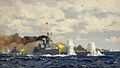
Battle of the Bay of Biscay 1943 – Painting by Norman Wilkinson
