
Government of the United Kingdom facts for kids
The UK Government, also known as His Majesty's Government, is the main group that runs the United Kingdom. It makes important decisions for the country. The government is led by the Prime Minister, who is currently Andy Burnham (since 20 July 2026). The Prime Minister helps the King choose other important leaders called ministers. The Labour Party currently forms the government, having won a majority in the House of Commons in 2024. The Prime Minister and top ministers meet in a special group called the Cabinet to make big decisions.
Ministers are like team leaders for different parts of the government. They must explain their actions to Parliament, usually in the House of Commons. This is where elected representatives ask them questions. The government needs Parliament's approval to create new laws. Every five years, or sometimes sooner, people vote in general elections to choose new members for the House of Commons. After an election, the King chooses the leader of the winning party to be the Prime Minister. This person is usually the one who has the most support in the House of Commons.
The UK has an unwritten constitution, which means its rules are not all in one document. The King is officially the head of the country's power. However, in practice, the government's top team, the Cabinet, uses this power. They lead different government departments to manage various aspects of the country.
People sometimes call the UK Government "Westminster" or "Whitehall". This is because many government offices are located in these areas of London. These names help to tell the main UK Government apart from the governments in Scotland, Wales, and Northern Ireland.
Quick facts for kids His Majesty's Government |
|
|---|---|
|
Other native names
UK Government
|
|
|
Central government
|
|
 |
|
| Overview | |
| State | United Kingdom |
| Leader | Prime Minister of the United Kingdom (Andy Burnham) |
| Appointed by | Monarch (Charles III) on the advice of the prime minister |
| Main organ | Cabinet of the United Kingdom |
| Ministries |
|
| Responsible to | Parliament of the United Kingdom |
| Annual budget | GB£1.416 trillion (2025/26) |
| Headquarters | 10 Downing Street, London |
Contents
- How the UK Government Started
- What the Government Can Do
- Government Ministers and Departments
- How Parliament Checks the Government
- Where the Government Works
- Limits on Government Power
- Who Works for the Government?
- Government Symbols
- Other Governments in the UK
- Local Councils
- Images for kids
- See also
How the UK Government Started
The United Kingdom is a constitutional monarchy. This means we have a King, but he doesn't make political decisions. The government and Parliament make all the big choices. This system developed over many centuries. It started with important steps like the Magna Carta in 1215, which limited the power of the King.
Since 1901, the Prime Minister has always been an elected member of Parliament. This means they are directly accountable to the people through the House of Commons.
What the Government Can Do
The King's Special Powers
The King is the head of state for the UK, but he is not the head of government. This means he represents the country but doesn't make political decisions. He stays neutral in politics. However, the government's power comes from the King, through something called "the Crown".
The King also has some special powers, known as the Royal Prerogative. These are powers that don't need Parliament's direct approval. They include things like issuing passports or even declaring war. Usually, the King lets his ministers use these powers.
The Prime Minister meets with the King every week. These meetings are private, but the King can share his thoughts on government matters. However, the King always follows the government's decisions.
Powers Inside the UK
The government uses these powers for things within the UK:
- Choosing the Prime Minister: The King formally appoints the Prime Minister. This is usually the leader of the party that wins the most seats in an election.
- Appointing Ministers: The King also appoints other ministers, but he does this based on the Prime Minister's advice.
- Making Laws Official: After Parliament agrees on a new law, the King gives it royal assent. This makes the law official. No King or Queen has refused to do this since Queen Anne in 1708!
- Armed Forces: The government, in the King's name, commands the Armed Forces. It also appoints officers.
- Passports: The government can issue or take away British passports.
- Pardons: The King can pardon people who have been convicted of crimes.
- Honours: The government can give out special awards and honours, like knighthoods.
- Creating Organisations: The government can create new organisations or give cities special status through a Royal Charter.
.jpg)
Powers Abroad
The government uses these powers for dealing with other countries:
- Making Treaties: The government can sign agreements with other nations.
- War and Peace: It can declare war or make peace.
- Sending Armed Forces: It can send the Armed Forces to other countries.
- Recognising Countries: It can officially recognise other countries.
- Diplomats: It can welcome diplomats from other nations.
These special powers, called the Royal Prerogative, come from old traditions. The government shared this list in 2003 to be more open about how it uses them.

Government Ministers and Departments
The UK Government has about 120 ministers. These ministers lead different parts of the government, called departments. They are supported by over half a million civil servants. These civil servants help carry out the government's work every day.
Most ministers are members of either the House of Commons or the House of Lords. This ensures they can be questioned and held accountable by Parliament.
How Parliament Checks the Government
The government needs the support of the House of Commons to do its job. This includes getting approval for its budgets and new laws. If the government loses the support of the House of Commons, it usually has to resign or call a new election. The House of Lords also checks the government's work, but its support is not as critical.
The Prime Minister answers questions from Members of Parliament (MPs) during Prime Minister's Questions (PMQs). This happens every week and allows MPs to challenge the Prime Minister on any topic. Ministers also answer questions about their specific departments.
During debates on new laws, ministers explain the government's plans. Committees in both the House of Commons and House of Lords also examine the government's work closely. Ministers often appear before these committees to provide information and answer questions.
Ministers must also announce major government policies to Parliament first. This allows MPs and Lords to discuss and question these important decisions.

Where the Government Works
The Prime Minister's official home and office is at 10 Downing Street in Westminster, London. Cabinet meetings also happen here. Many government departments have their main offices nearby in an area called Whitehall.

Limits on Government Power
The government has many powers, but there are limits. Some important officials and groups, like judges and local councils, are largely independent. The government's powers are set by old laws (common law) or by new laws passed by Parliament. Courts can check if the government is following these rules.
For example, the King is protected from criminal charges and can only be sued with his permission. While the King is not required to pay income tax, Queen Elizabeth II chose to pay it voluntarily from 1993 until 2022.
The government also influences local councils through funding. Many services provided by local councils, like housing benefits, receive money from the central government.
Who Works for the Government?
The "government" usually refers to the group of ministers currently in charge. However, it can also include people and organisations that work closely with ministers. The civil service helps ministers by giving advice and carrying out their decisions. Some civil service groups even have "Government" in their names, like the Government Actuary.
Government Symbols
The UK Government uses a simpler version of the Royal Arms as its logo. This symbol appears on all Acts of Parliament, on government department logos, and on UK passports. A new design of the Royal Arms is created for each new King or Queen.
.svg)
Some departments, like the Home Office and Ministry of Defence, use different symbols for historical reasons.
Other Governments in the UK
Since 1999, some powers have been given to separate governments in Scotland, Wales, and Northern Ireland. These are called "devolved governments". They are not part of His Majesty's Government and are accountable to their own parliaments or assemblies. There isn't a separate national government for England, but the Greater London Authority and other regional authorities have some devolved powers.
Local Councils
Across the UK, there are also elected local councils. These councils manage local services like rubbish collection and parks. They have limited powers to raise local taxes. Many other local groups also have powers, usually overseen by the central government.
Images for kids
-
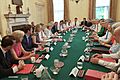
A meeting of the cabinet in the Cabinet Room, 10 Downing Street

See also
 In Spanish: Gobierno del Reino Unido para niños
- Constitutional reform in the United Kingdom
- Departments of the United Kingdom Government
- Supreme Court of the United Kingdom
- Gov.uk
- Government spending in the United Kingdom
- British Government Frontbench
- His Majesty's Most Loyal Opposition
- List of British governments
- Northern Ireland Executive
- Scottish Government
- Welsh Government
- Whole of Government Accounts
- Office for Veterans' Affairs
